Hamilton to Sula, Montana Tuesday, June 4, 2024.
Today would be the easiest of the next four days, no major climbs, just 36 miles; would’ve liked to go further, but that’s how the lodging worked out. There was a big challenge today, however, 7 miles of a scary twisty road, busier US 93 this time, with no shoulder.
At least I’d been forewarned. Montana has an excellent resource, a highway map tailored to bicyclists, indicating the width of shoulders, presence of rumble strips, and traffic density, along with big climbs.


In the map detail, you can see today’s route with Hamilton towards the top and Sula, most of the way to the bottom. If you look at the legend, you can see that most of the route has rumble strips and wide shoulders, but the neon green arrow points to a 7 mile stretch where there is no shoulder at all, and that gets 1404 vehicles and 105 trucks a day.
It helped to know that other people had done this, and that in fact it was part of the Transamerica Trail, so soon it will be the site of thousands of bicyclists. But I am ahead of the crowd and did not see another cyclist all day.
Most people would not even dream of tackling a road like this. Of all the potential ways you could get hit by a car, people seem to most fear being run down from behind. In fact, this is a tiny fraction of car/bicycle accidents, most of the collisions come from cars that are in front of you*.
One of the greatest lessons I got from MIT had nothing to do with biology. A traffic engineer, John Forester, had studied car/bicycle accidents for 40 years, and compiled his findings in a seminal book called Effective Cycling (MIT Press). It’s still in print.

Bicycling has been my primary mode of transportation my entire life. Between commuting and touring I have ridden over 200,000 miles, through many Vermont winters, and many cities—such as DC, Boston, New York, London, and Paris—and never had an accident, or even a close call. I credit this book with keeping me alive. Forester took his data and compiled many pages of strategies for dealing with just about every challenging traffic situation: storm drains, parked cars, exit ramps, left-hand turns, poor shoulders etc. They have become my mantra, second nature to me. They have kept me safe.
Forester’s central premise is that bicycles are vehicles, subject to the rules of the road, and entitled to their protections. Like any slow moving vehicle, they should stay to the right as much as they safely can, and faster cars should pass them in the adjacent lane.
The key phrase is “as much as they safely can”. For bicycle, that means about 2 feet out from the edge of the pavement or obstructions such as potholes or storm drains, or a car door’s length out from parked cars. I’m always looking ahead for these obstructions, and take that safety margin ahead of time, so that I don’t have to swerve suddenly into traffic.
Most states require vehicles to pass bicycles with 3–4 feet of clearance. It’s all about visibility. With my dynamo generator my headlight and taillight are on 24/7, my panniers and clothing are high-visibility, and I use that crazy bright flasher in dicey situations like today’s poor shoulders. Nevertheless, I assume that cars ahead of me don’t see me unless I establish eye contact, and behave accordingly.
All of this often means that I am “taking the lane” more than the typical bicyclist does, but because I behave predictably and always follow the rules of the road, I almost never get attitude from drivers. I can count on one hand the number of times per year I get honked or yelled at.
Whenever a friend or patient has an accident, or whenever there is a bicycle fatality in Vermont, I try to get all the details. With the exception of drunk or distracted drivers, I feel my strategies would have avoided that accident.
For today’s scary shoulderless 7 miles, I turned off my audiobook, changed my AirPods from “noise canceling” to “transparency” (actually amplifies, like a hearing aid) and had my eye on the rearview mirror almost constantly. When blind curves approached, I tried to position myself so that cars behind me could see me as far away as possible, then pulled over to my safety margin as they approached. I tried to think like a driver. I made it with no incident, no honking.
The only accommodation on the stretch was Camp Sula, campground and cabins. The general store was closed.
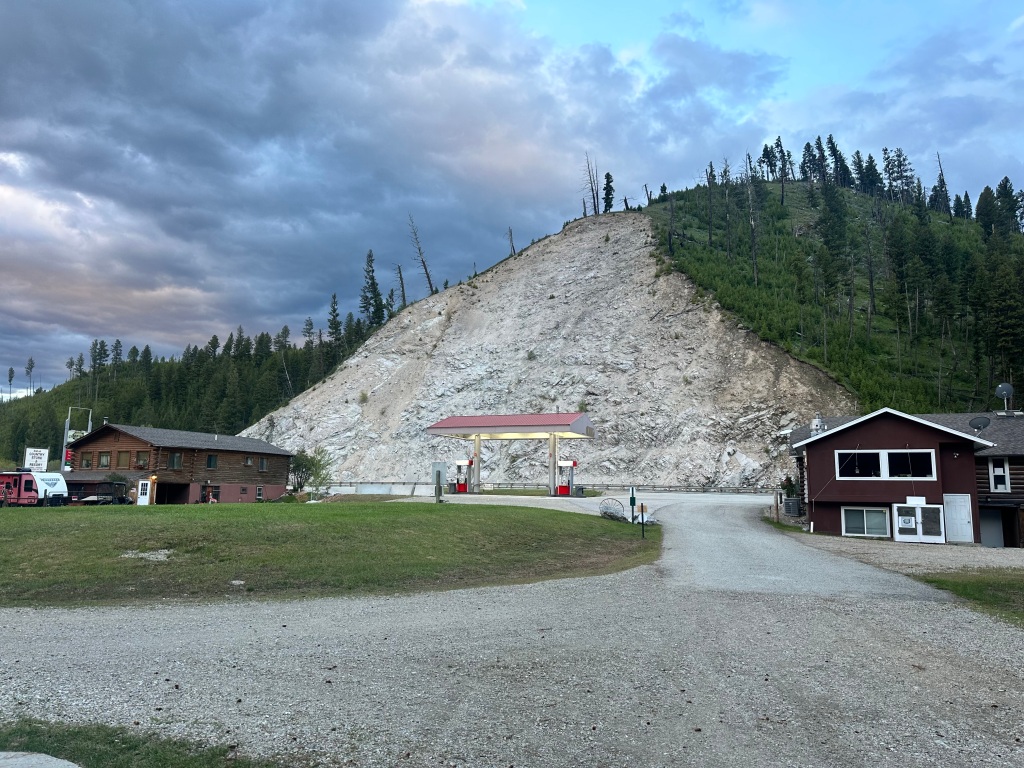
My campsite looked inviting, and had an electrical hook up

but I didn’t like the look of those clouds,

and I opted for a cozy cabin, heated and with linens, for only $30 more.

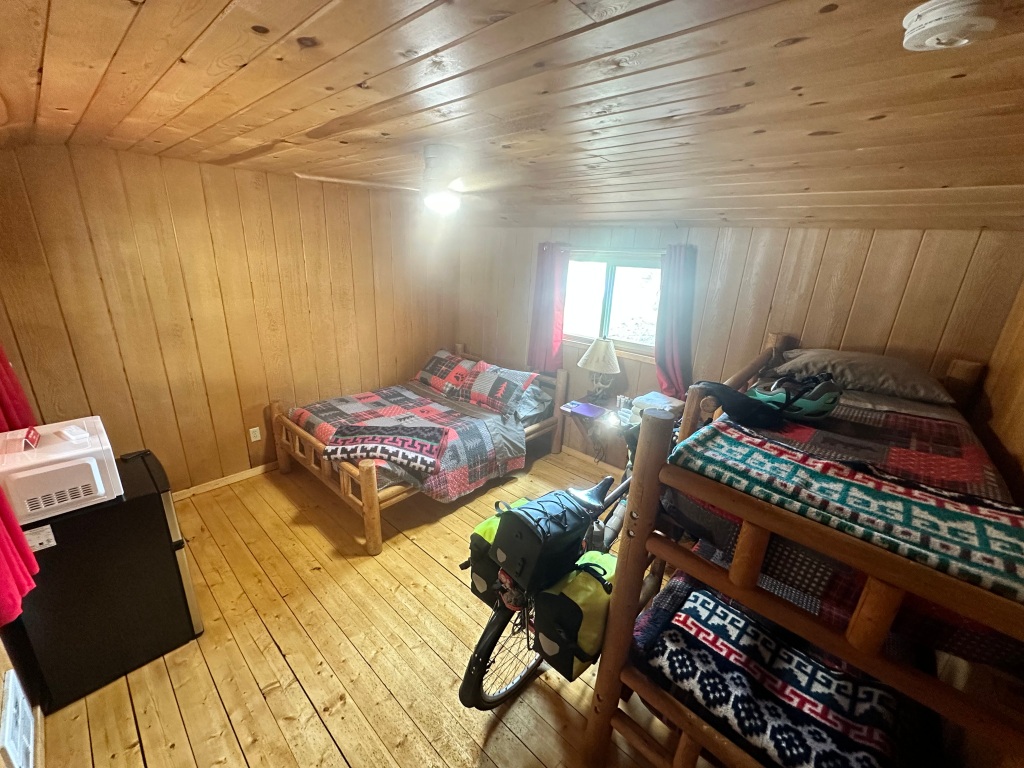

I need to get an early start tomorrow. The Bitterroot River, babbling just outside my window, lulled me to sleep. Yup, a river runs through it.
Distance 36 miles, 1,342 total. Time 6 hours with stops. Elevation gain 1,438 feet
©️ 2024 Scott Luria
* the most common accidents are the left cross, where an oncoming vehicle turns left into you, the right hook, where passing vehicle makes a right hand turn right in front of you, and the T-bone, where a vehicle on the side street doesn’t see you.
 The Ends of the Earth
So glad that you are following your researched safety rules! I have been concerned about you on the shoulders, but feel relieved to hear that you are fully focusing in dangerous areas.
I can attest to the danger of a “right hook”, when I was training in Washington, D.C. for my upcoming bike ride through Europe, I was going downhill at a good clip on Connecticut Avenue when suddenly a taxi turned right in front of me, causing me to hit the taxi and flip over and land on the other side. Fortunately, even though we didn’t have helmets back then, my injuries were just scrapes and cuts all over my arms and legs. And I did get the taxi company to give me a ride home, and they also replaced my totaled bicycle with a much better bike than I had.
Still, keep vigilant! We are all counting on you being safe.
Love,
Anne
LikeLike
I know it was long ago, but so sorry to hear that you had a “right hook“ accident. This is possibly the most common car vs. bicycle accident.
Forester’s strategy for prevention is to take the whole right lane. Cars often don’t see you when you’re riding close to the curb. if there is a right turn only lane, stay just to the left of the line separating them. If you have to be all the way over on the right, listen carefully for cars approaching from behind you and deccelerating, they might be about to make a right turn.
I’ve had three friends grievously injured because they were being polite, staying as far to the right as possible during a rapid descent. Cars are tempted to squeeze by them in the same lane, which can be disastrous if this car spots oncoming traffic and has to swerve right, nudging the bicyclist. That’s what happened in all three cases.
So especially when descending rapidly, take the whole lane. It’s your right, as a vehicle operator. Make the cars pass you like they were passing a car. I don’t think I’ve ever been honked at while doing this.
Get Outlook for iOShttps://aka.ms/o0ukef ________________________________
LikeLike