Pomeroy, Washington to Lewiston, Idaho. Sunday, May 26, 2024.
This script almost wrote itself. I should’ve known better. If I wax poetic about my dream bike, if I gush with pride, something is sure to happen.
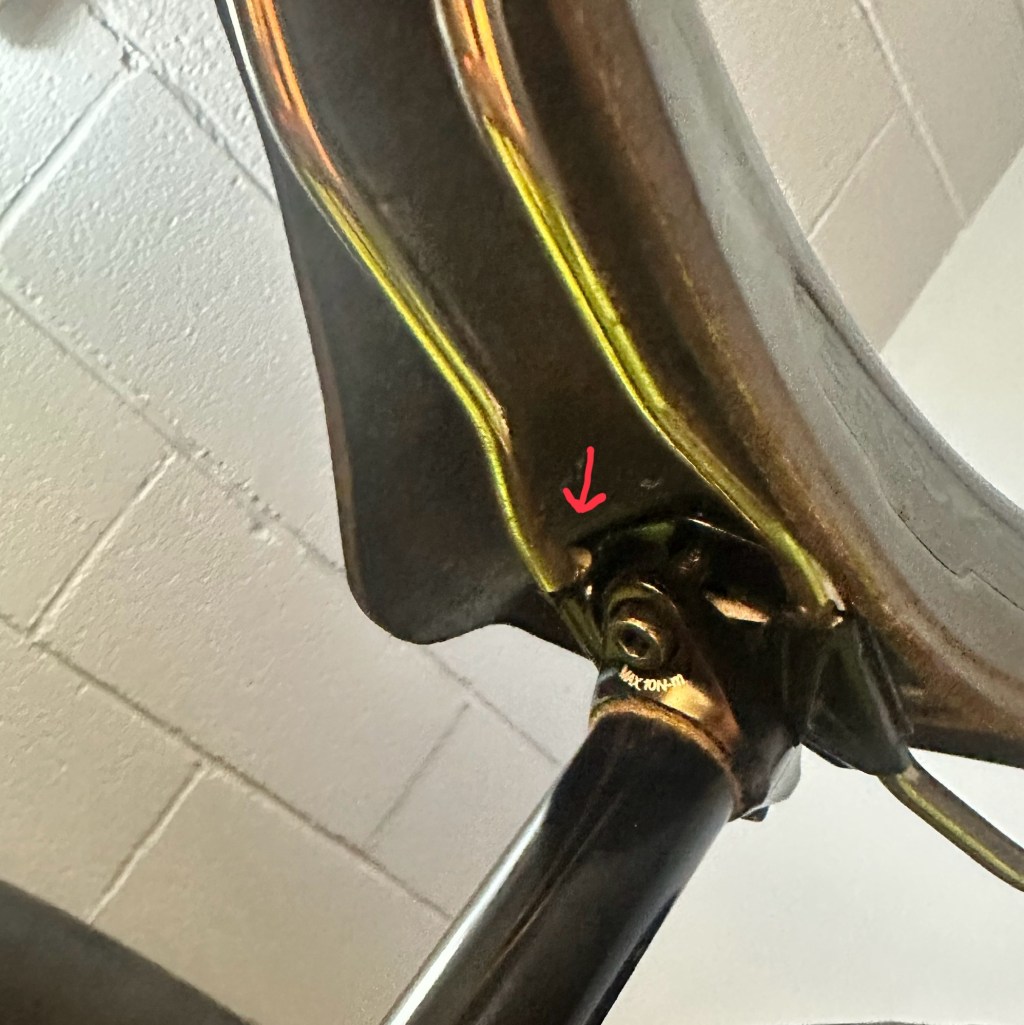
The seat had been squeaking more than usual, so I got down below it to apply some lube. I was immediately taken aback.
D’oh!
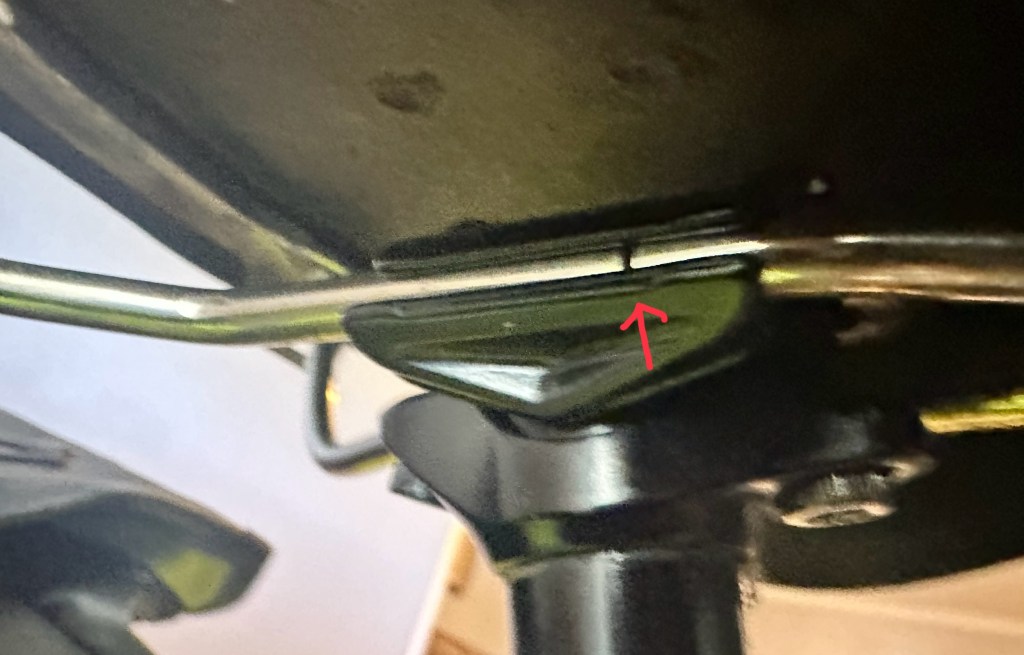
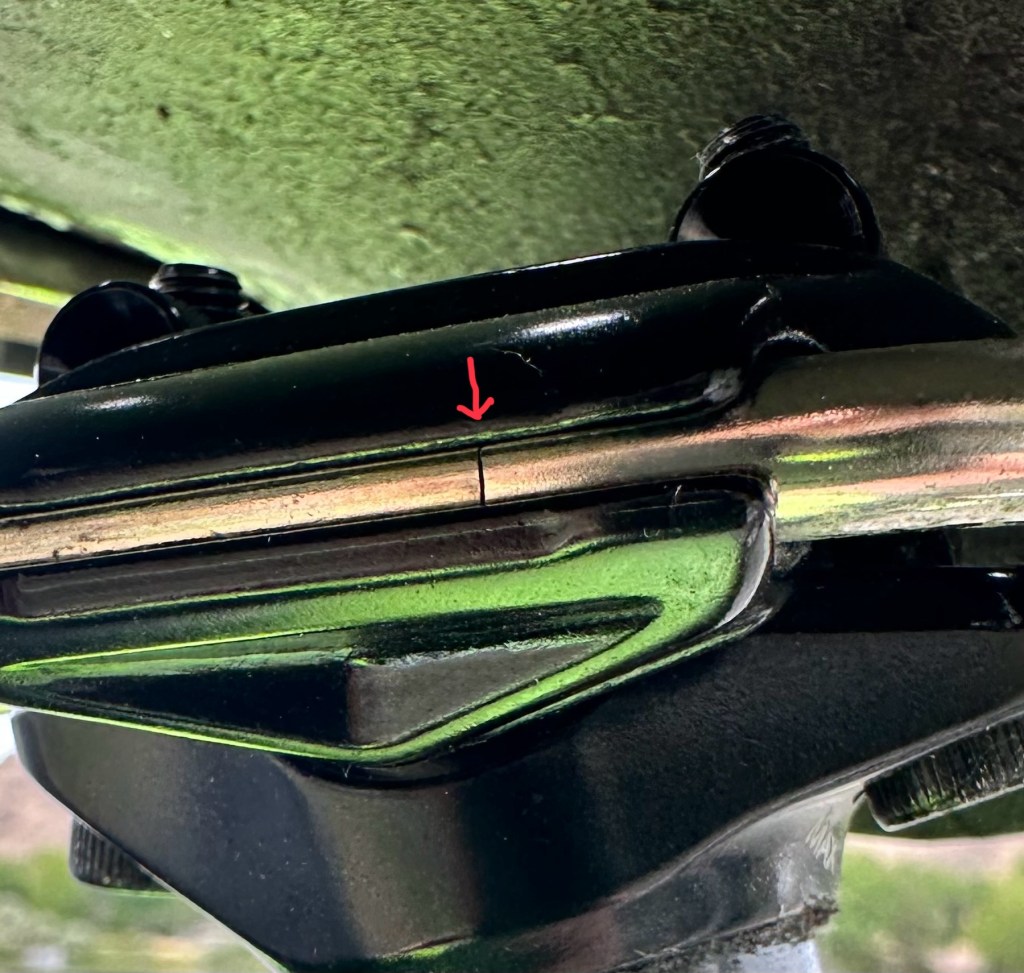
Oh no! The right seat rail had broken, just as in the seat before, but this time I couldn’t blame the seat post clamp, it was brand new and much more supportive than the previous. I noticed this early Sunday morning of Memorial Day weekend, and for a moment, I was at loss about what to do. I called Jane, who talked me off the ledge.
I was in this tiny town, Pioneer, with the only establishment being a small grocery store. No handy garage with a welder, no service station at all. I looked for bike shops, only one showed up on Google maps, 32 miles away in Lewiston, Idaho, where I’d already reserved a room for tonight. It was open from noon till four today, then not again until Tuesday. Other than that, there were no bike shops at all until you hit Missoula, Montana!
Take an Uber to and from the bike shop, Jane suggested. I was skeptical Uber would even come here, in the middle of nowhere, but apparently I could do it, for $170 round-trip. Or I could see if I could squeeze the bike into the Uber and save one leg. But that would of course “break the chain” of a coast-to-coast bike ride, and my sea to summit mountain climbs.
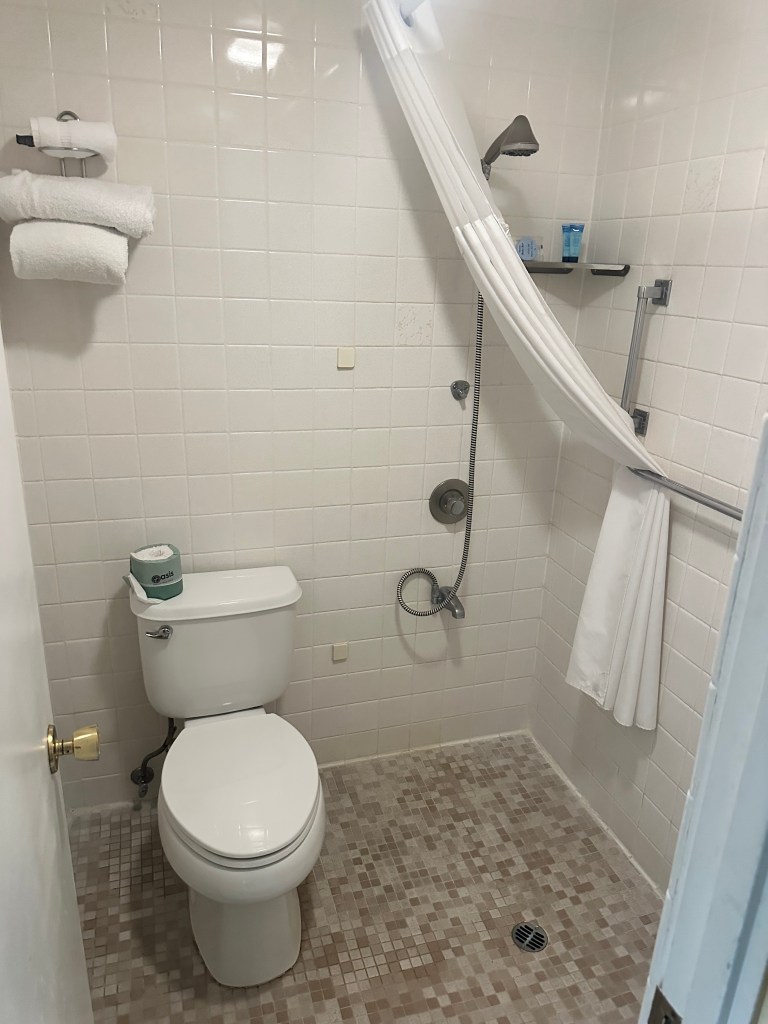
I could see if the motel proprietress, Rhonda, knew a welder in town. I’d survived the shower, so she’d morphed in my mind from Norman’s Mother to Help Me Rhonda.
These were sensible suggestions, but none sounded too appealing. I futzed around a bit and was able to slide the seat backwards, so that the clamp acted as a splint across the break.
Hmm…
Maybe, if I was very ginger on the bike seat, I could ride the bike to Lewiston on my own. Jane was rightly skeptical. What if this MacGyver job failed, and I was really in the middle of nowhere, out of cell range, with no chance of making it to the bike shop before it closed? I’d be up the proverbial creek. Get the Uber, she said.
What do you call a man with half a brain? Gifted. The old joke echoed in my head as I torqued the clamp bolts to 10 Newton meters and cringingly headed down the highway, trying not to put too much weight on the seat. There was a thousand foot climb to Alpowa Summit, then an exhilarating 10 mile descent to the Snake River, averaging 32 mph. I tried to stand on the pedals, did not want the seat to fail here. When I reached the river, it took a minute to unclench my teeth, and pry my fingers from the handlebars.
The seat seemed intact. I dared a look.
Could it be? It looked like the gap was smaller! Could I have taken the half brained option and gotten away with it?
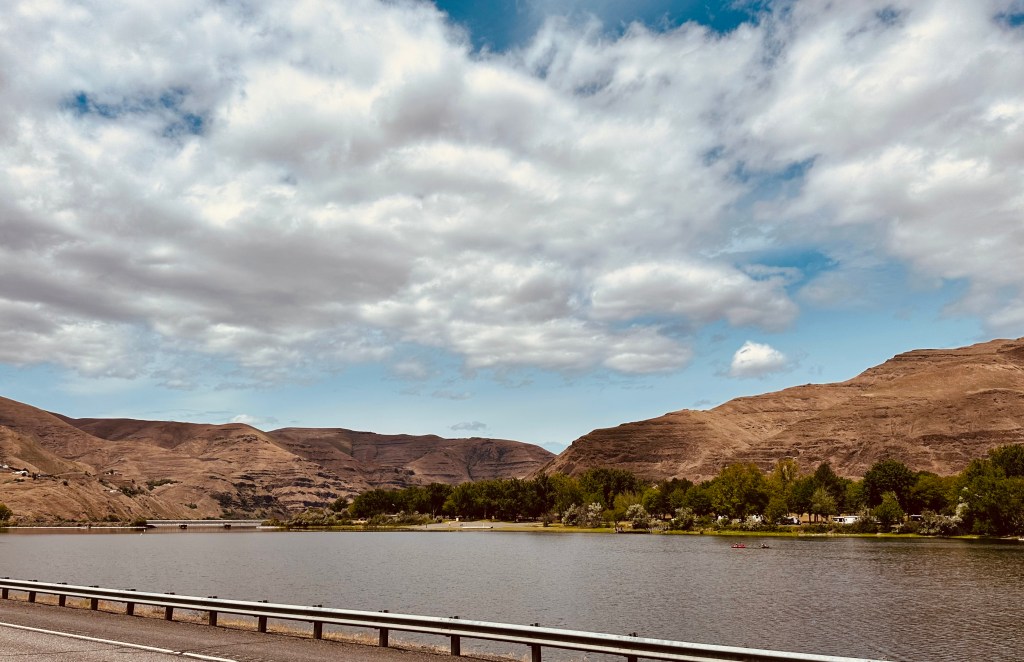
Anyway, I could relax a little and notice the Snake and the scenery.
The Snake River, the major tributary of the Columbia. I would follow it for only ten miles before it veered off to its eponymous Canyon, site of the infamous Evel Kenevel Skycycle jump so long ago. I’d been so anxious I failed to notice my odometer rolling over to 1,000, and missed the chance to belt out, as I had in the rain in 2021, the thumping Proclaimers song.
And. I. Would. Bike. Five. Hundred. Miles. And. I. Would. Bike. Five. Hundred. More. Just to be. The. Man. Who. Bikes. A. Thousand. Miles. To. Fall. Down. At. Your. Door.
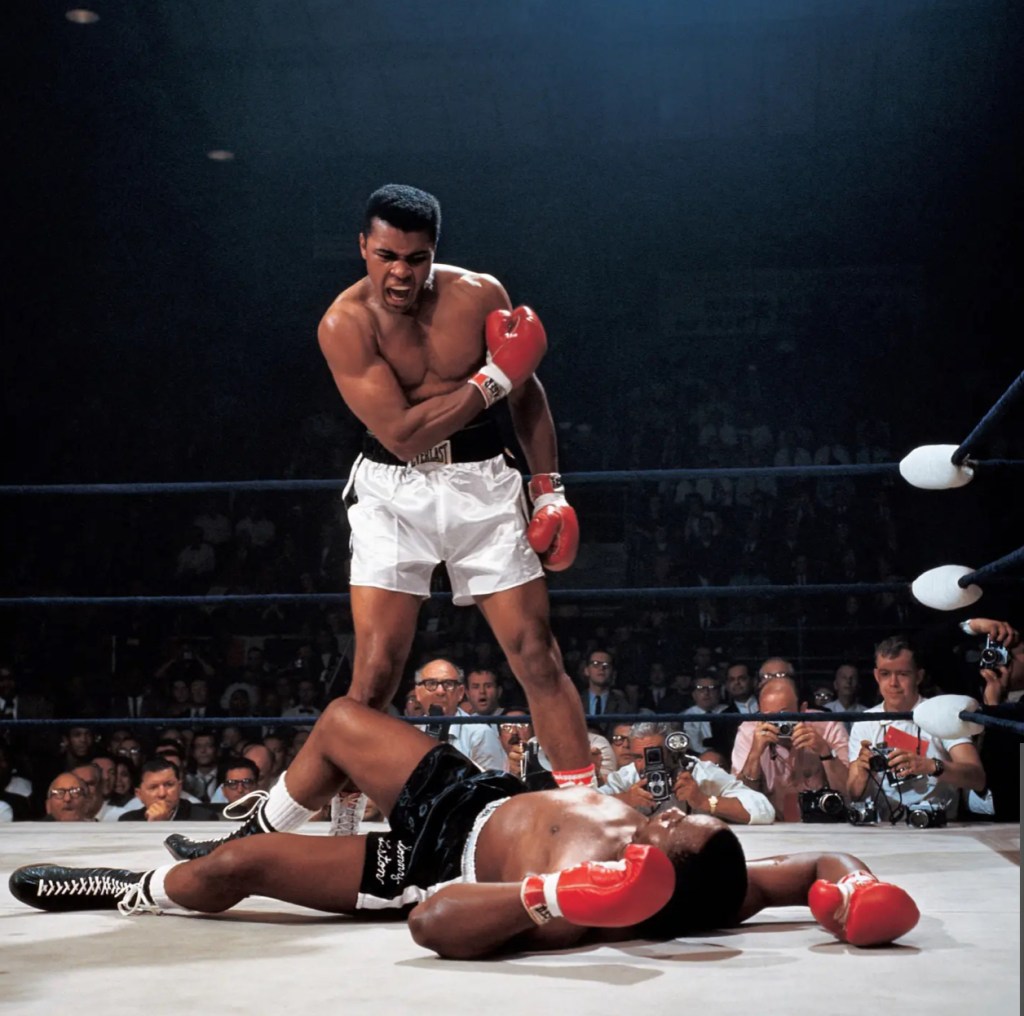
It was just ten more miles to Clarkston, my last town in Washington, which seemed little more than a commercial strip, then across the Snake to Lewiston, Idaho, much cuter and leafier. The town name reminded me of BFF Brian and Frank’s college town in Maine. Bates was the classic New England small college, so beautiful, such a contrast to the sterile halls of MIT; I would escape there whenever I could. Funny it was surrounded by the gritty town of Lewiston Maine, site of Muhammad Ali’s “phantom punch” defeat of Sonny Liston in 1964
and much later, the largest mass shooting in Maine’s history.
But I digress. I failed to notice that Lewiston and Clarkston were named for my old buddies Meriwether and William, and belatedly purchased the Audiobook Undaunted Courage, Stephen Ambrose’s classic biography. And I’ve been on the Lewis and Clark trail for three weeks. D’oh!
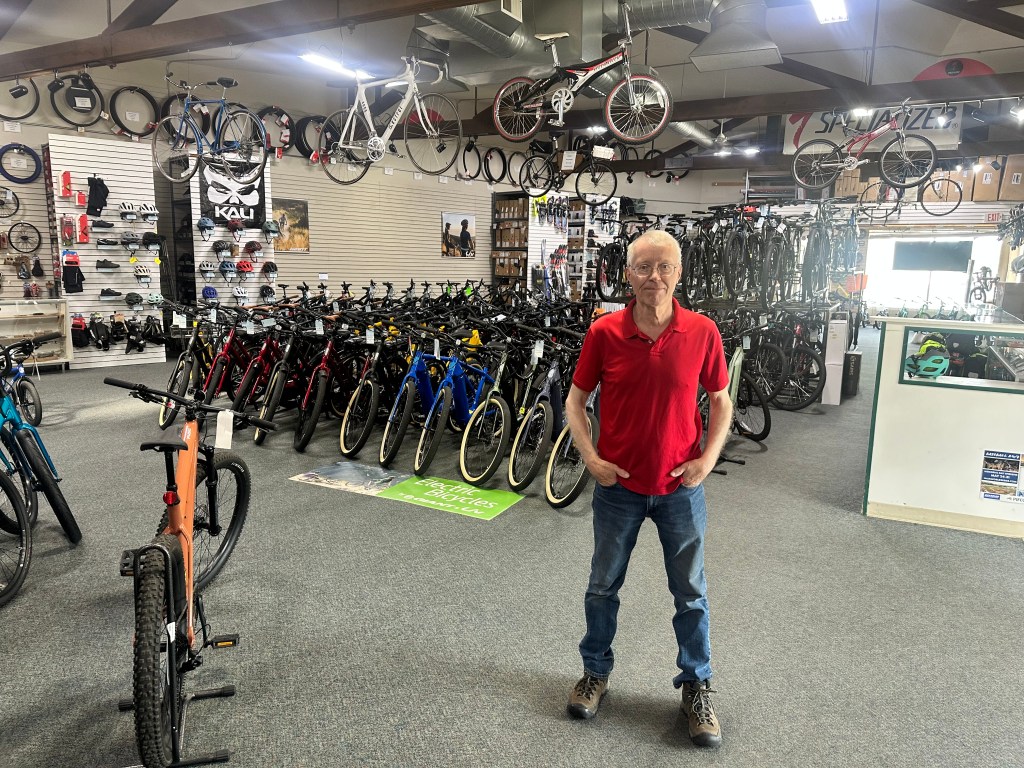
The bike shop, Follett’s Mountain Sports, was still open, and Scott was very helpful.
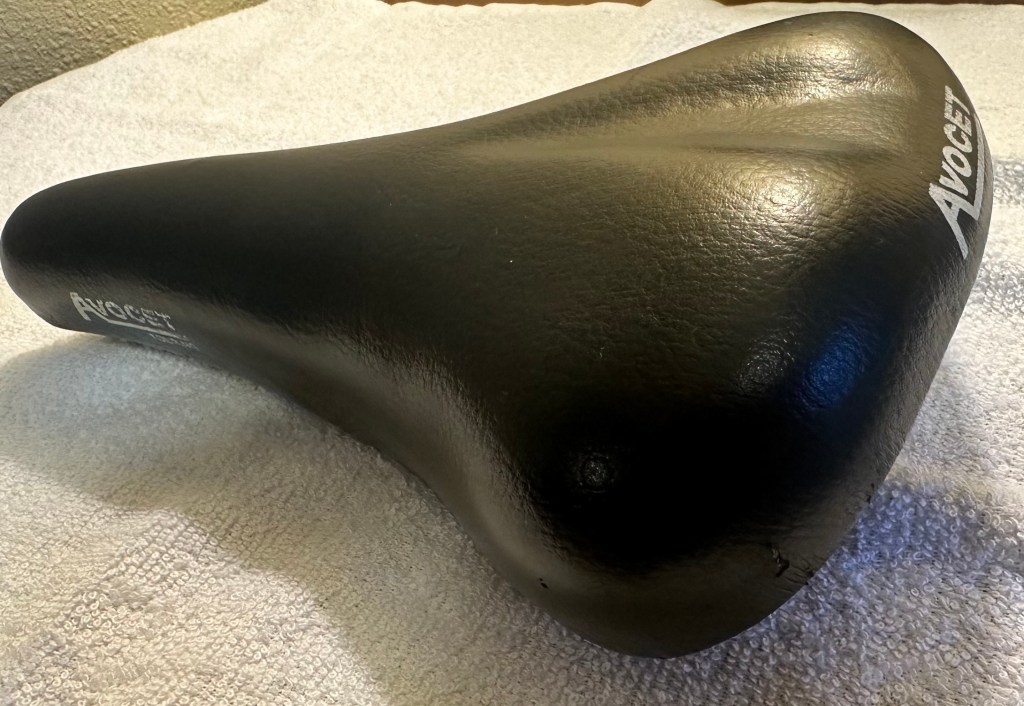
He is a collector of Lionel model trains, and showed me a photo of his awesome home set up. He mentioned he had met Evel Knievel at a convention, he seemed a rather withered old man. He warned me of a hazard in these parts, goathead thorns, cause of many flat tires. And he sold me a classic Avocet touring bike seat for only $15.
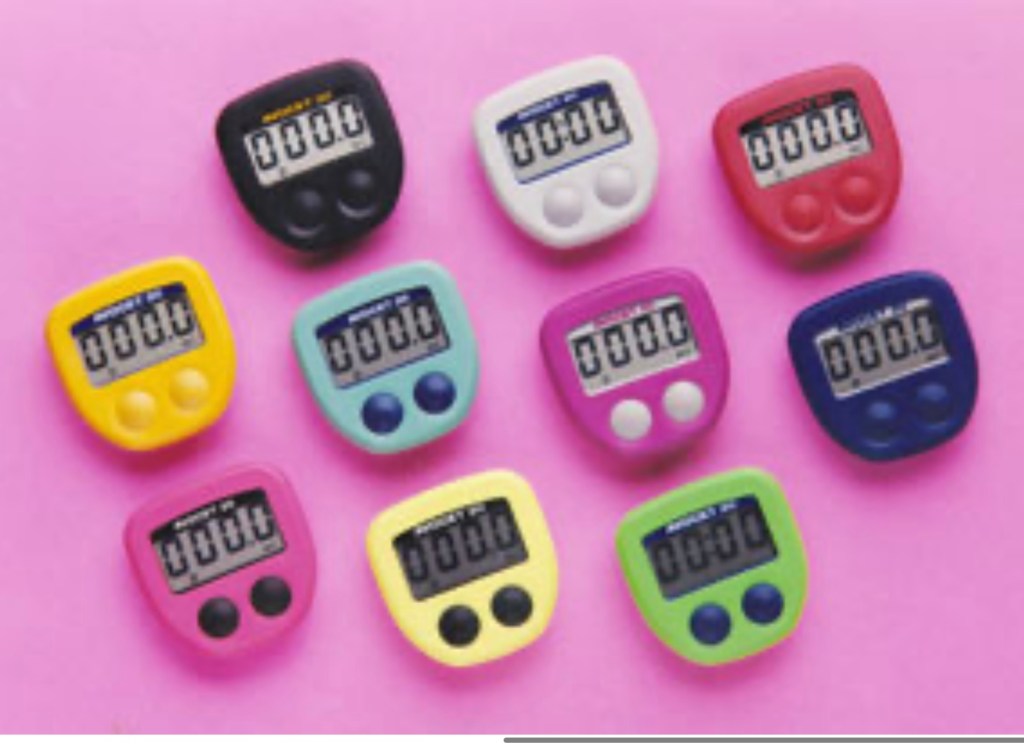
I remember these from the 1980s, the first of the anatomically padded bike seats. Avocet was more famous for their adorable little cyclometer, so simple and light, came in many colors, all of the Tour de France riders sported them back in the day.
Since the MacGyver job seems to be holding I think I’ll keep the Brooks Saddle until it fails, having the Avocet on hand. I texted Simon Firth, the Brooks guru in Philadelphia, for his ideas on why the rails keep breaking. Scott at the bike shop has never seen that happen. Meantime, Jane will mail my other Brooks Saddle, the one Simon repaired, once I figure out a good pickup spot, and I’ll send this one to Simon. And so the triangle trade continues. Maybe, as I lose further weight, this dance can stop. Not ready to give up on Brooks yet.
The hotel was full of baseball players, from Indiana University Southeast campus, I had fun chatting with Ben, their coach. Lewiston is the site of the NAIA World Series. I wish them luck.
Idaho. One of my least visited western states, although incongruously I have climbed the highpoint, Borah Peak, twice (don’t ask). Famous for potatoes, Sun Valley, Hemingway’s suicide, and the Ruby Ridge debacle. For me, notable for the Idaho Stop (Idaho was the first state to allow bicycles to use stop signs as yield signs) and for an inane childhood riddle.
If Mrs. Ippy leant Miss Ouri her New Jersey, what would Della Wear?
Idaho. Alaska.
Distance 34 miles, 1,028 total. Time 6 hours with stops. Elevation gain 1,243 feet
[Heads up campers, this post is going to get deep in the weeds about my bicycle. Normal people, as opposed to bicycle geeks, should feel free to skip this one.]
“The bicycle is the most efficient machine ever created. Converting calories into gas, a bicycle gets the equivalent of three thousand miles per gallon.” — Bill Strickland
My love affair with bicycles began when I turned six, my father let go of the back of my bicycle seat, and I felt like I was flying. It’s never stopped. In my freshman year of college, a seminal article came out in Scientific American that touted the efficiency of bicycles compared to any animal or machine (sorry it’s so blurry).
How cool. In terms of energy (measured in calories) per kilometer of travel, the bike stands head and shoulders above (or in this case below) any other form of transport. Five times more efficient than a person walking. It helps balance, it’s good for your weight, good for your knees, good for your heart, and good for climate change. What’s not to like?
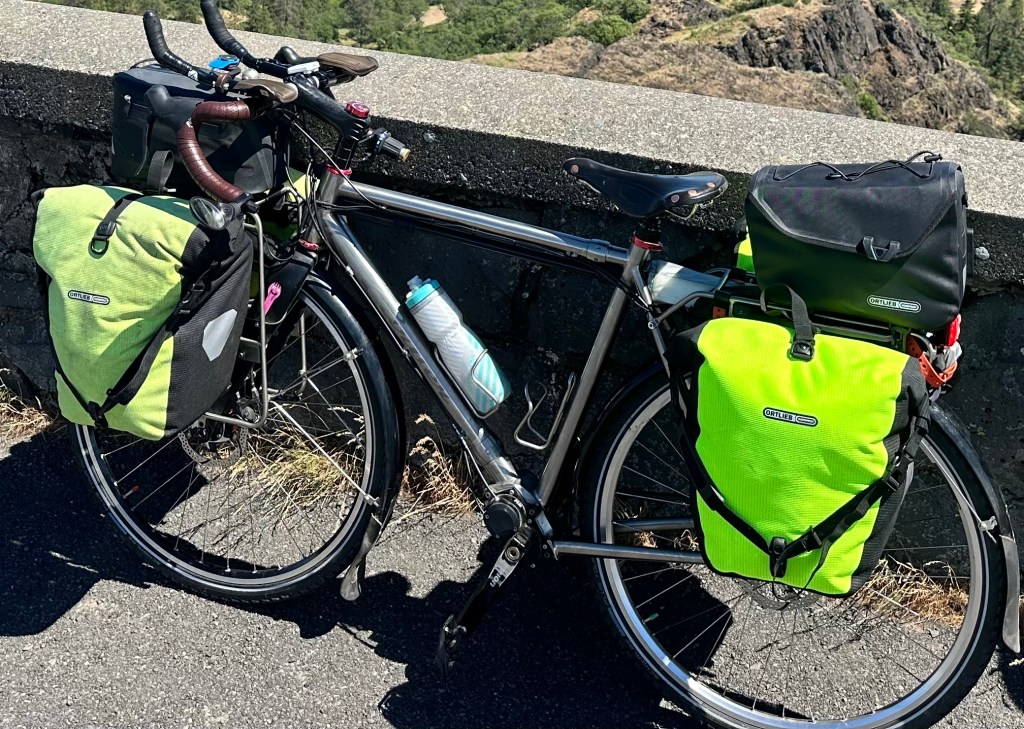
Of course it helps if you have a dream machine. I can look back nostalgically and think of every bike I’ve ever owned, but they all seemed to be building to the current model, a Carver, designed by Davis Carver in Maine (using the specs from my custom-made* Seven), fabricated by Waltly in China. How do I love thee? Let me count the ways.
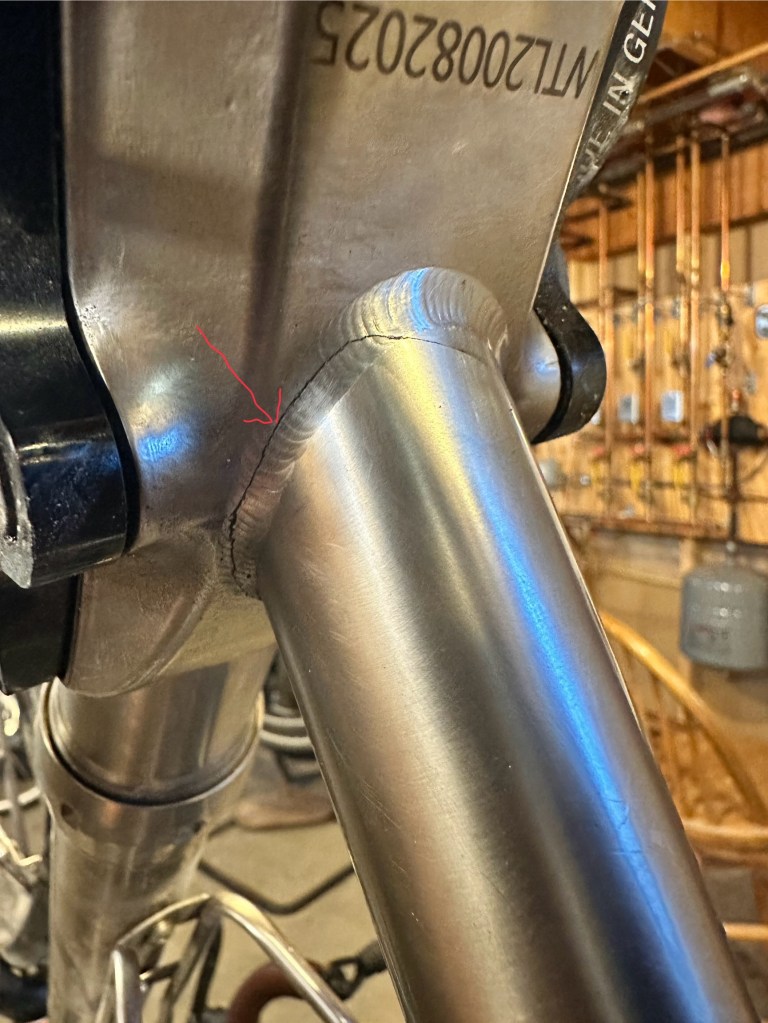
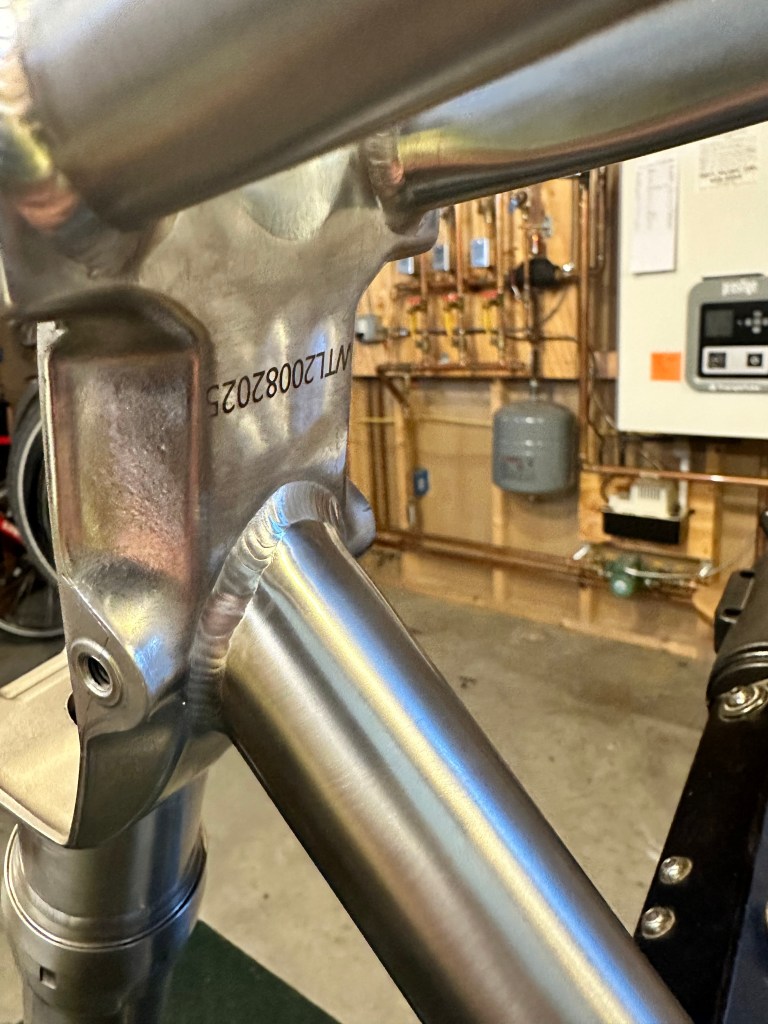
Titanium. Sounds exotic, but it’s actually the seventh most common metal on earth, titanium oxide is the chief ingredient in white paint. Purified, not only is it much stronger for its weight, but it has a resiliency, a combination of rigidity and shock absorption that rivals steel, much heavier. Aluminum is light too, but rock hard, riding over bumps is a real boneshaker. Titanium doesn’t rust, looks pristine after winters of road salt and summers of sweat exposure. You don’t need to paint it, if you like gunmetal gray (I had my logos etched in, so there’s no decals to chip or peel off). The other high-end frame material, carbon fiber, is glued together and can’t be repaired. Titanium is welded (has to be done in an inert gas atmosphere, one of the reasons why it’s so expensive); I had a crack appear after 4.5 years and 20,000 miles, it was repaired under warranty, check out these before-and-after pictures.
The arrow shows the crackLooks brand new
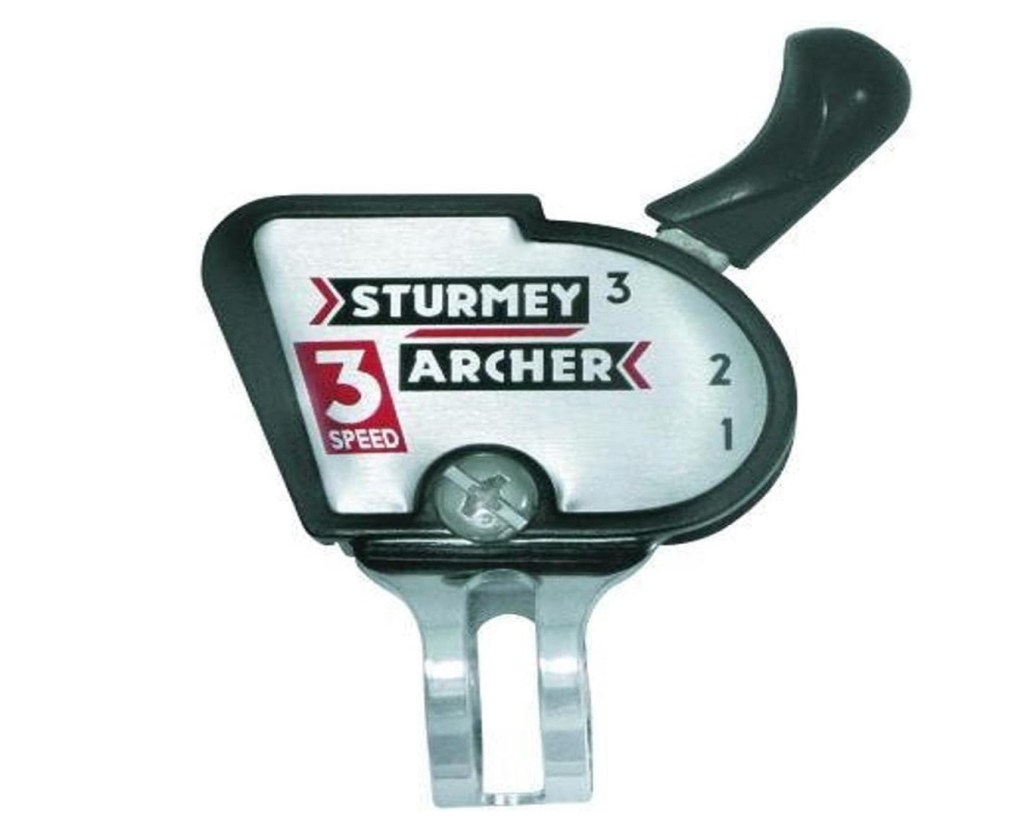
Pinion drive. You boomers out there, remember our old Raleigh three speeds? The flimsy lever on the handlebars, the gears all inside the rear hub with the little chain coming out, pulled by the gear cable?
They had a narrow range and were clunky and inefficient, but totally protected from the elements. We all couldn’t wait to upgrade to ten-speeds with their fancy derailleurs. Over the years, these evolved to as many as 30 speeds. Triples up front, 10 cogs in the back, efficient but fussy, messy, needed constant tweaking.
Lovers of “loaded touring” like me need a very wide range, super-low granny gears for uphill, high gears so you wouldn’t spin out going downhill. To do that you needed that triple up front, but these were being phased out. After a while, I couldn’t get replacement parts, even on eBay. I saw the writing on the wall. Internal gears were calling me back.
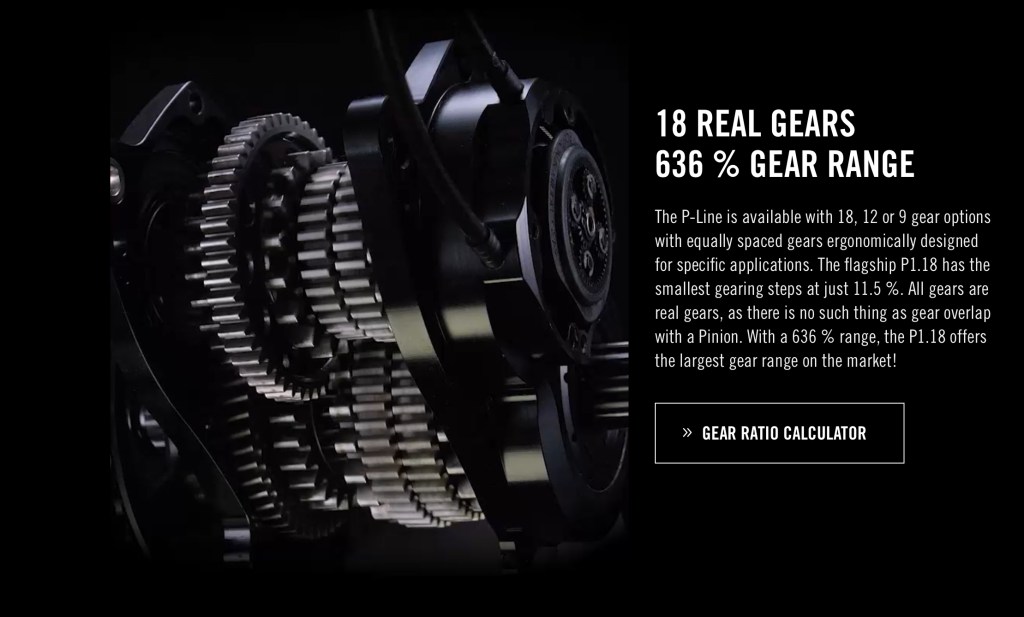
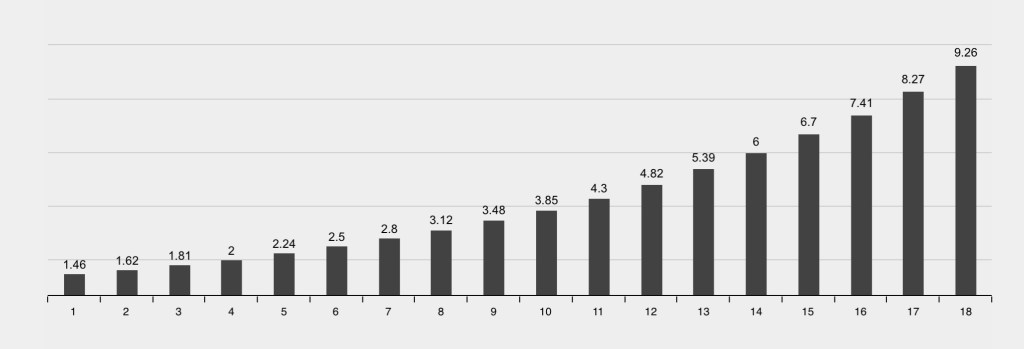
Fortunately, the technology had advanced. I chose Pinion, a German company founded by two Porsche engineers, because the gears were in the bottom bracket, not the rear hub. The P1.18 had 18 of them, with a 626% range, in a sealed unit that needed no maintenance at all (well, you had to change the oil every 6000 miles).
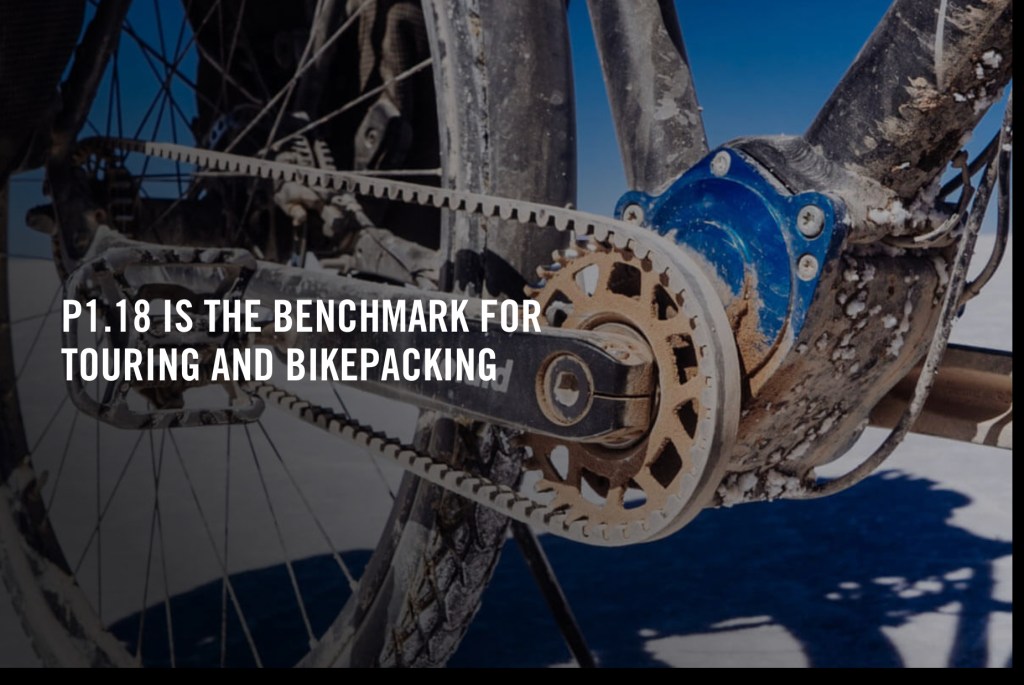
Paired with a Gates carbon belt, that also lasted for 6000 miles, you could forget about your drivetrain; no futzing, no adjusting, no lubrication, just hose it off or let the rain clean it. This picture says it all. For all of my anguish in the ankle-deep mud in Wisconsin on 5/24/21, my gears were one thing I was not worried about.
I’m using their photos, but I should clarify that I have no financial relationship with this company
You may ask, what on earth do you need 18 gears for? Pinion has them spaced out evenly, every time you shift, the change in effort is 11%, up or down. Especially with multiple chain rings, derailleurs can’t offer that evenness, often there is redundancy.
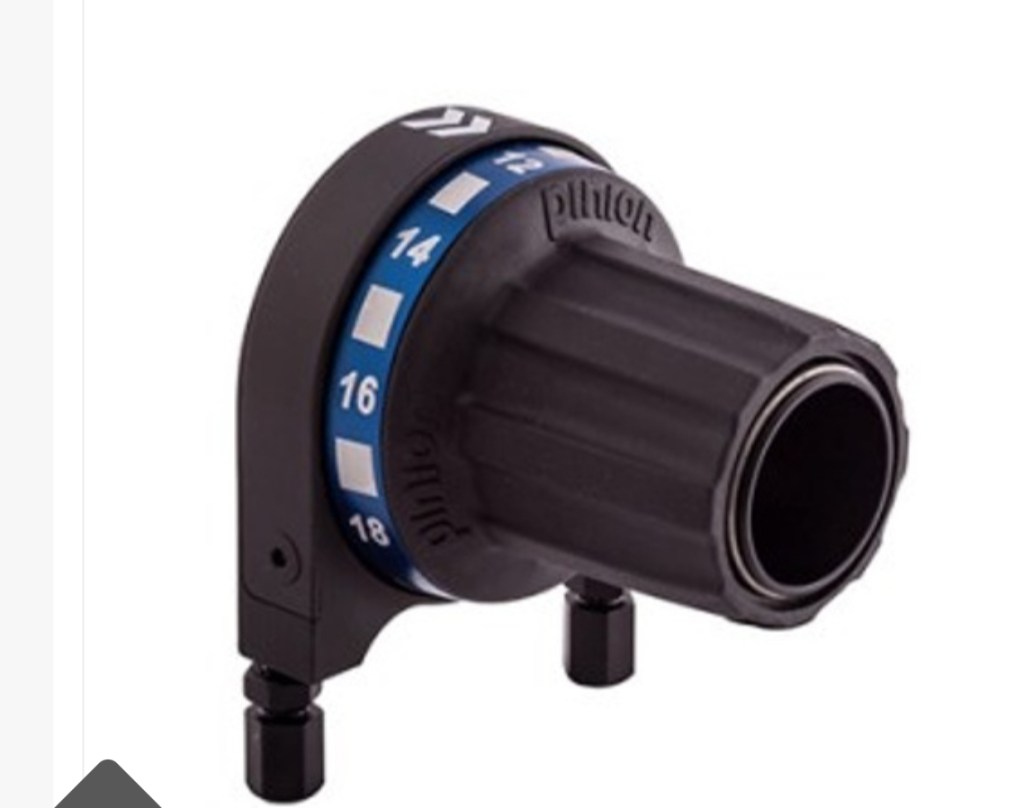
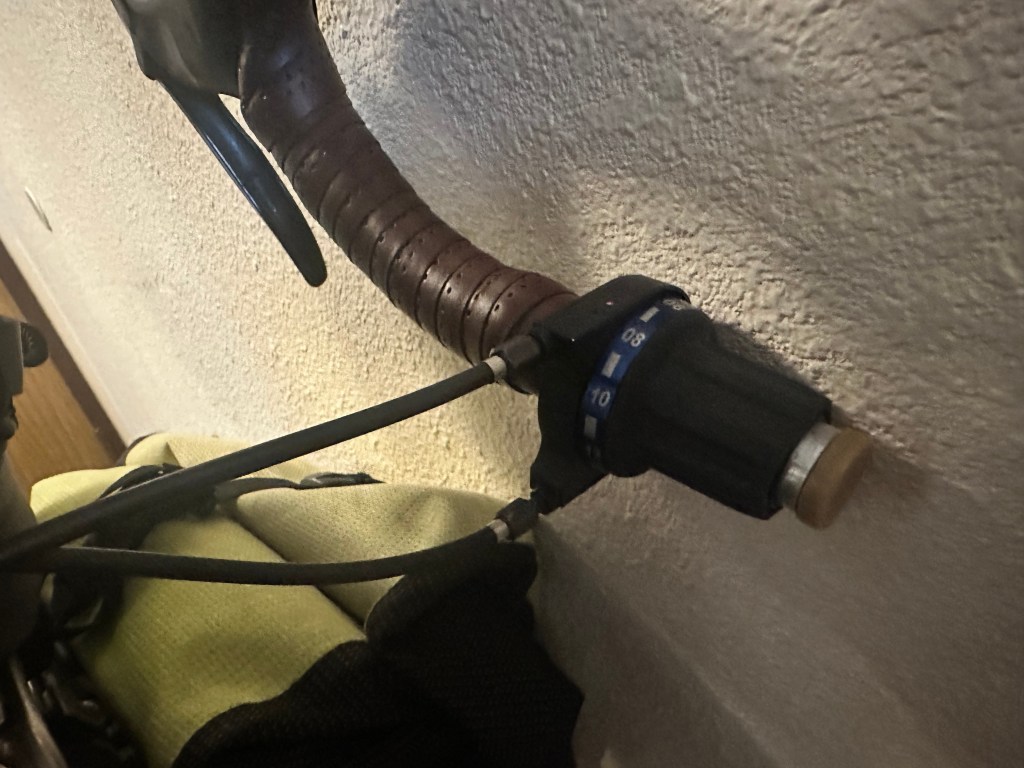
The design requires a grip shifter, which took some getting used to. Now that I’ve adapted, I love it. Cables control the shifter in both directions, there is no relying on a return spring to shift in the other direction. I have mine mounted on the end of my right drop handlebar, and it’s kind of like adjusting the temperature in the shower. You just twist it slightly to the right or the left until you get the exact ratio you want.
Stock photo My setup
There are some downsides. It’s heavy, the gearbox alone weighs 6 pounds, the total setup is about 2 pounds heavier than an equivalent derailleur setup. You can’t shift under load, you have to ease up on the pedals for a fraction of a second to make a shift, although this becomes intuitive quite quickly. What you can do is shift multiple gears when stopped, a big advantage at stoplights. No internal gearbox can be as efficient as a perfectly tuned derailleur system, 90% versus 98% efficiency. But the fact is, most derailleur systems are not perfectly tuned, they get out of adjustment easily, and their efficiency plummets as the chain wears, the lube dries out, the cogs deform, the pulleys get rusty.
And of course, it’s expensive, and you have to have a specially modified frame. This puts it beyond the reach for the casual bike user, but for a guy like me, for whom his bicycle is his primary means of transportation, it’s worth it. Once you try it, you’ll never go back. They’ve just come out with an integrated motor system, this video is a little overblown, but I do think this will be the wave of the future. https://youtu.be/pHkrEpm5hcA?si=pIV4P8F4pIwVJybN
Für das deutsche Vaterland. The Pinion gearbox is German, I’m German, and Teutonic pride led me to choose a trio of German accessories.
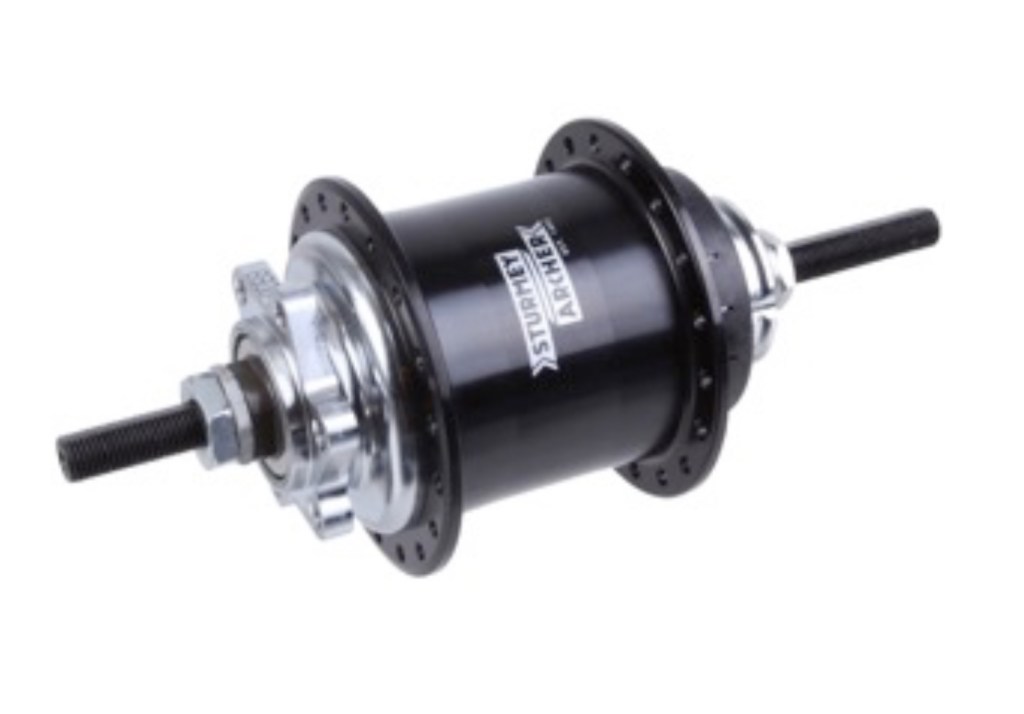
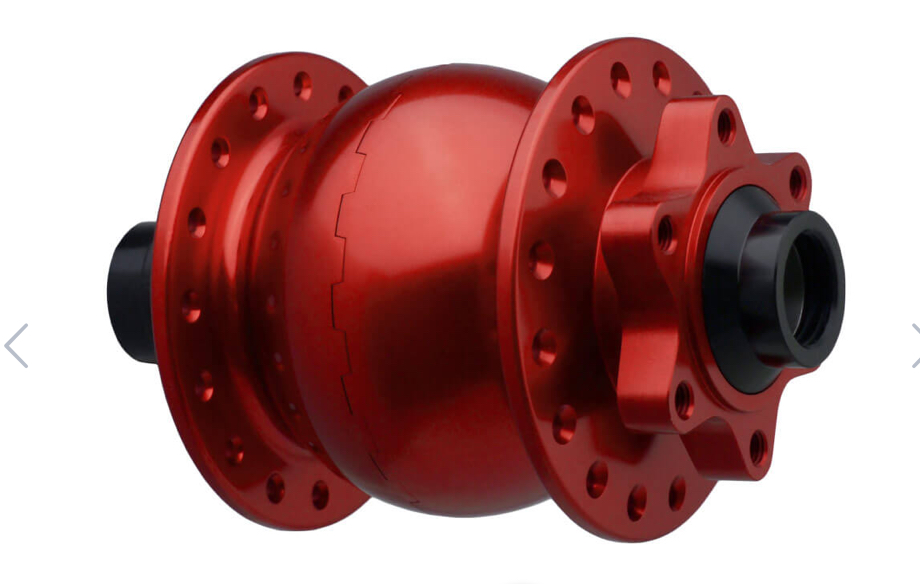
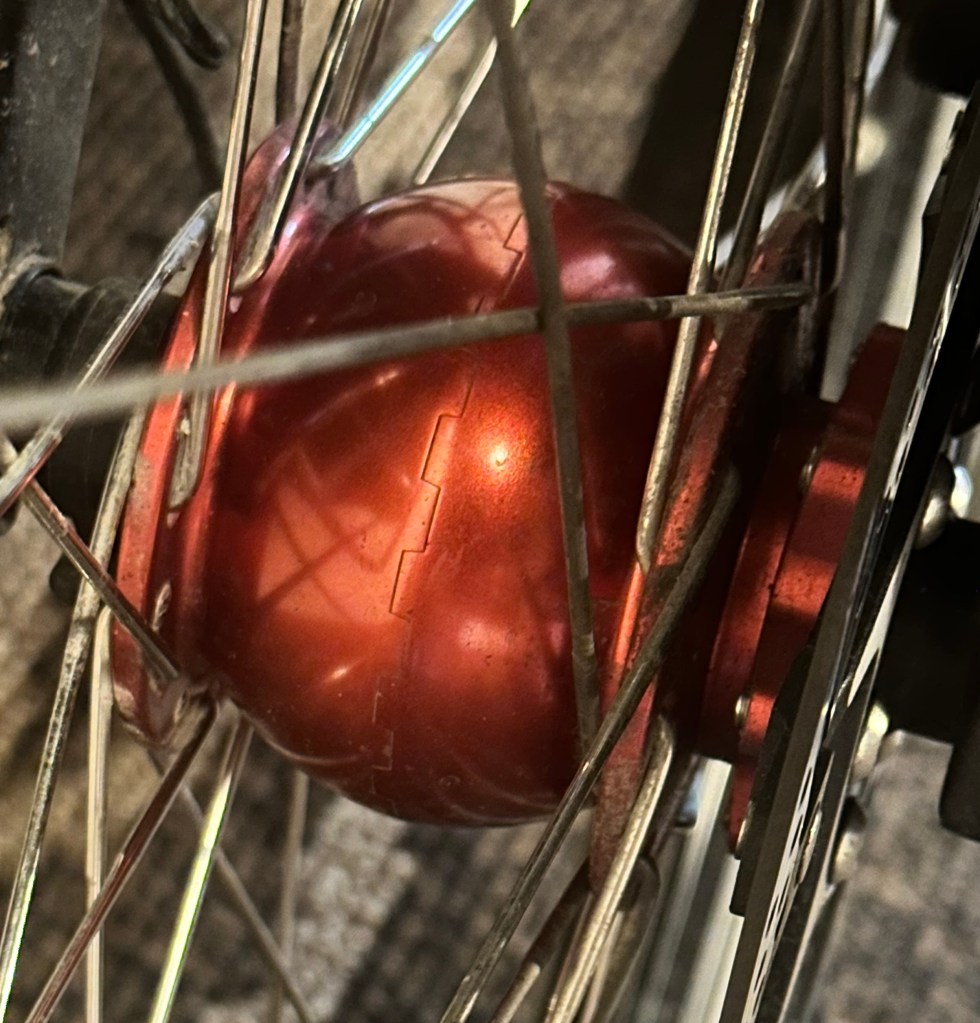
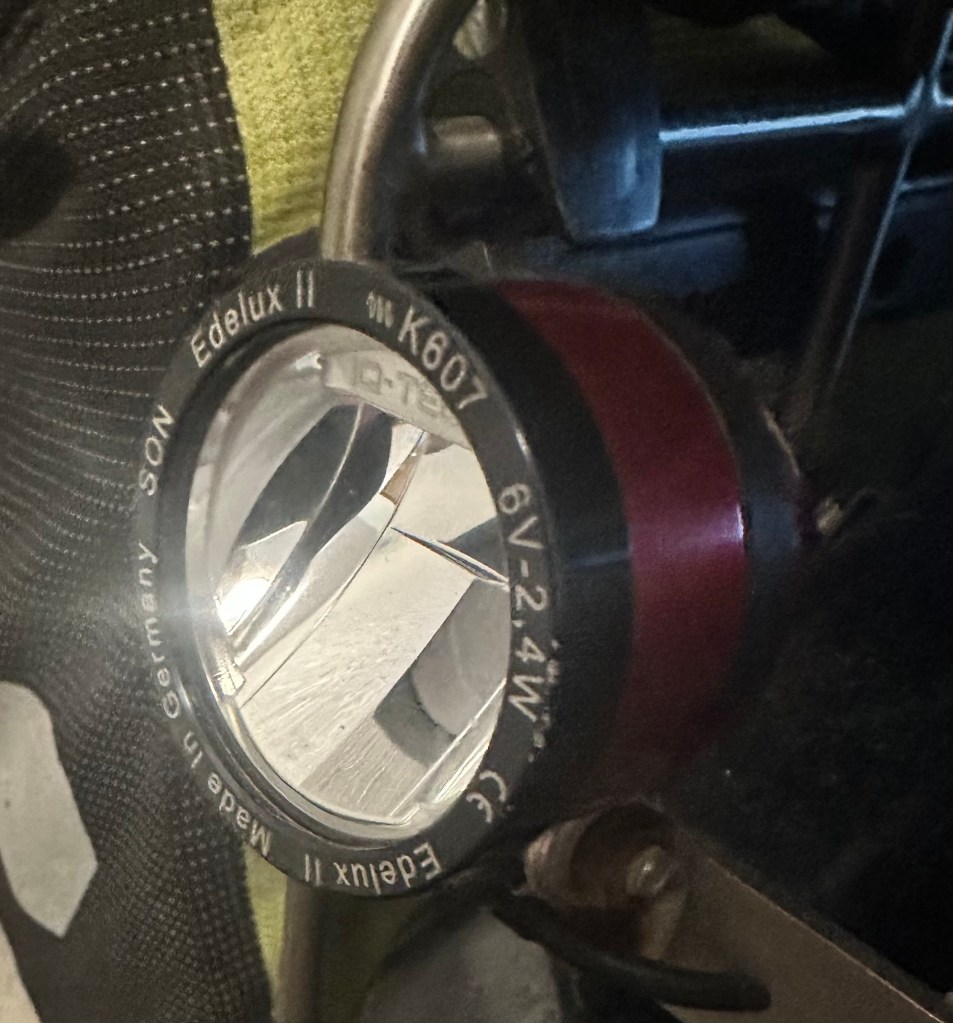
My lighting system is by Schmidt, who makes the most efficient hub dynamos, paired with Edelux LED head and taillights
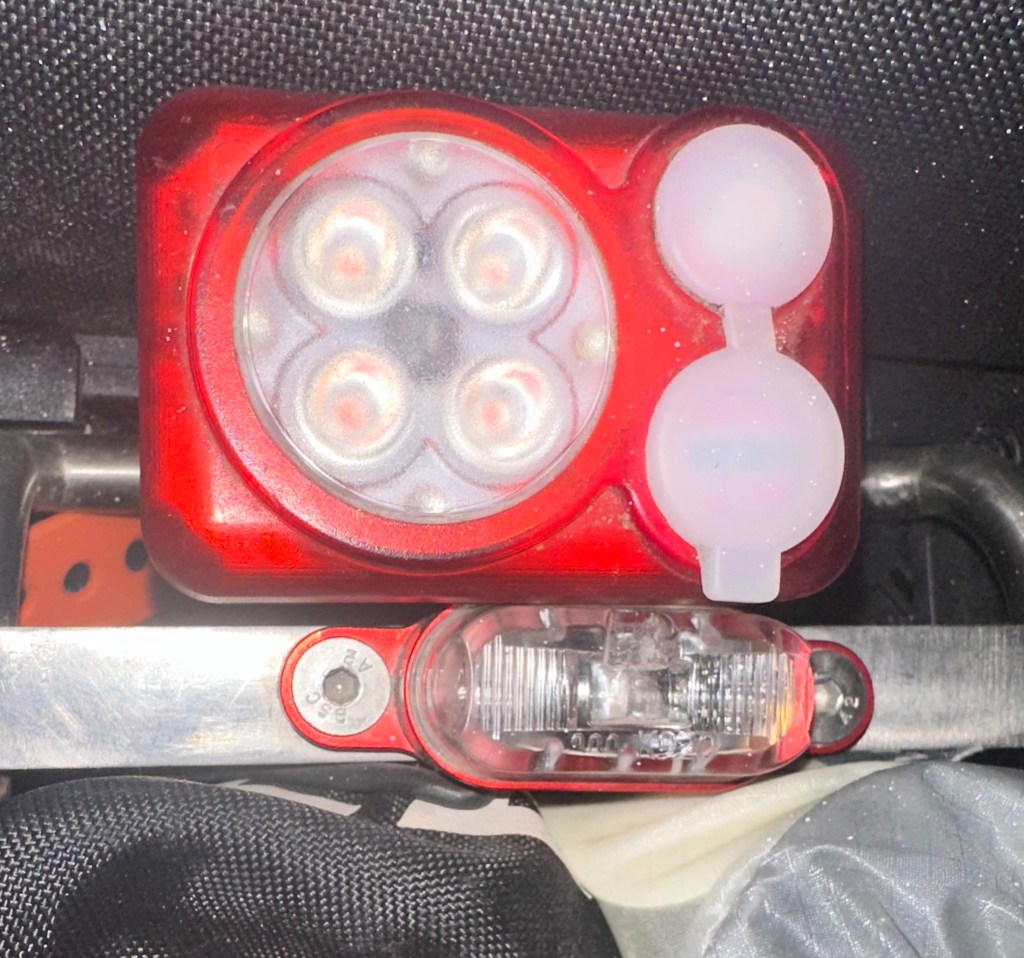
Stock photoMy front hubThe wiring is internal, runs right through the titanium racks Edelux taillight below, DiNotte flasher above
The lights are on 24/7, never burn out, and produce minimal drag. There’s a built-in capacitor called a standlight, allowing the lights to remain on for seven minutes after you come to a traffic light. Brilliant.
My panniers are all Ortlieb, all the time. Impregnated with Illuminite reflective threads, they kept everything dry in those days of constant Pacific Northwest rain.
Finally, the tires are Schwalbe Marathon Plus, heavy, slow, indestructible. I’ve had one flat in 7,000 miles. In winter, I use the studded version.
Brooks Saddle. I’ve already sung the praises of my Brooks B-17 leather saddle, when fully broken in there is nothing more comfortable. Now that I have a dropper post it’s even better, I can lower it for mounting and dismounting, raise it to my usual riding position, and even the higher for ultimate efficiency. The English company also makes my handlebar grip tape, indestructible.
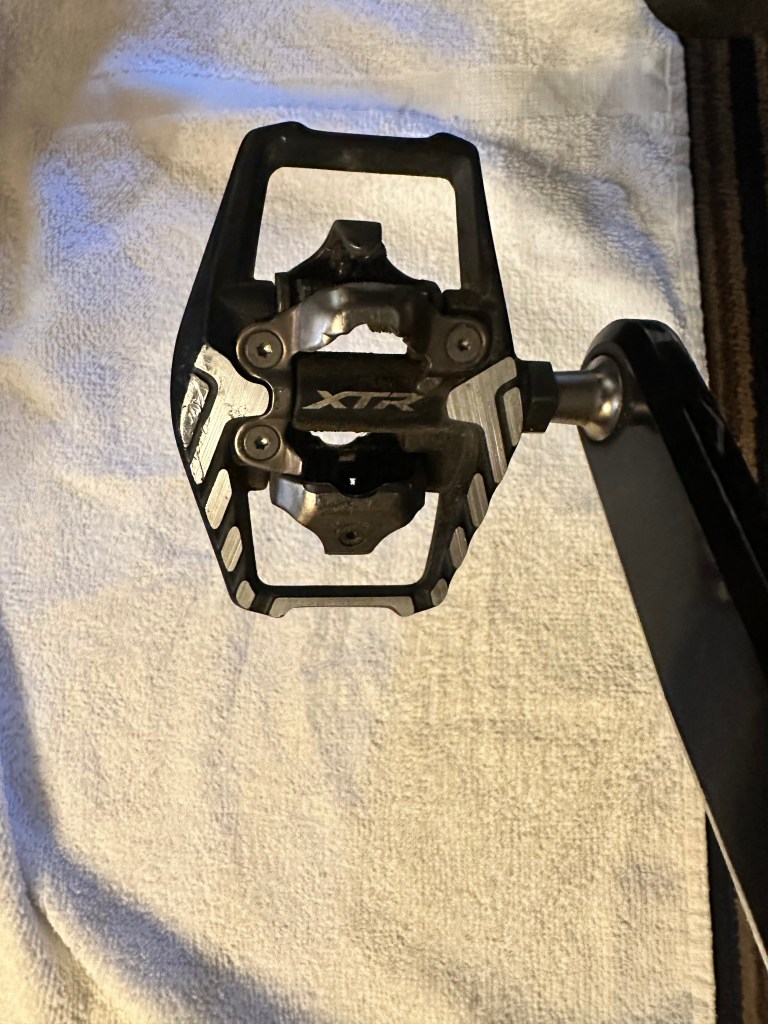
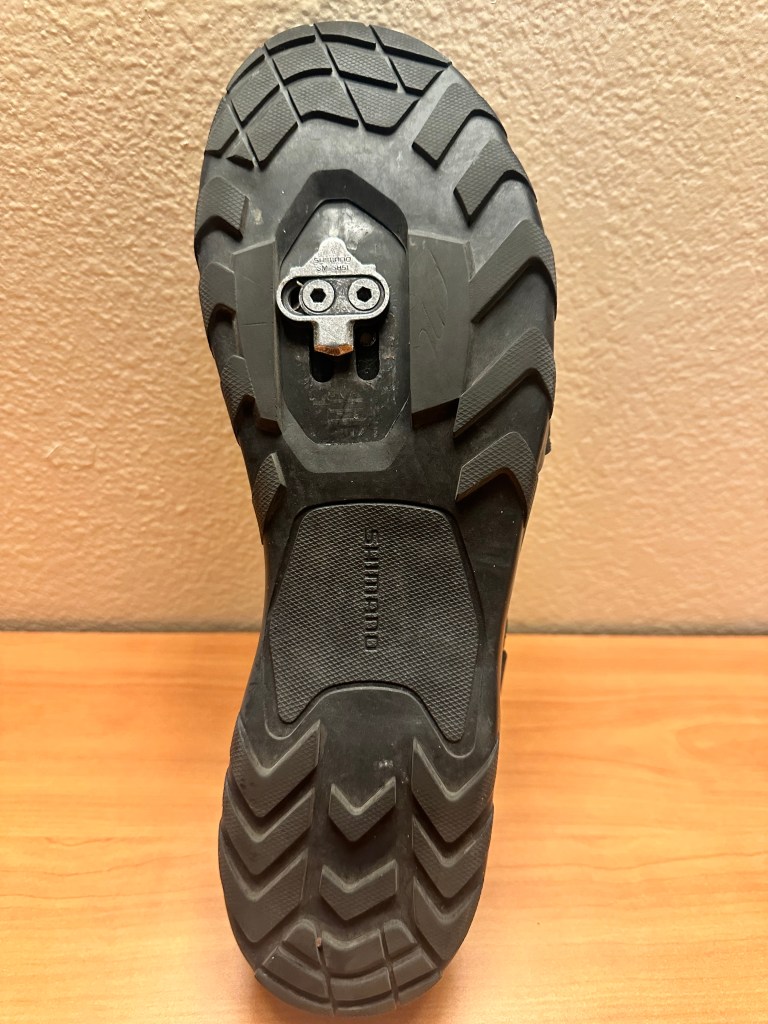
Pedals. The Japanese component on my bicycle. Shimano has been making state of the art equipment for decades. My pedals are their XTR platforms, they clip into my SPD cycling sandals, but can also be used with street shoes. Many people are nervous, to have their shoes clipped in like that, but they pop out easily, ensure perfect foot/pedal alignment, and allow you to pull up as well as push down.
The cleat is recessed, so you can walk on floors without scratching
I should probably pause to explain here why I wear cycling sandals, subjecting the world to my ugly feet. They’re just so comfortable. Cool in the summer, they dry off quickly after rain, I hate cycling in wet socks. I can get pretty sore after 50 miles, but they have a textured footbed; if I loosen the straps, they massage my feet with every stroke. They’re not high-performance, but then, neither am I. When it gets cooler or wetter, waterproof socks and toe covers make them quite warm, good down to 35°.
Brakes. Spyre TRP mechanical disc brakes with dual pistons. Disc brakes are becoming the standard for all bicycles, an improvement over the classic rim brake, which can overheat on braking descents , and cause a blowout, they also wear out the rim. Disc brakes work in the pouring rain, are unaffected if your wheel goes out of true, and have much more stopping power for the same effort than traditional brakes. Hydraulic brakes offer better modulation and even greater power, but you need special tools and they have to be bled periodically.
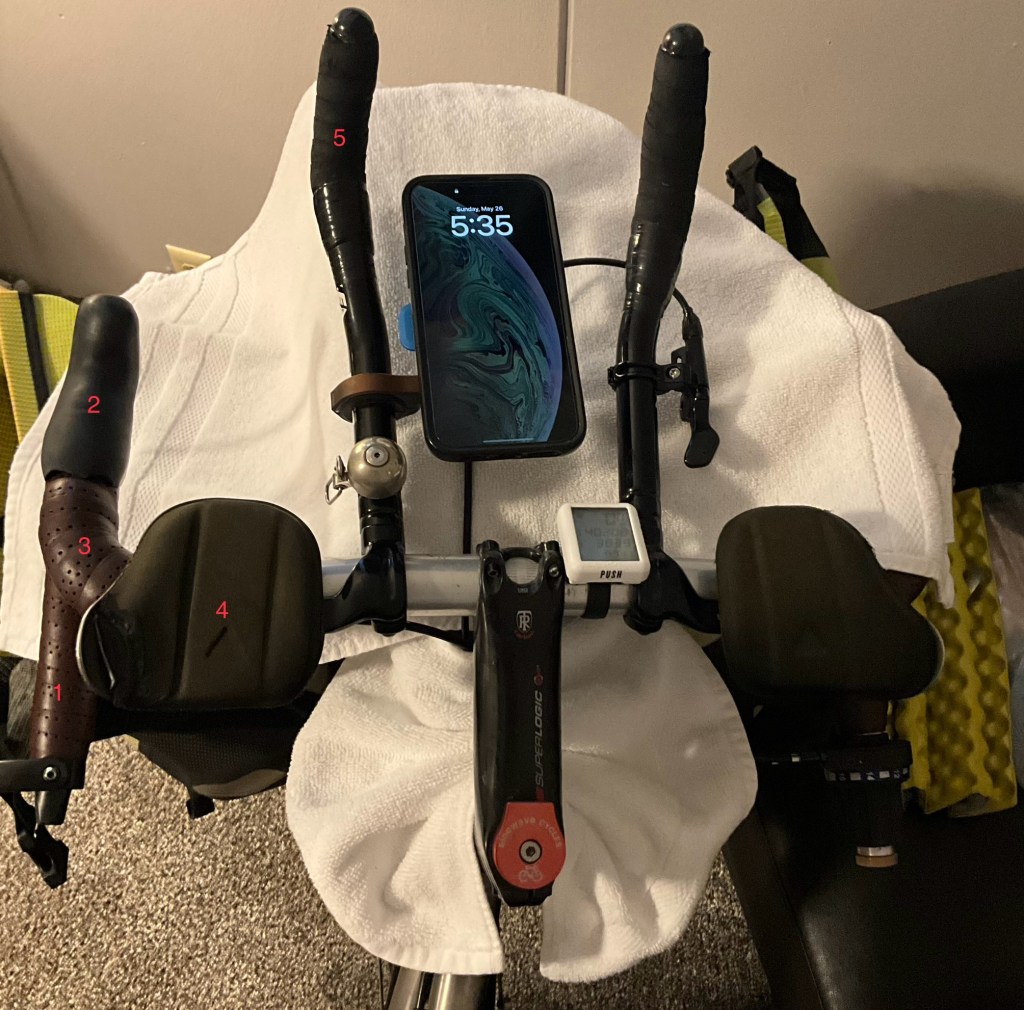
Aero bars, AKA bullet bars, let you get into a fuller tuck in headwinds, and give your hands a rest. Conversely, you can also rest your hands on top of the elbow pads for an even more upright position. They also provide additional mounting space for my bell, phone, and the control lever for the dropper post. Which brings up the big advantage of drop bars as opposed to flat handlebars. I have five different ways I can grip the handlebars (numbered in the photo, to grip at # 5, you rest your elbows at #4), and I use them all. It really helps on long rides. I’m mostly at position # 1, down in the drops. It took some getting used to, but once my body adapted, I found it much more comfortable.
The towel is there for contrast. The USB port is the red thing at the bottom
USB port. The Sinewave Cycles (Cambridge MA) Reactor lets you divert some of the dynamo current to recharge your phone. This is one item that works better in theory than in practice. I have my lights on 24/7, when you do that you have to go 10 mph to charge the phone. My average speed typically hovers around 10 mph, so the charge keeps kicking in and out, and every time the phone pings annoyingly and the screen lights up. I suspect this burns up more energy than I’m supplying. Might make sense to use on a long downhill, but I typically rely on power bank back ups for the phone.
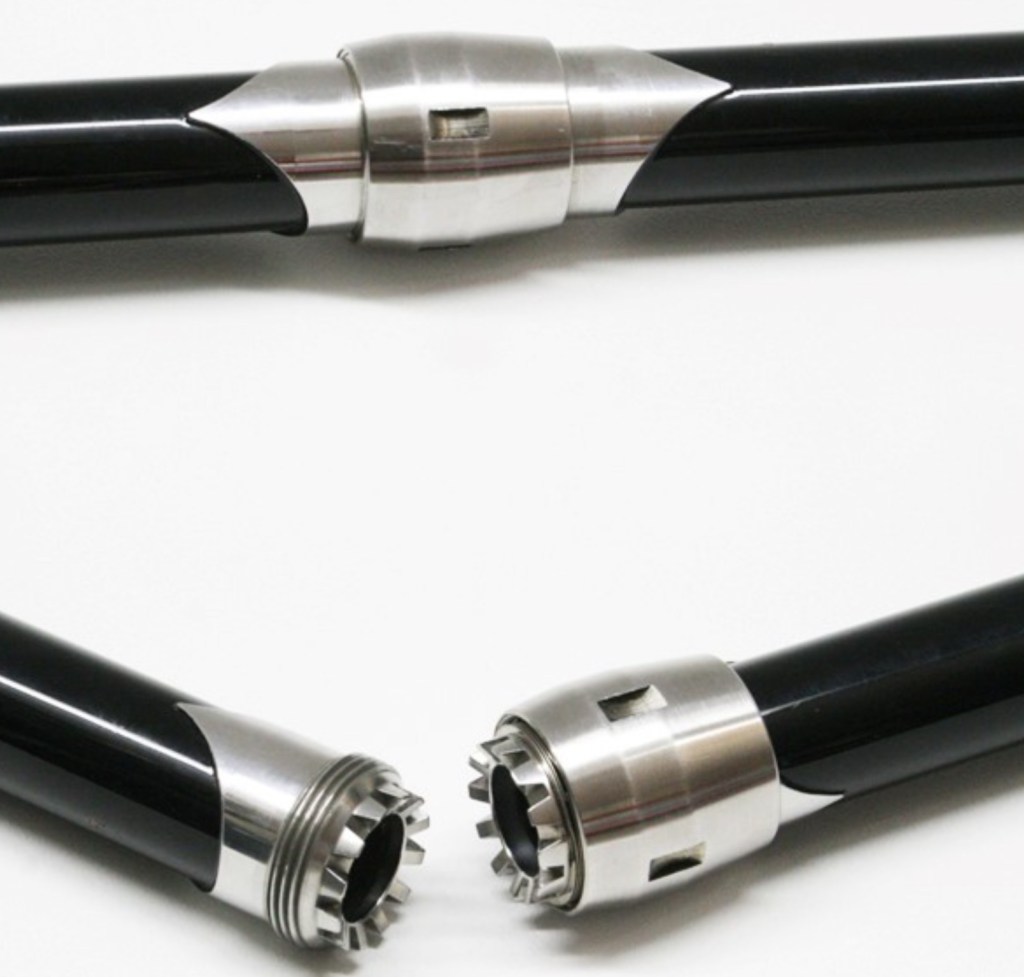
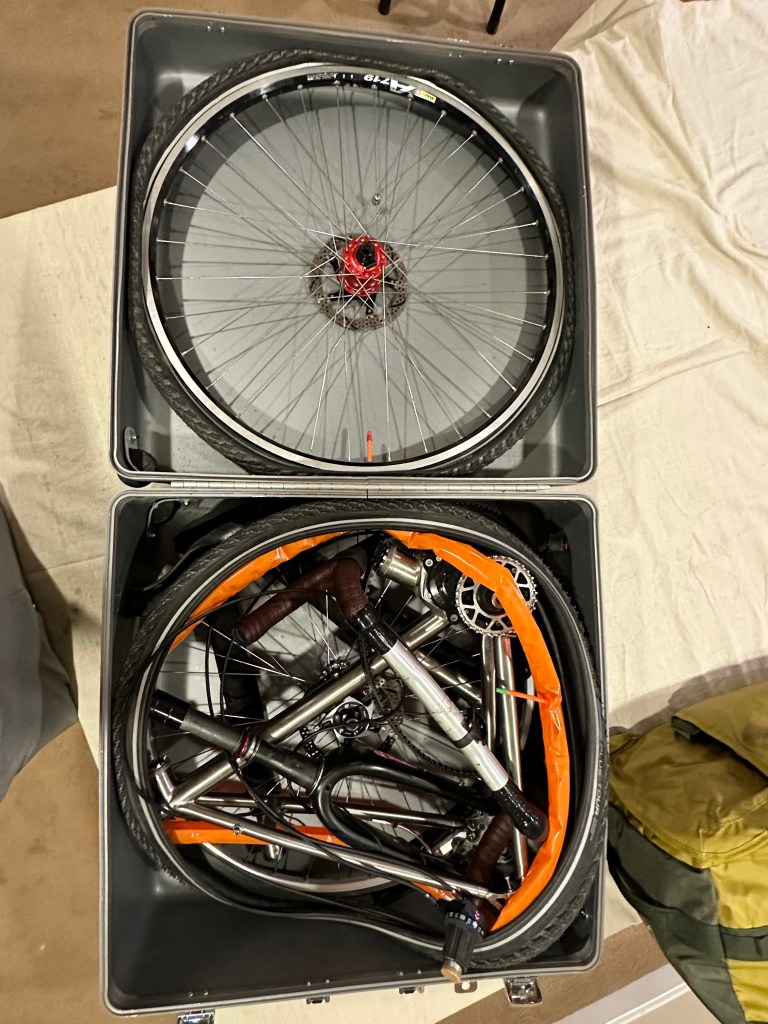
Couplers let you break the bike in half to fit into a regulation suitcase, and save on excess baggage fees. The clever dragon-tooth mechanism is actually stronger than the frame itself, like a healed broken bone.
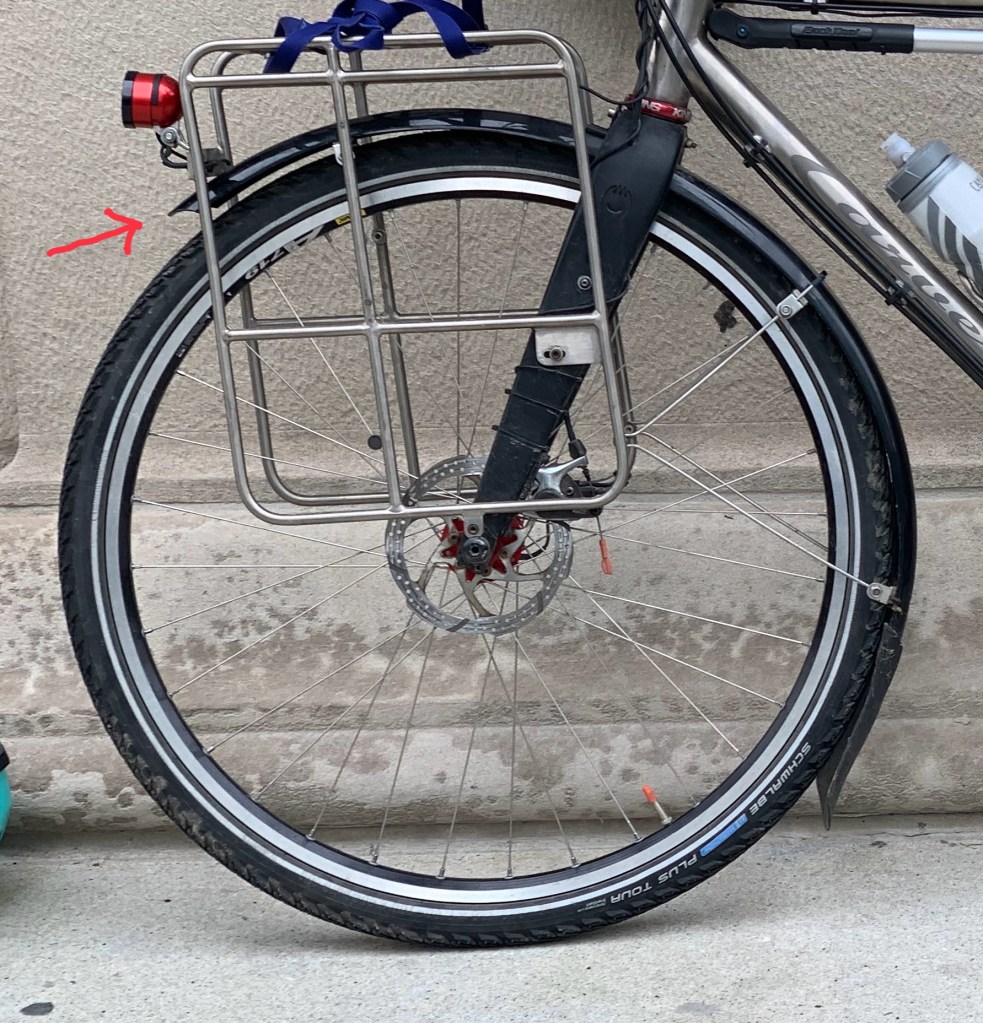
Fenders. We used to hate them: heavy, rusty, noisy, and ugly. The newer ones are plastic and quite light, make it big difference in the rain. No more black stripe up your back. If you’re going to get wet, better from the clean rain above than from the filthy grit kicking up from your wheels. I modified the front fender by trimming a second rear one, to give more coverage to my headlight. Planet Bike Cascadia, Wisconsin.
Frame-fit pump (mine is the classic Italian Silca) can fill your tires faster that a mini pump. Many use CO2 cartridges instead, but you’re stuck if you deplete them. Plus, CO2 gas is polar and diffuses through rubber more than room air; you need to top up more often.
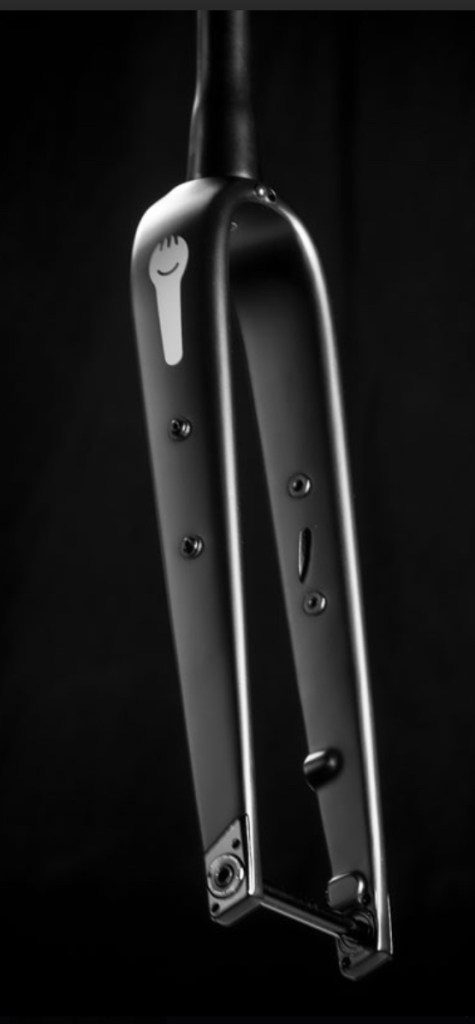
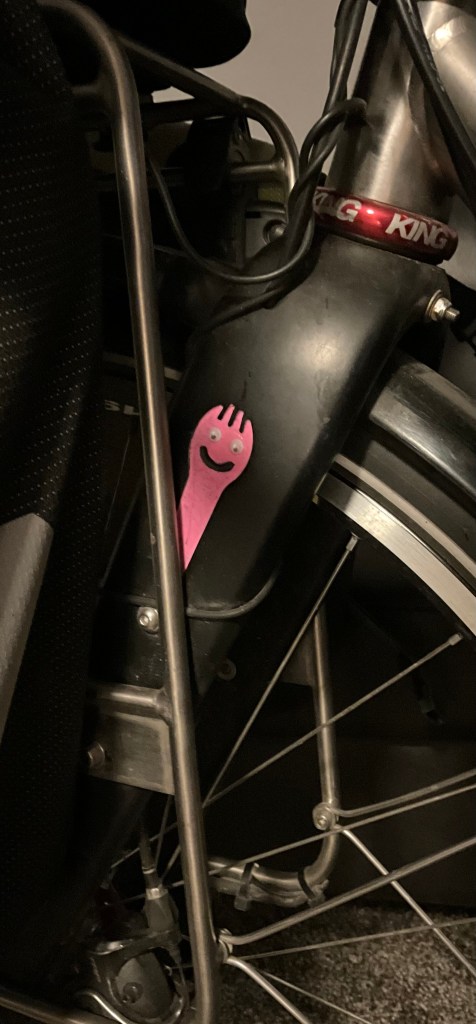
Fork. Titanium forks tend to be too flexible, so I chose a carbon fork, a Spork 2.0 by Rodeo Labs of Colorado. It has fender and rack mounts, and internal wiring from the generator. I added the googly eyes.
Chris King headset above it
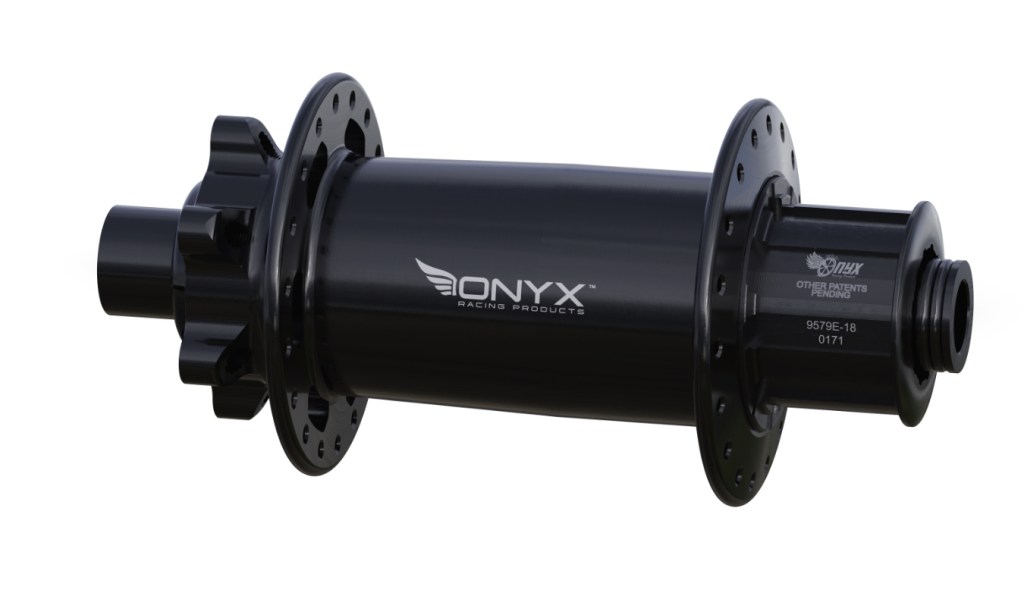
Rear hub by Onyx in Minnesota, has a sprag clutch rather than traditional pawls; less drag and it coasts silently. Stealthy.
Mine’s red, of course
Rear flasher. The Edelux generator taillight is quite bright, and suitable on its own for most occasions. In the city, and on sketchy roads, I turn on my DiNotte (New Hampshire, a charge lasts 6 hours at full power) quad red flasher, so bright it’s almost obnoxious, even in broad daylight. I remember one Saturday night, a drunk yelled out his car window, “Turn off da f_ckin’ lights!”
There’s more, but this is enough. Minnesota. Maine. Colorado. Massachusetts. New Hampshire. Wisconsin. Germany. China. Britain. Japan. Italy. Switzerland (spokes). France (rims). My bike is a veritable United Nations, living in harmony. And the whole is greater than the sum of the parts.
All those parts add up, the bare bike (with racks) weighs 35 pounds, surprising for a titanium bicycle. But it handles like a thoroughbred, managing the bumps silently, with no chain slap or derailleur rattle. I’ve ridden it almost every day, through five Vermont winters, and it still looks pristine.
* For my 50th birthday, Jane gave me a custom-made bike from Seven Cycles, a high-zoot builder in Watertown MA. Their local representative, David Porter, spent hours measuring (it seemed) every bone in my body, making a mock up and having me ride it around for half an hour, then making further adjustments before sending the specs off to the factory. It was like getting fitted for a bespoke suit on Savile Row. Fits me like a glove. The trouble is, once you’ve ridden a custom bike, it’s hard to ride any other.
I loved that Seven, still do, but the triple derailleur is wearing out, I can’t get a replacement, and Seven doesn’t do Pinion-compatible bikes.
Dayton to Pomeroy, Washington Saturday, May 25, 2024.
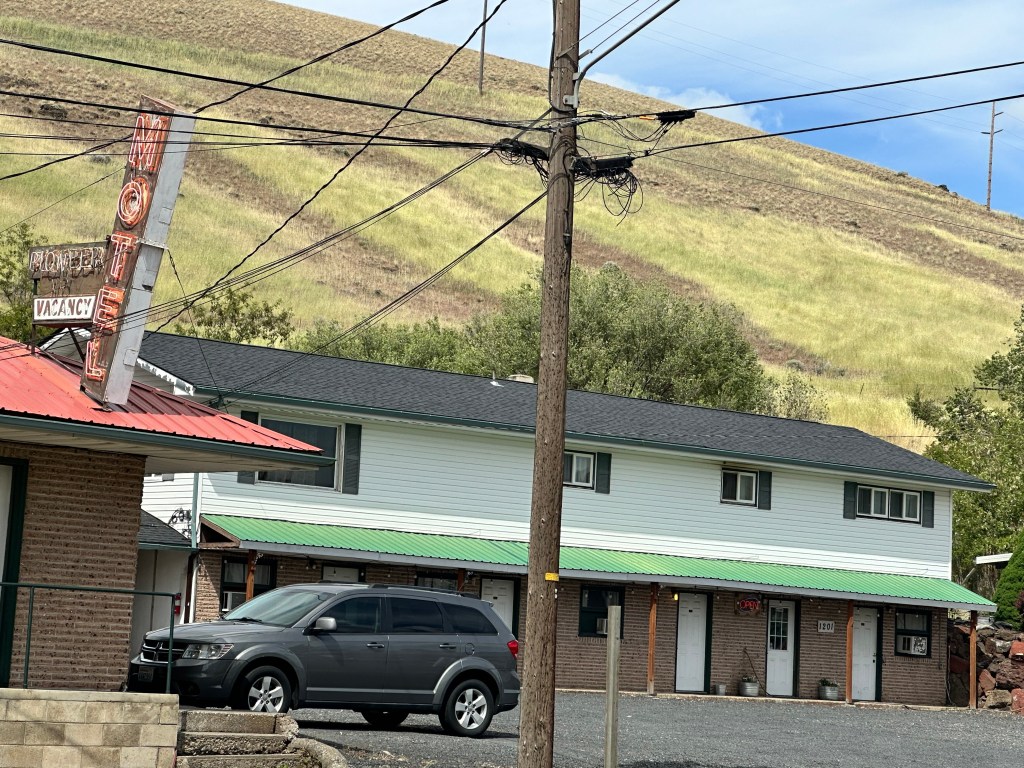
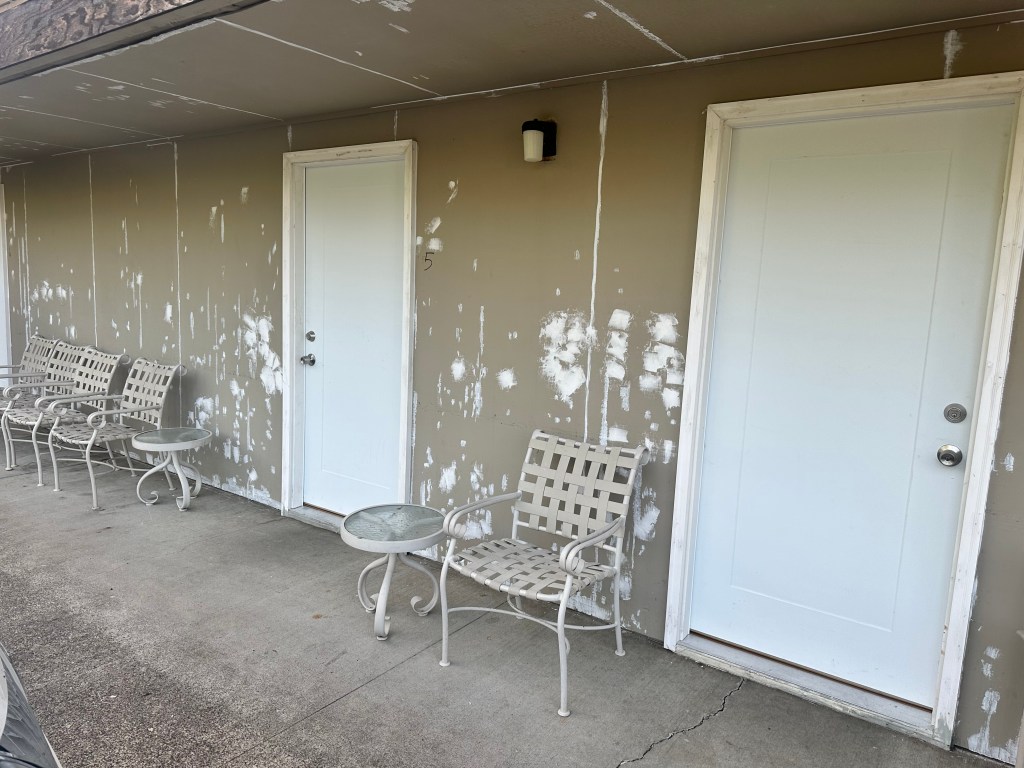
OK, this fleabag wasn’t that creepy, and there were only 11 vacancies. But it was in the ballpark.
The car in the parking lot indicates one other guest
The office was behind the windowed door, and my room was the one just to the left. I didn’t see any peepholes. The proprietor was an older woman, not an intense young man, but it could’ve been his mother. I guess I’ll take a shower anyway*.
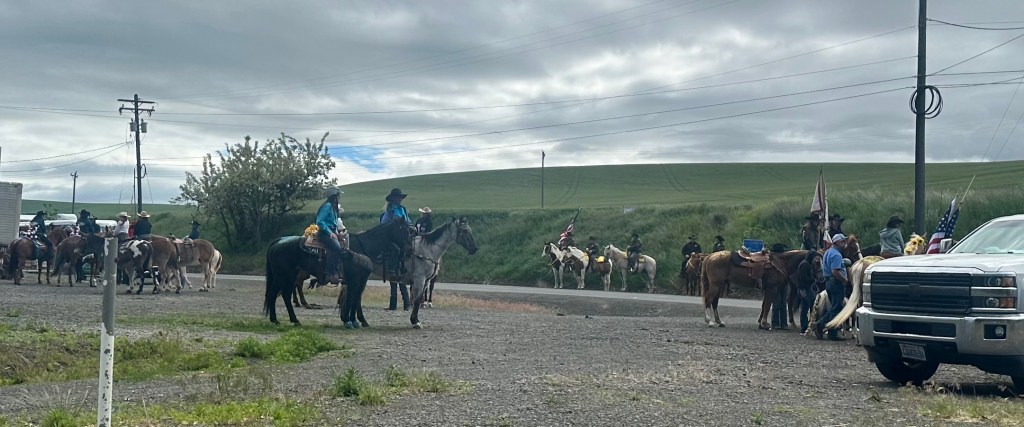
It was a cap-off to a slightly weird day. Dayton was having its Memorial Day parade, and the main street was blocked off. I convinced the sheriff to let me go through anyway; spectators lined the sidewalk but the parade hadn’t come through yet, so it was just me, going the wrong way. I sheepishly tried to wave, but had visions of a similar scene in Easy Rider. Those guys wound up in the hoosegow.
Riders lining up to start the parade
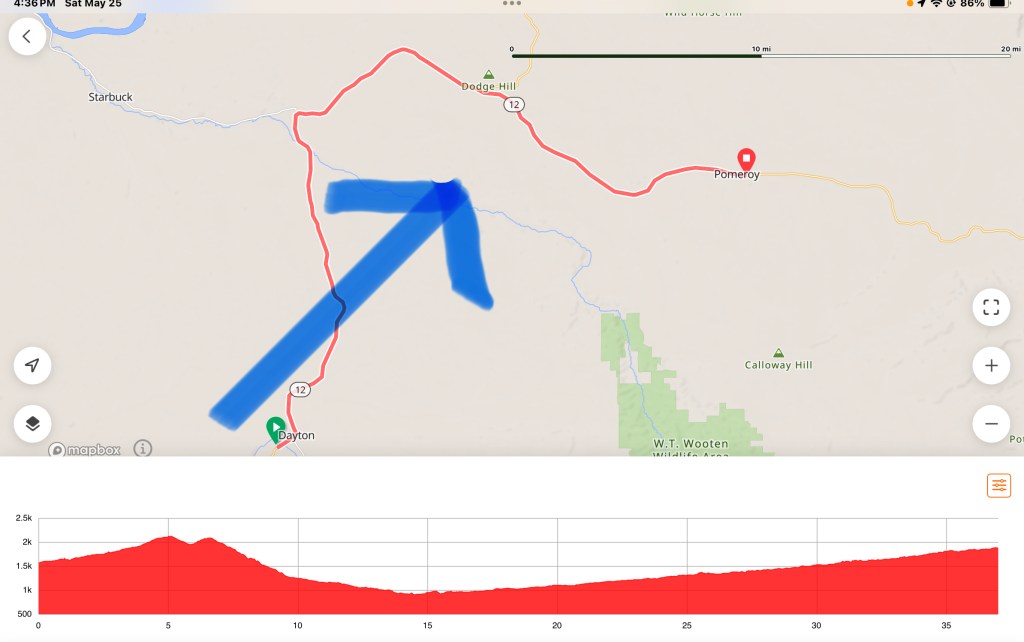
There was a strong southwest wind, 20 to 30 MPH with higher gusts, indicated by the blue arrow I drew over my Ride with GPS track for the day.
As you can see, mostly a tailwind, but sometimes a buffeting crosswind, that threatened to blow me right into traffic. The way it whipped around the Palouse hills reminded me of sailing regattas in the Charles River, surrounded by skyscrapers (at least there were no traffic helicopters hovering overhead). I had to keep an iron grip on the handlebars, and by the time I hit Pomeroy, I was pretty tapped out. As is common in this neck of the woods, there was nothing, nada, zippo, no place to stop for 37 miles. I thought maybe I’d go another 30 miles to Lewiston, but felt it best to stop here, even if the Pioneer Motel was creepy.
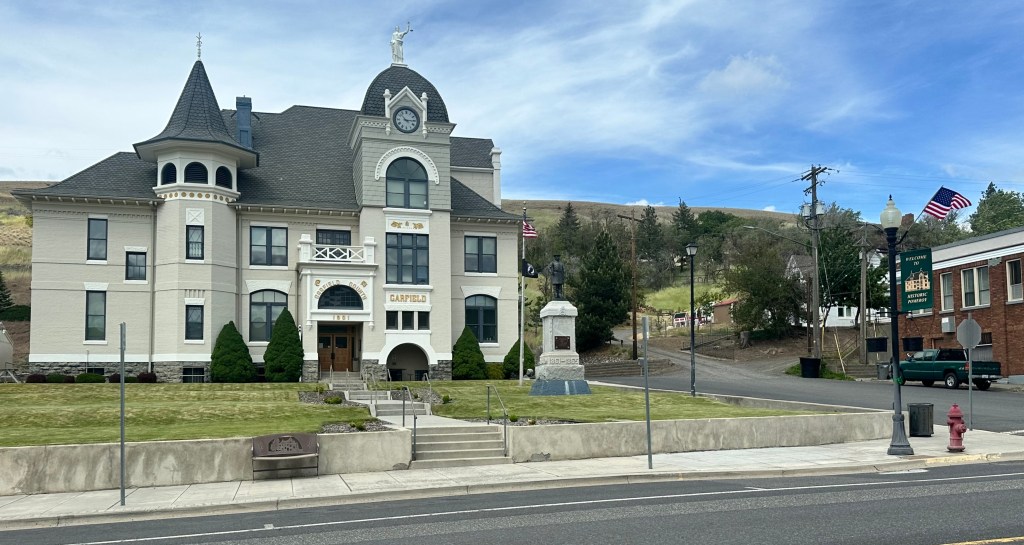
I arrived at 2:05 PM, the only restaurant in town had just closed. So I stocked up on groceries for lunch, dinner, and the following breakfast. Another string town, pretty dead, although the Garfield County Courthouse was interesting.
Distance 38 miles, 994 total. Time 5 hours with stops. Elevation gain 1,850 feet
*In one of my more egregious examples of bad parenting, I let my daughter watch Psycho at age 9. For the next 10 years, she would not take a shower unless our dog was in the bathroom.
Walla Walla to Dayton, Washington. Friday, May 24, 2024
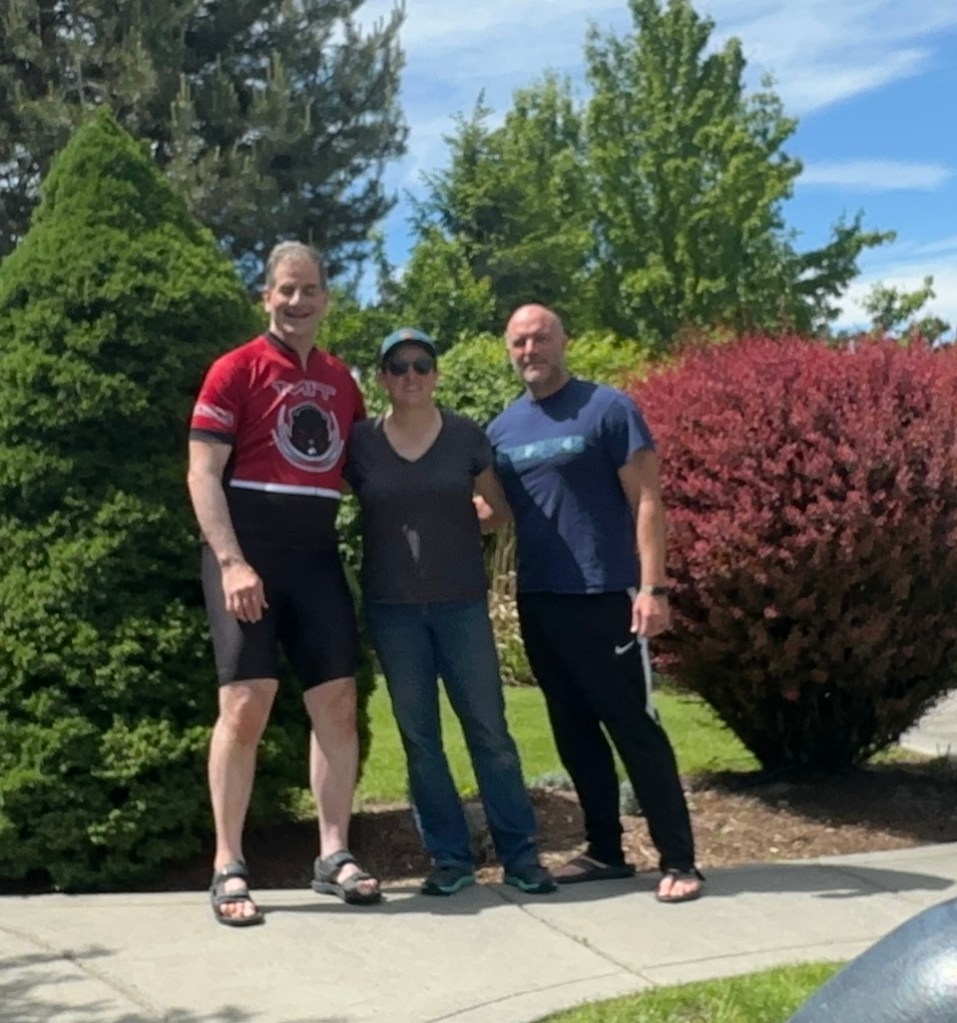
Low-key day today. Accommodation spacing, mountainous terrain, and Memorial Day weekend crowds have dictated that I take a trio of 30-mile days. Knowing this, I tarried with the Brannans, we had lots of fun sharing experiences, talking about our kids, careers, the airline industry, bike rides, contracting, and the whole Warmshowers experience. We shared jokes and videos, and could’ve talked for hours more. As it was, I didn’t leave till noon and got this farewell photo, unfortunately slightly blurry.
Me, Laura, and David
I toured downtown Walla Walla and Whitman College, both very attractive, but not particularly photogenic. What struck me most was the Palouse.
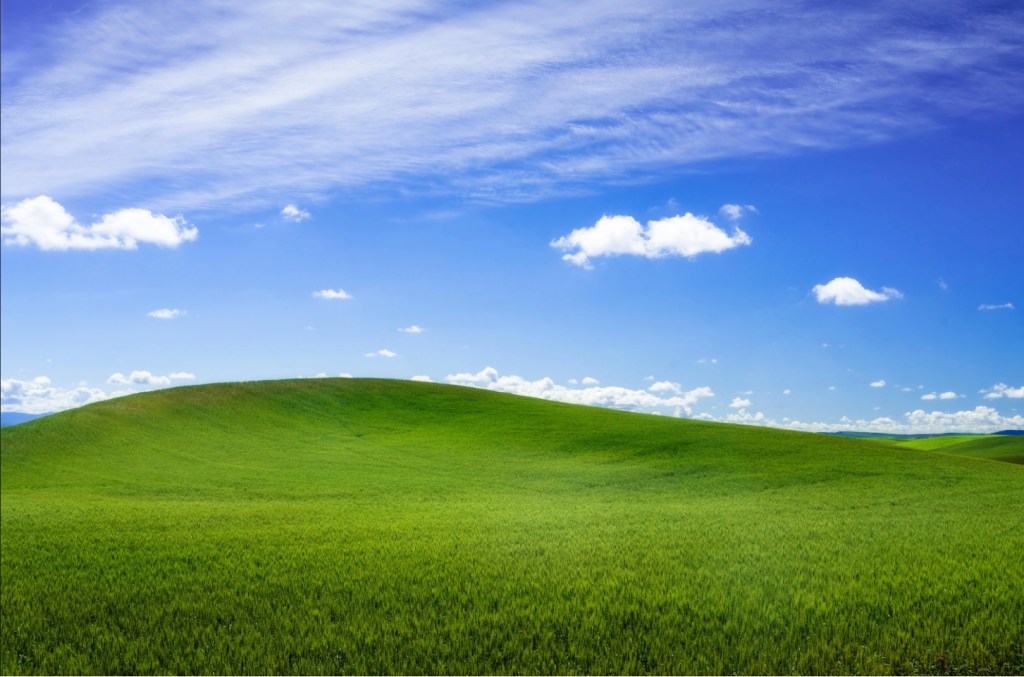
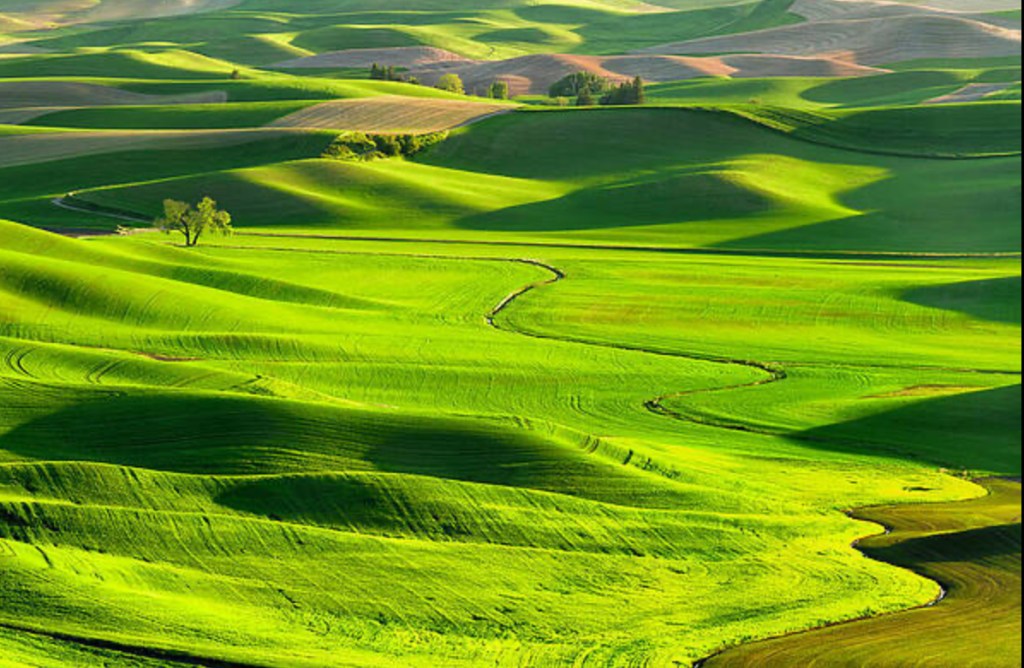
Stepbrother in-law Thom had told me of this place, a land of rolling hills covered in wheat, vivid green this time of year. They were made of loess, a predominantly silt-sized sediment that is formed by the accumulation of wind-blown dust (basically fertile sand dunes) like the Loess Hills on the border of Iowa and South Dakota I encountered on 7/15/21. Centered about 100 miles north of here, it extended as far down as Walla Walla. Some of you may remember it as the Windows XP wallpaper, called Bliss.
Actually, the photo was taken in California, but everybody thinks it was in the Palouse, in the same state as the Microsoft headquarters
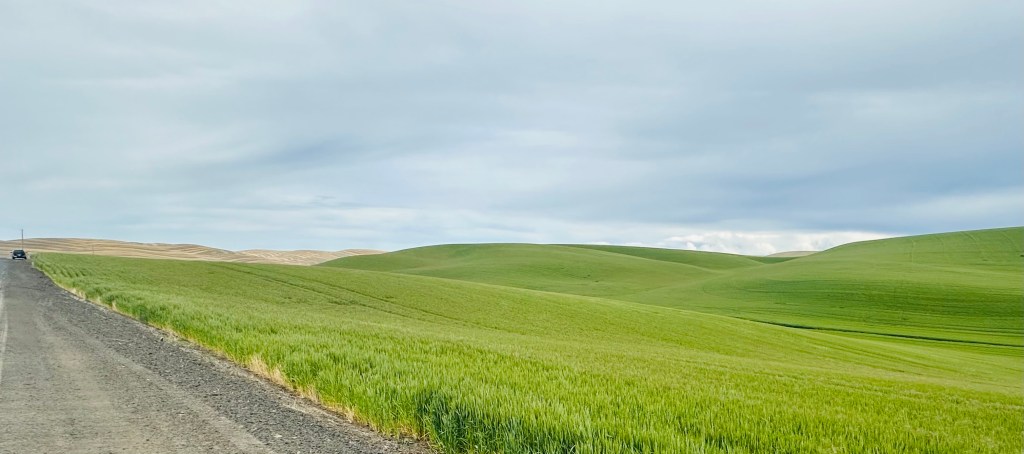
Not remarkable or spectacular, but extremely soothing to look at. On the Middle Waitsburg Road, I found myself surrounded by these hills, and despite the challenging ups and downs, felt eerily at peace.
My photo Professional photo
Dayton, Ohio, home of the Wright brothers. Dayton, Tennessee, site of the 1927 Scopes monkey trial. Dayton, Washington, a tiny town in the Palouse.
Distance 32 miles, 956 total. Time 6 hours with stops. Elevation gain 1,650 feet
Umatilla, Oregon to Walla Walla, Washington Thursday, May 23, 2025.
The day off turned out to be a godsend. A storm was raging outside, I got lots of loose ends taken care of, and had great talks with family and friends.
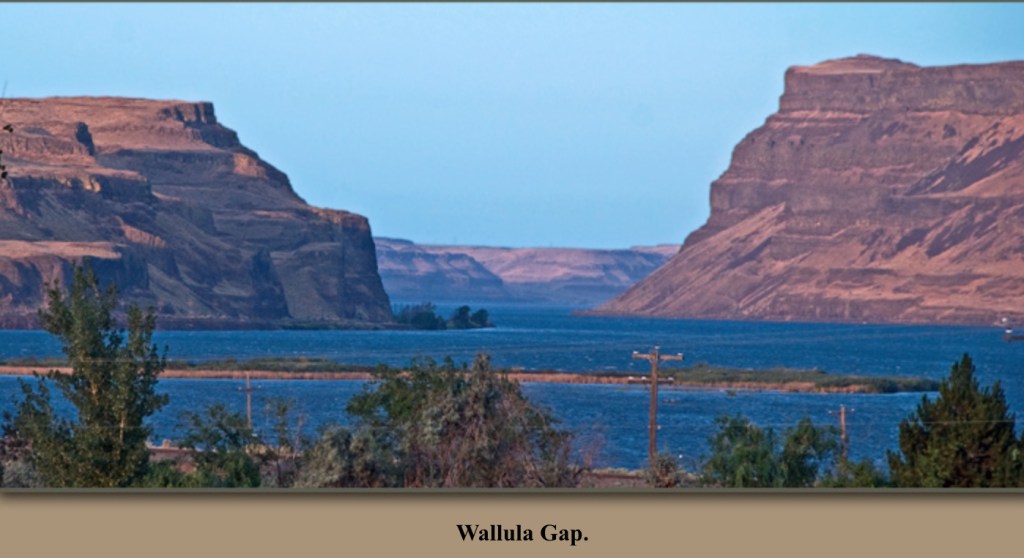
Today’s ride took me through Wallula Gap, an upstream version of the Columbia River Gorge. Dramatic, but the shoulder was narrow, trucks were roaring by, and I didn’t dare take a picture for myself, had to get this one off the web.
This is where the Columbia river turns north, and ceases to become the southern boundary of Washington state. I left Oregon for the last time. Encountered my first three long-distance bicyclists. The first two were an older couple riding from Astoria, Oregon to Plymouth, New Hampshire. They had reserved a string of B&B‘s for the entire trip. They were going faster than me, like everybody does, but it turns out they had e-bikes. I didn’t think that would be practical on a trip like this, they would have to be recharged too often.
The third was David Rapoport, a McGill-educated computer engineer who changed careers and was working at the Alta ski resort in Utah. He was biking from Spokane to the coast, against the wind, but then was heading south to San Francisco. I know from prior experience he’ll have a beautiful tailwind for that stretch.
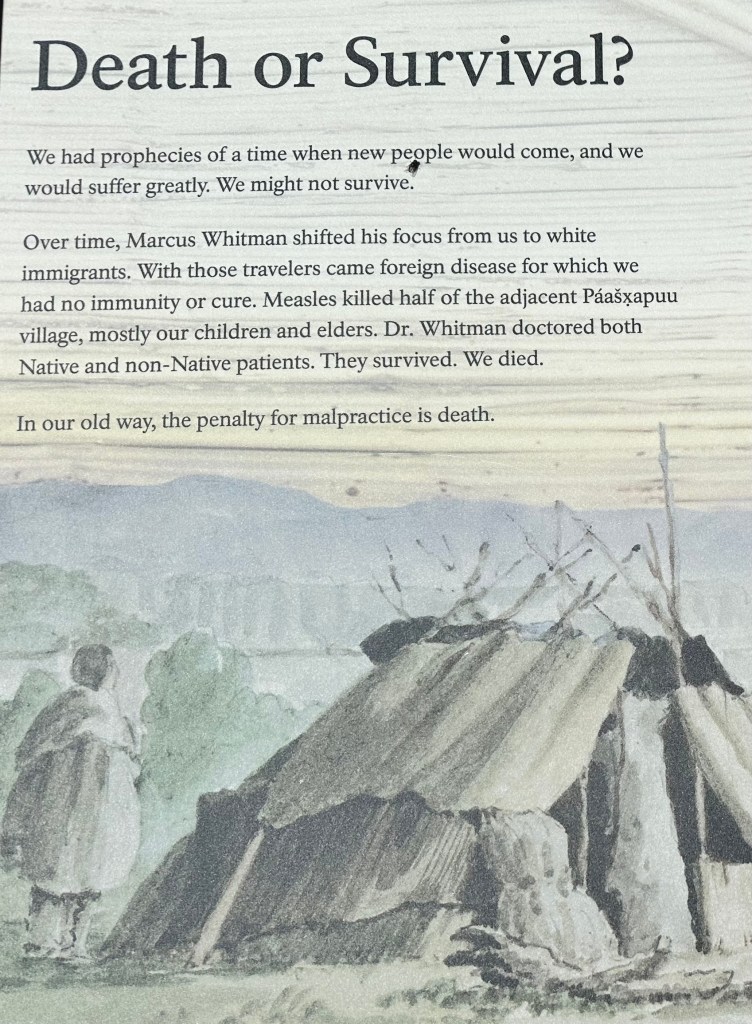
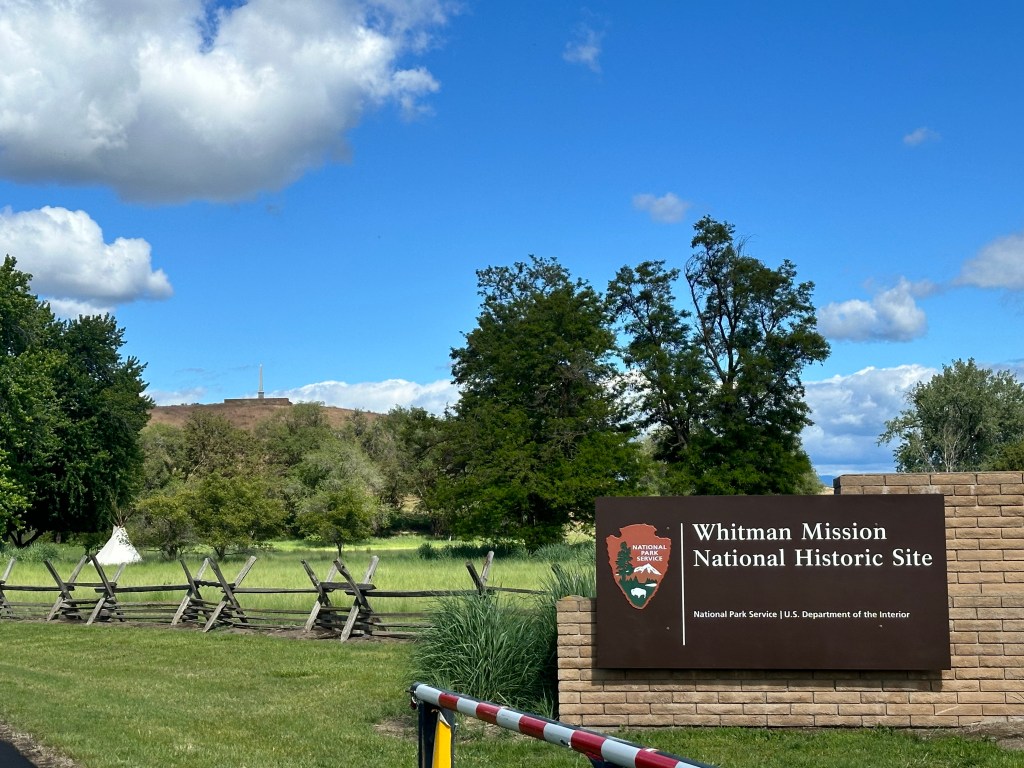
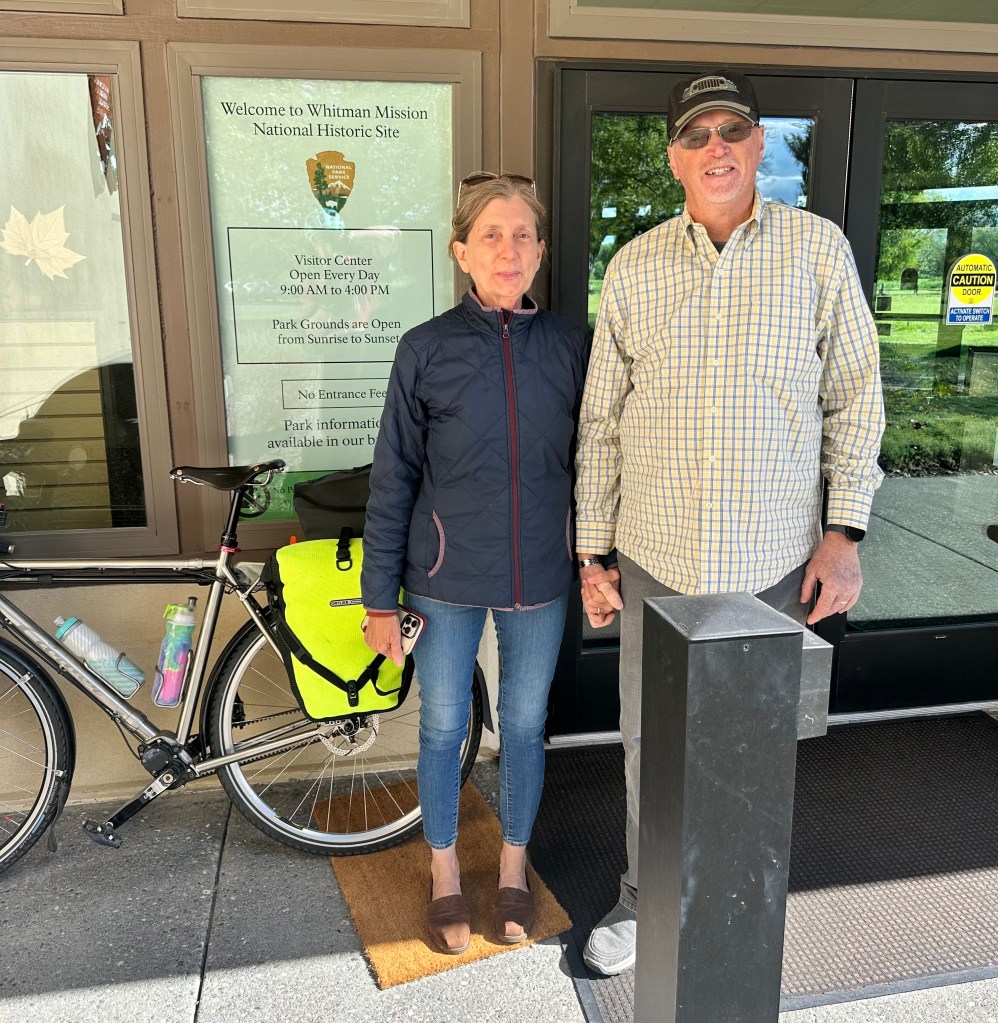
Next up was the Whitman Massacre site, now known as the Tragedy at Waiilatpu. I’d never heard of it, this was one of the first episodes of violence in our westward expansion, and led to the creation of the Oregon Territory. The story was so poignant, the Whitmans were missionaries who were part of the Second Awakening in the early 1800s, driven to convert the Cayuse Nation to Christianity. He was also a doctor. His intentions were good, and relationships with the natives thrived initially, but then things turned sour. The press of further white migration, rumors of atrocities in the east, disputes over land rights set the stage, but what triggered the incident was measles. An outbreak devastated the Cayuse, and they believed the doctor was trying to poison them. In fact he was trying to help them, but their background immunity was weaker, having no prior contact with Caucasian diseases, so their death rate was higher than the whites, and they became resentful.
Yikes. Put a whole new spin on malpractice insurance..
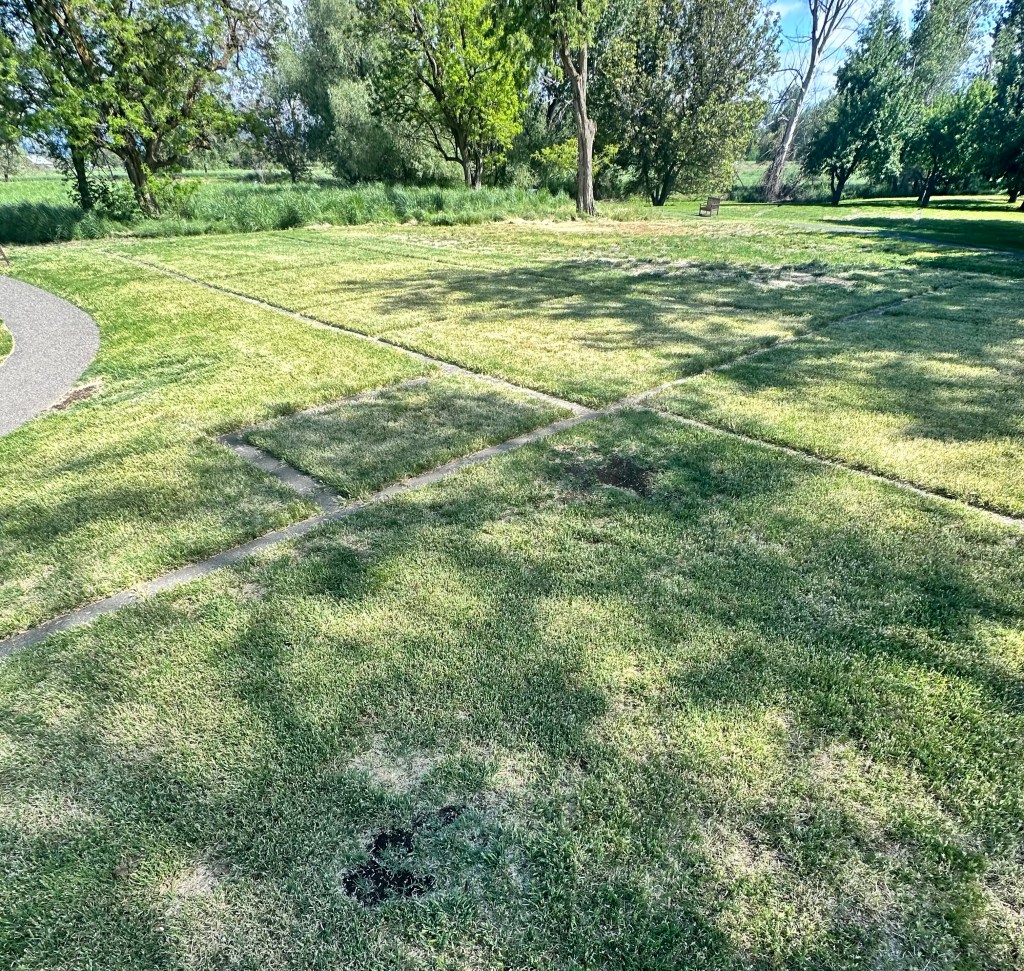
Dr. Whitman was warned of this, but he chose to stay. On November 28, 1847, he along with his wife and 12 others, were brutally murdered. All that remains of his Mission is the outline of the foundation.
If you zoom in, you will see an obelisk on a hill. Nothing happened there, it was erected years later, in the same wave of monument-building that also gave us the confederate statues that triggered the beginning of the Jim Crow era. The perpetrators were hanged. The whole episode was so sad, born of a misunderstanding, but the beginning of a wave of Manifest Destiny atrocities that ended so sadly at Wounded Knee. The Park Service video is quite compelling, and explains that the story was more complicated than that.
A reminder of how devastating measles can be, a disease that should be eradicated by now, but is rearing its ugly head again because of the anti-vaxxers.
Also a reminder of the haunting lyrics from the Eagles’, Paradise, The Last Resort
You can leave it all behind… Just like the missionaries did So many years ago
They even brought a neon sign “Jesus is coming” Brought the white man’s burden down Brought the white man’s reign
Who will provide the grand design? What is yours and what is mine? ‘Cause there is no more new frontier We have got to make it here
We satisfy our endless needs And justify our bloody deeds In the name of Destiny And in the name of God
And you can see them there On Sunday morning Stand up and sing about What it’s like up there
They call it Paradise I don’t know why You call someplace paradise Kiss it goodbye
Yeah.
Had fun chatting with Fred and Madeline, who sent a picture of me riding off.
Walla Walla, Washington. The king of alliterative place names. My stepsister and her husband, Jen and Thom Bolduc, practiced pediatrics there a decade ago, and Thom gave me tips of places to see. Spent a delightful evening with my Warmshowers hosts Laura and David Brannan, their son Samuel, and two adorable pugs. Laura is a general contractor, David a pilot for Alaska Airlines, they remembered that they took their kids to the Bolducs. Small world.
Distance 59 miles, 924 total. Time 9 hours with stops. Elevation gain 1,296 feet
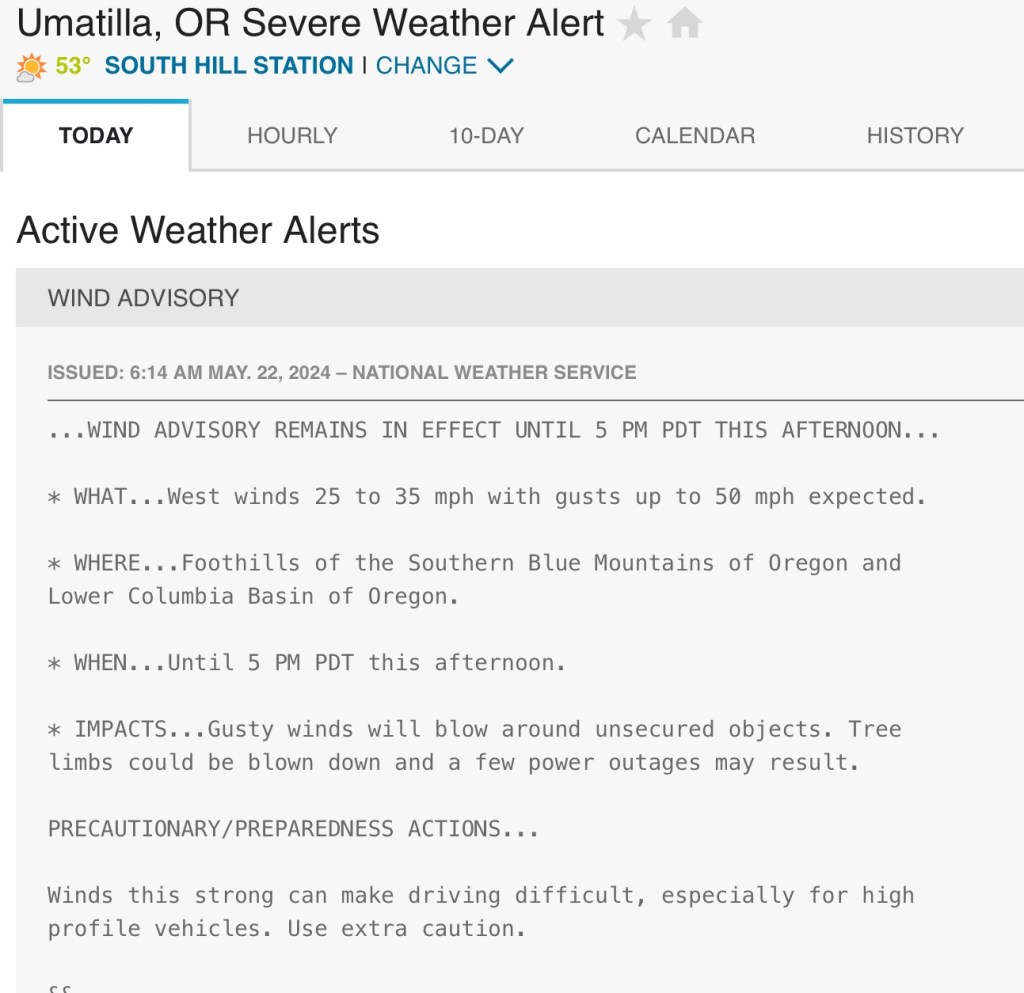
I was all set: laundry done, route planned, Warmshowers host arranged in the next town, Walla Walla; even got a reasonable amount of sleep. My knees seem to be a little better. Got up early, ready to bolt, but then I checked the morning forecast.
On the one hand, it was a tailwind, promising to blow me to Walla Walla in no time. On the other hand, I am the quintessential high-profile vehicle, especially with those large bags over the front wheel, which can get blown around like a sail. Even in yesterday’s moderate tailwind, I would sometimes struggle to maintain control of the bike as I descended at nearly 40 mph, buffeted by gusts. Thunderstorms were also predicted, 50% chance. I couldn’t get that scene from Wizard of Oz out of my head. https://images.app.goo.gl/yGVo2wgHm8faGzUZ7
But right at the point of decision, the sky looked clear. I asked the receptionist if I could possibly stay another day, and before I could stop him, he had booked me. So the decision is made.
It was a classic example of cognitive dissonance. After the fact, I decided it was for the best. My knee is better, but not perfect. I haven’t had a “day off” since I started a month ago, if you don’t count that transition day when I was licking my wounds.
So once again I’m quoting Bob Dylan (perhaps I’m entitled, having gotten a private tour of his boyhood home, see post of 6/9/21). Stuck inside of Umatilla with those Walla Walla blues again. Maybe there’s something interesting about the town, but the Wikipedia page was less than encouraging:
“The population in 2010 was 6,906, but the city’s population includes approximately 2,000 inmates incarcerated at Two Rivers Correctional Institution. Umatilla has the highest poverty rate (24%) and lowest Median Household Income ($38,796), of all communities in the area.”
Besides, it’s 2 1/2 miles away, right into the teeth of that headwind. Ain’t gonna happen. Down that steep hill I came up yesterday is the McNary Dam, which appears to have some kind of a fish ladder exhibit. The Oregon Fish View Room it’s called, and reviews say that sometimes you see fish, often not. Hmm.
There’s a decent greasy spoon just down the street, I had their chili-and-cornbread special last night and they’re famous for their Awesome Burgers. Maybe without the bun. There’s a pool outside, but it’s 52°. I can see the thunderheads building on the horizon.
Or maybe just hole up here in my ironically-named Quality Inn. My Apple Watch tells me I’ve only averaged five hours of sleep per night, I could try to catch up. Maybe try to plan the route more than one day in advance, line up some Warmshowers hosts without last-minute notice. Call the family (had an hour long conversation with number one son Andrew yesterday, while the wind was blowing me along). Maybe do one or two of those background posts I’ve been meaning to get to for weeks. Maybe try one of those NYT crosswords (gasp). Or maybe just do a whole lot of nothing.
The trains keep rolling by, on both sides of the river, blowing their mournful whistles. Yeah, I’m stuck in Two Rivers Prison, but better off than the Man in Black.
When I was just a baby, my mama told me, “Son Always be a good boy, don’t ever play with guns” But I shot a man in Reno just to watch him die When I hear that whistle blowin’, I hang my head and cry
No statistics for today, unless you call count walking back and forth to the greasy spoon.
Roosevelt, Washington to Umatilla, Oregon Tuesday, May 21, 2024
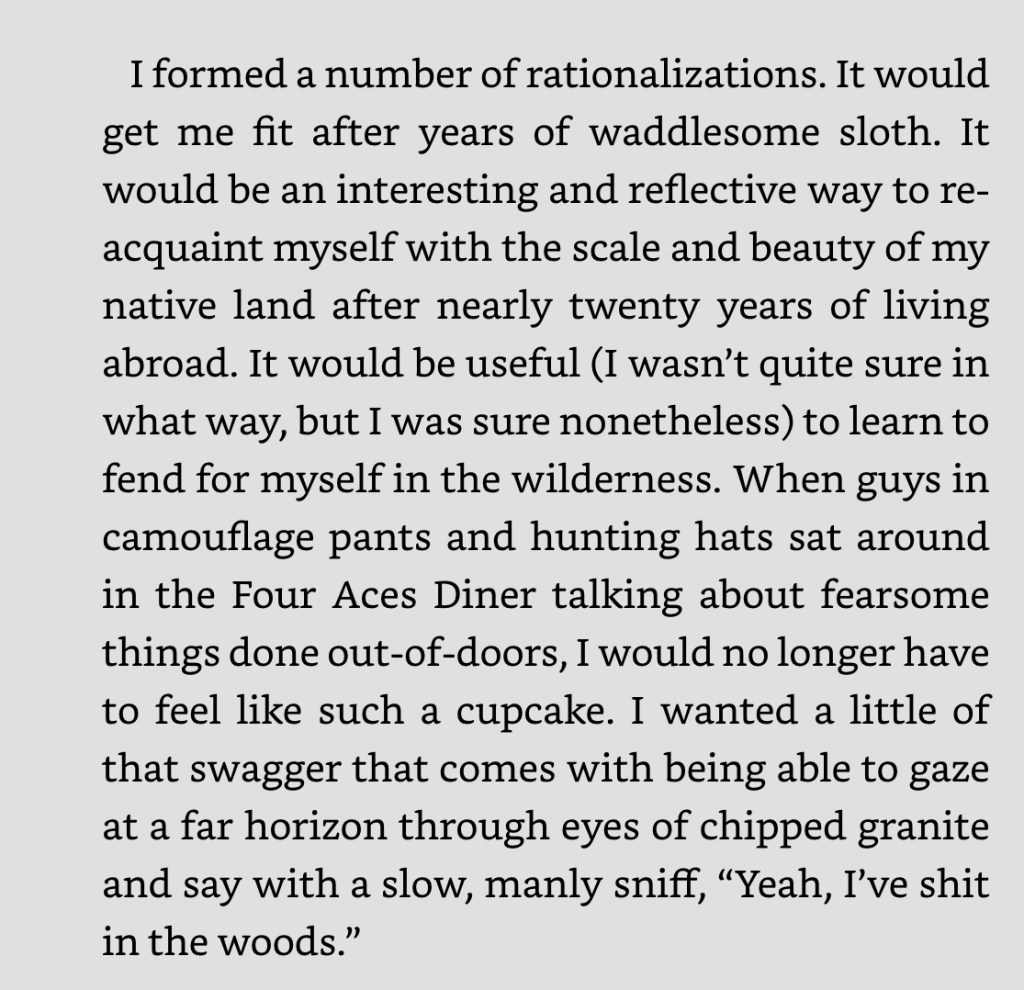
Today was the end of the century, the century I thought I could do yesterday, until reality told me otherwise. I was comfortable enough in that new tent, but there were trains going by all night on both sides of the river, mitigated somewhat by the custom-fitted earplugs I got for the Camino. I braved the 48° temperature to take a shower in that sketchy bathroom, went back to that same general store (the only one in 100 miles) for breakfast, an immediately had a flashback to a favorite passage from Bill Bryson’s A Walk in the Woods, where he explains his sudden impulse to hike the Appalachian Trail:
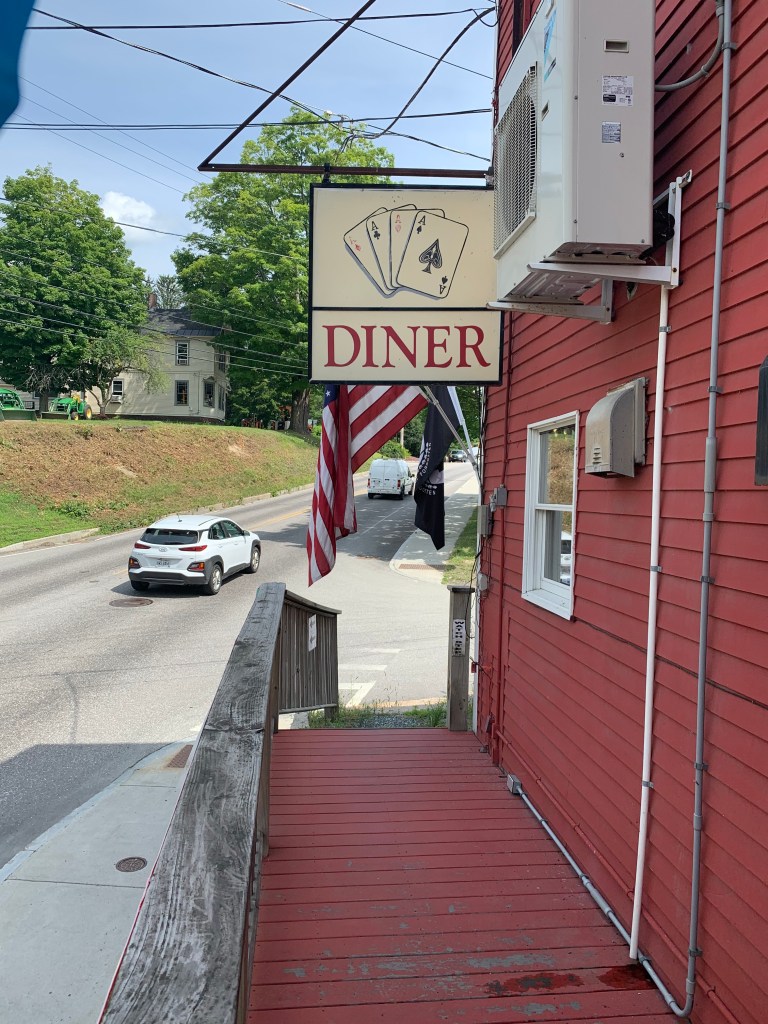
Four years ago, on my bike ride to the ocean to start my climb of Mt. Washington, I passed this sign in Lebanon, New Hampshire
and thought OMG, that’s the Four Aces Diner! Alas, there were no such characters inside then, but there were there this morning, right out of central casting, sitting around drinking coffee and mercilessly teasing the weird guy in Lycra with the titanium bike. I wish I’d taped the banter, it was priceless. The line I remember was, you’ll have wind up your ass all the way to Idaho.
I presumed he meant tailwinds, magic words to any cyclist. And sure enough, I had a good stiff breeze pushing me the 53 miles to Umatilla. The hills had moderated, the pavement was smooth and sparsely trafficked, my bravado came back and I thought, yeah, I could have done this last night. I’ve got a good headlight. I could’ve done that century.
It never fails. You get cocky, reality kicks in. The mouse in my left knee started squeaking.
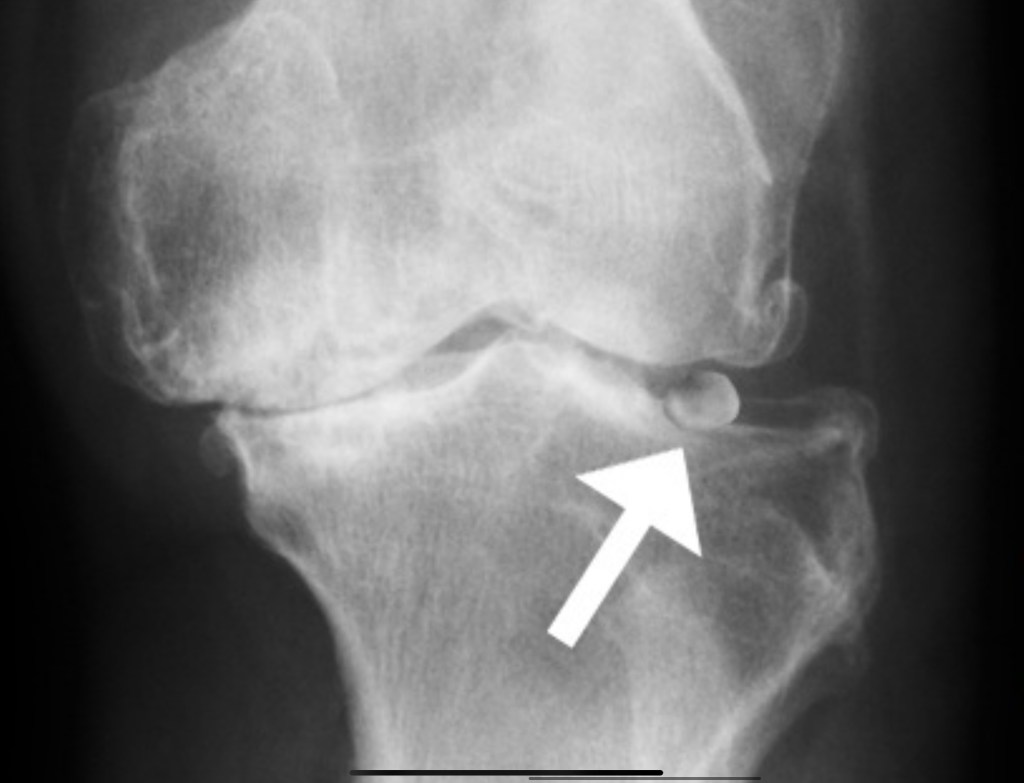
A joint mouse (corpus liberum) is a loose piece of cartilage or bone tissue that floats freely through the joint, most commonly the knee.
I’ve had one for years, normally giving me no trouble. But every once in a while, it will float into the articular surfaces of the knee, like a burr in the gears, and produce sharp pain. Then, after a few more steps, it floats out of the way and everything is fine.
Lately it’s been serving as a wakeup call, a warning when I’m overdoing it. Last fall, on our campervan tour of New Zealand, we were racing to catch a ferry on one of the world’s premier trails, the Milford Track, and the knee started acting up. I (and Jane) could hear a pop with every step. We made the ferry but the pain persisted, this time for months. The Mouse That Roared. An orthopedist said yeah, you’ve got osteoarthritis, like everyone else your age. Our good friend and crack physical therapist Lesli Bell gave me exercises but the pain abruptly stopped and I never did them. Doctors make the worst patients.
The last mile to my motel was comically steep, it had started raining, and I was limping. My body was telling me, Dude, there’s no way you could have fined that siècle.
You think I’ll listen?
Distance 53 miles, 865 total. Time 5 hours with stops. Elevation gain 1,341 feet
The Dalles, Oregon to Roosevelt, Washington. Monday, May 20, 2024
Figuring I might have to do a century today, I tried to get an early start, but early starts are not my strong suit. As always, crossing the Columbia was both scenic and harrowing, made more so by a strong crosswind. I passed right in front of The Dalles dam, but barely got a chance to look at it; it appeared to have a pretty dramatic spillway.
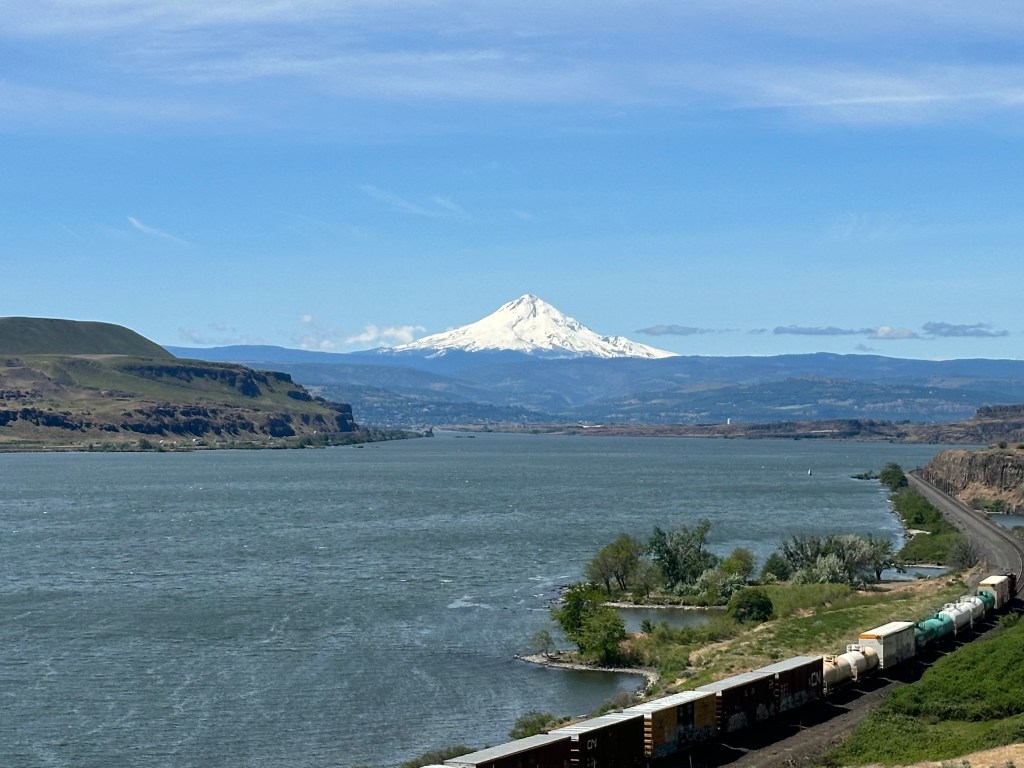
Once I rounded the bend I had a full-on tailwind, and life was sweet. My average speed increased from my usual 8 to 13 mph, despite over 3,000 feet of hills. It was almost like I was riding an e-bike. I looked over my shoulder to catch one last taunting sneer from Mt. Hood.
I’ll see YOU later, sucka
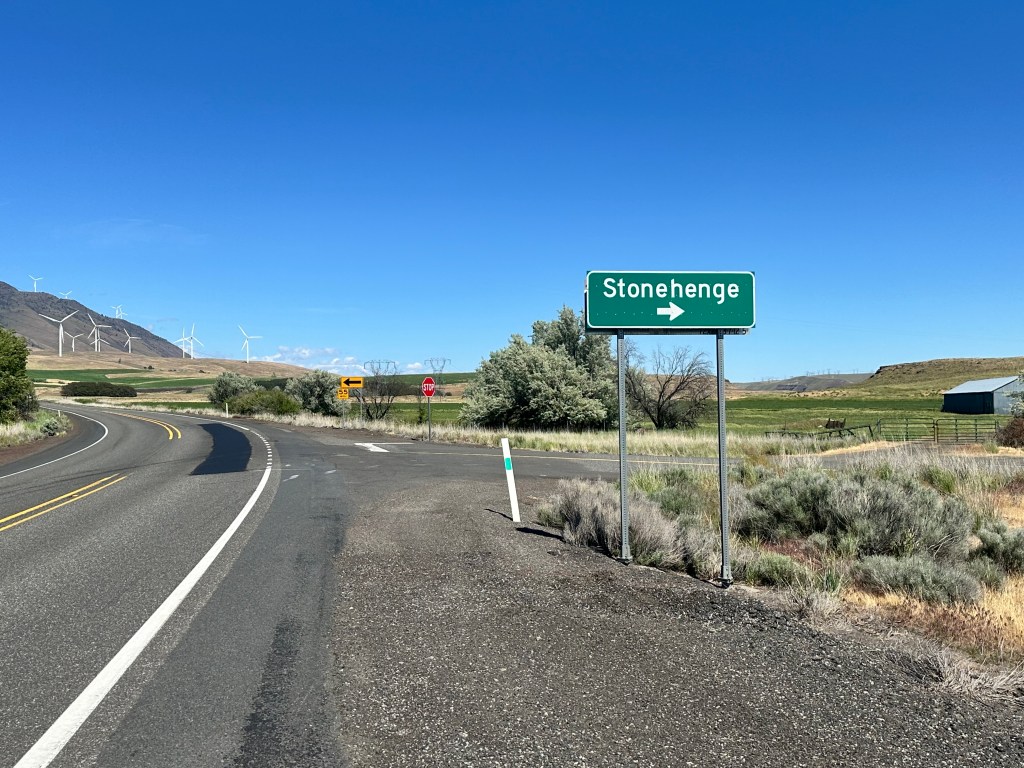
A few miles later, I was brought up short by an unexpected sign.
Huh?
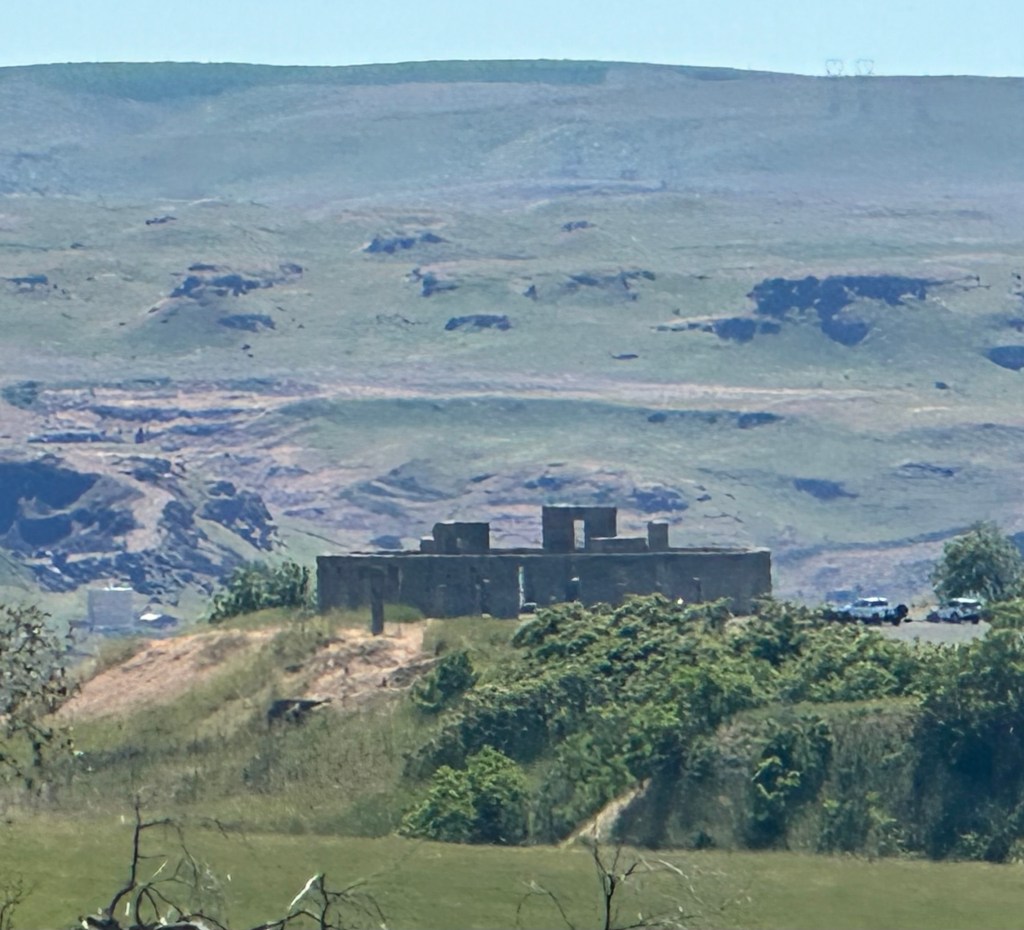
It was a replica, of course, constructed as a World War I memorial. Visiting it would’ve meant a 4 mile detour, so I had to settle for a telephoto shot.
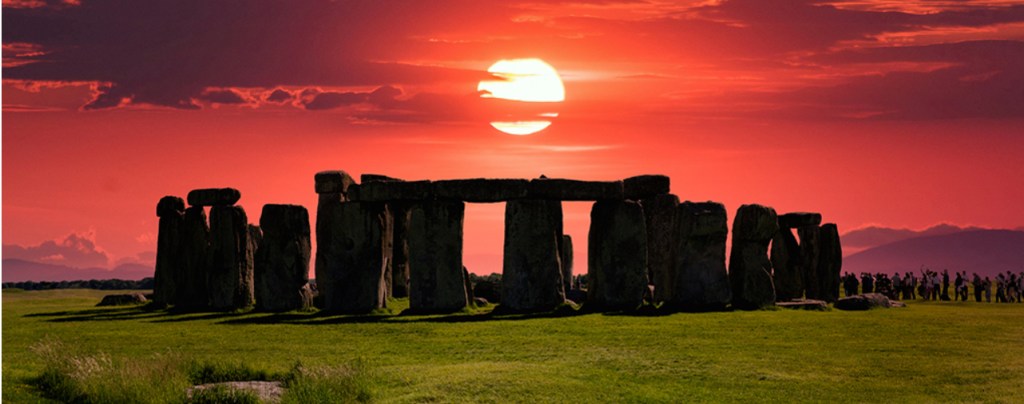
but it triggered a whirl of reflection and rumination. I’ve never seen the original in Salisbury, England, hear it’s overrun with tourists and so fragile that you can’t get close to it. But what a thing. Constructed over 3000 years ago by Druids that left no written language, it appears to have been a sophisticated astronomical observatory. Most famous is the Heelstone, that marks the summer solstice sunrise, but accessory features apparently also could predict solar eclipses. Amazing. Here’s one of the better web photos I could find.
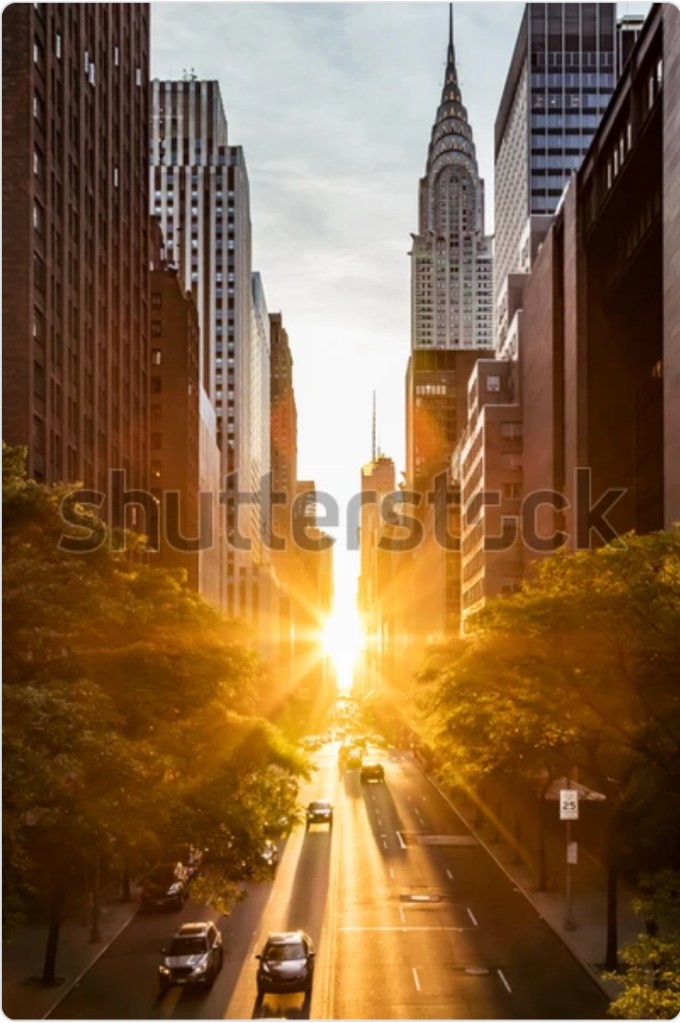
What’s also fascinating is how the concept of solar alignment has fostered many tributes. Perhaps you’ve heard of Manhattanhenge, where the sun lines up perfectly with the cross streets of Manhattan.
I had to glom this photo from Stutterstock
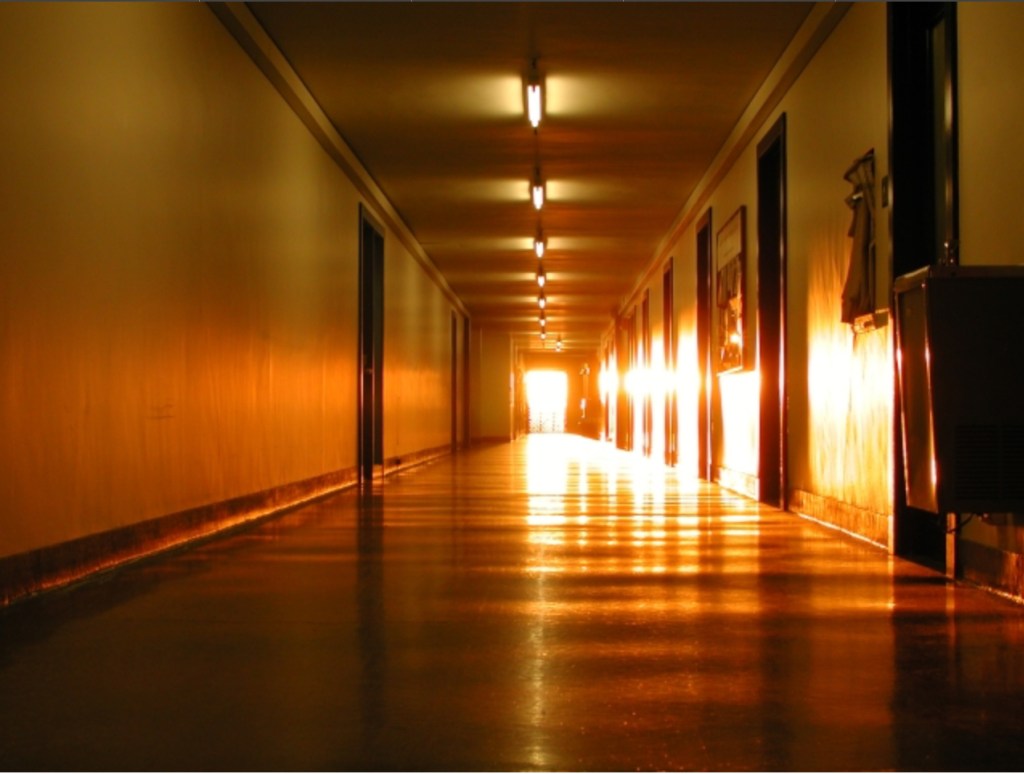
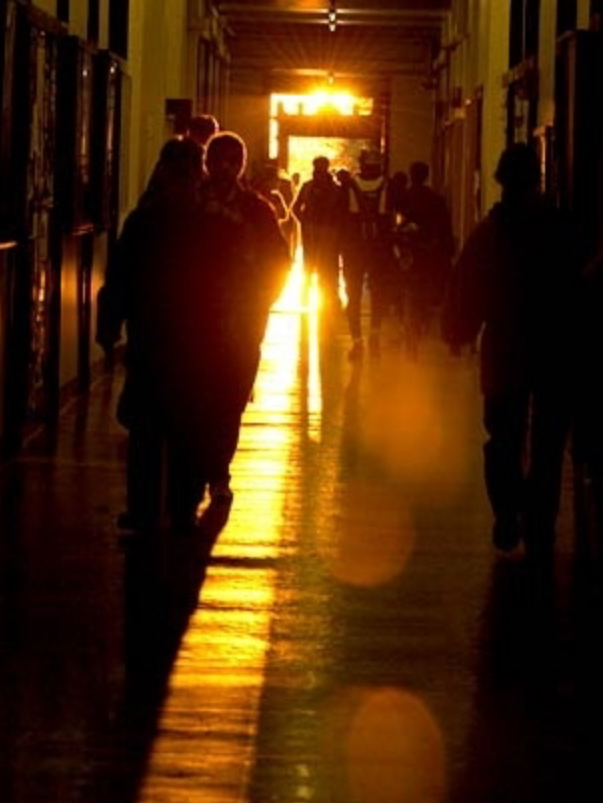
From college I remember MIThenge, where twice a year the sun illuminates the iconic Infinite Corridor, central axis of the university, three football fields long.
And in true solipsistic fashion I have Luriahenge, where on March 5 the sun sets precisely over Mt. Whiteface (site of the 1932 and 1980 Lake Placid Olympics) as seen from our bedroom window.
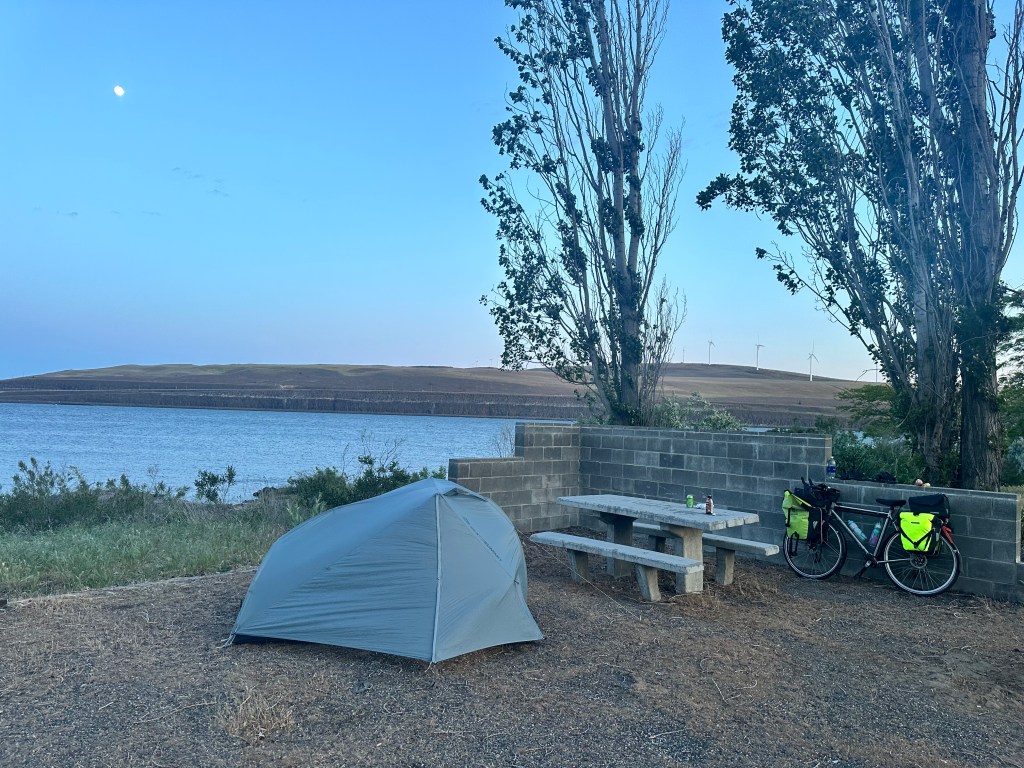
I would like to say I rode a century today, but at the town of Roosevelt, 60 miles in, I realized I was running out of daylight. There was a general store, the only one in 100 miles, whose proprietor told me that there was a campground down the road that didn’t appear on any of my maps. It was deserted and a little creepy, but had a semi-functioning bathroom, and the price was right. I was gratified to be able to set up my brand new two-person tent in the relentless wind. If you ignored the abandoned cars and trailers nearby, it was actually pretty scenic, right on the Columbia with a nice moonrise.
Distance 61 miles, 812 total. Time 9 hours with stops. Elevation gain 3,079 feet
Hood River to The Dalles, Oregon. Sunday, May 19, 2024
I’ve always wondered about this town, with the odd name. It’s unusual to have the article “the” in a town name, I can only think of The Hague and The Bronx. Countries like the Ukraine and the Bahamas have dropped the article, once they became independent states. Anyway, it’s the largest settlement on the Columbia east of Portland.
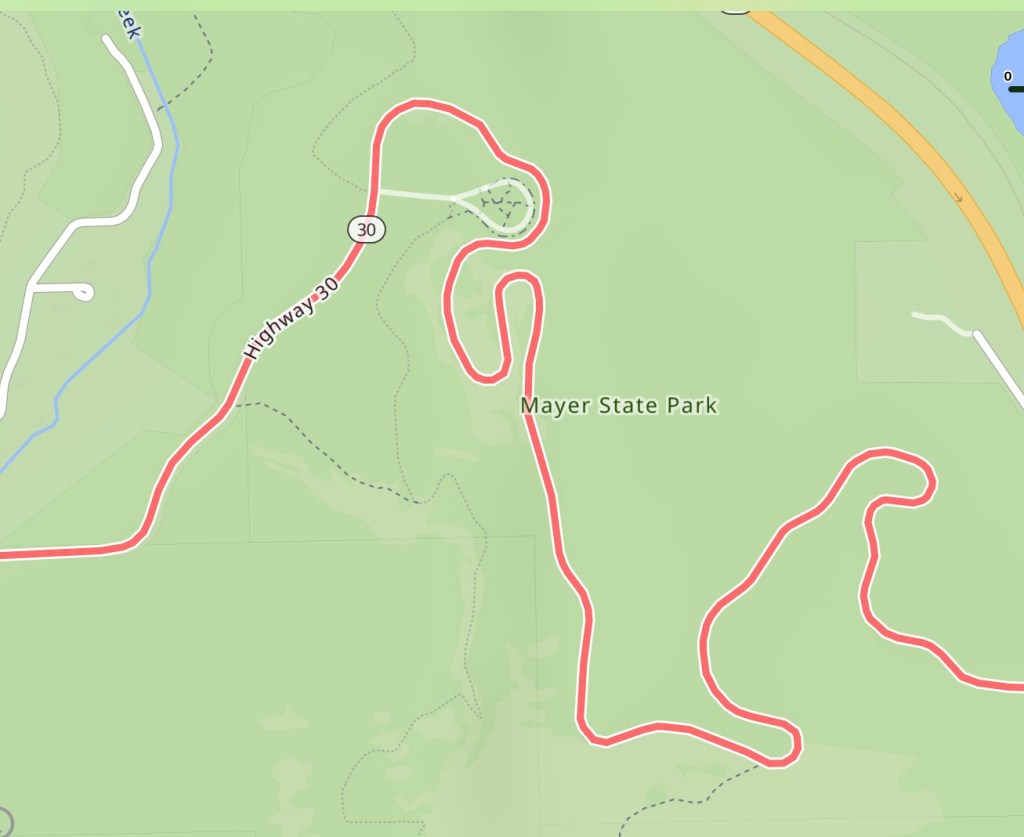
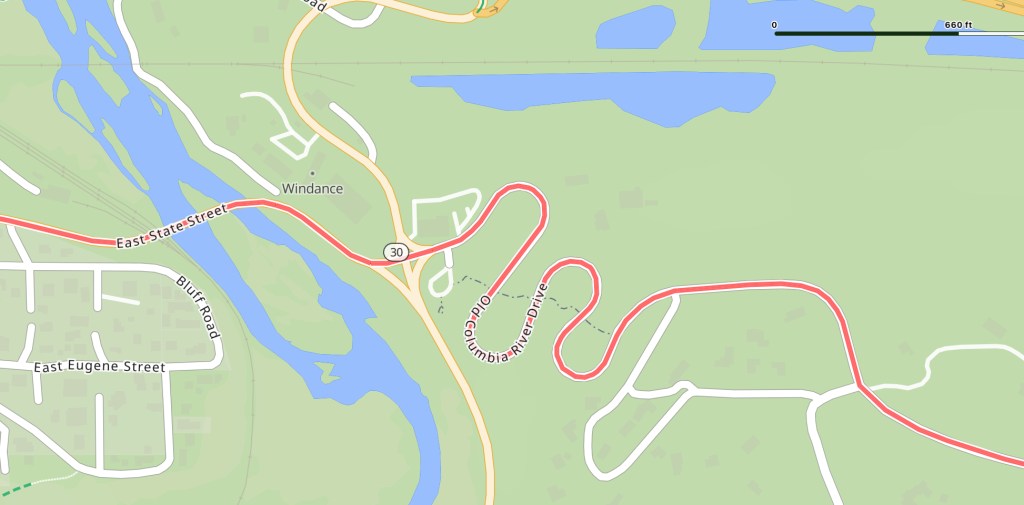
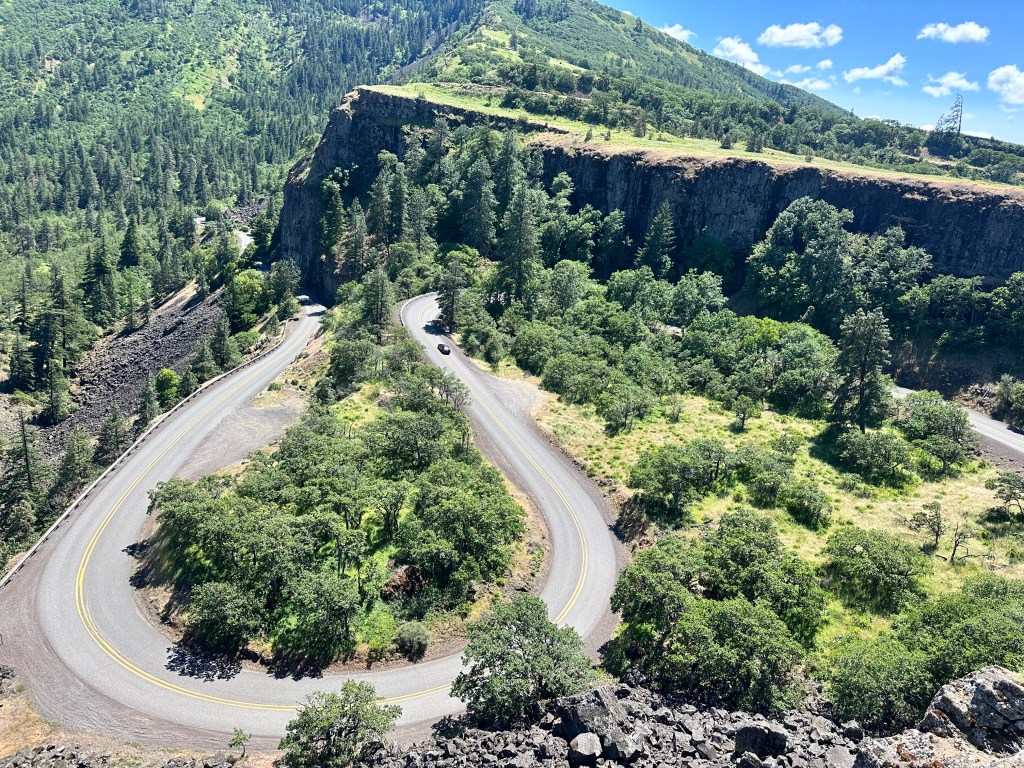
It also marks the end of the Columbia River Gorge, and boy what a finish. The serpentine Historic Columbia Highway bike path outdid itself, as the screenshots of my route will testify.
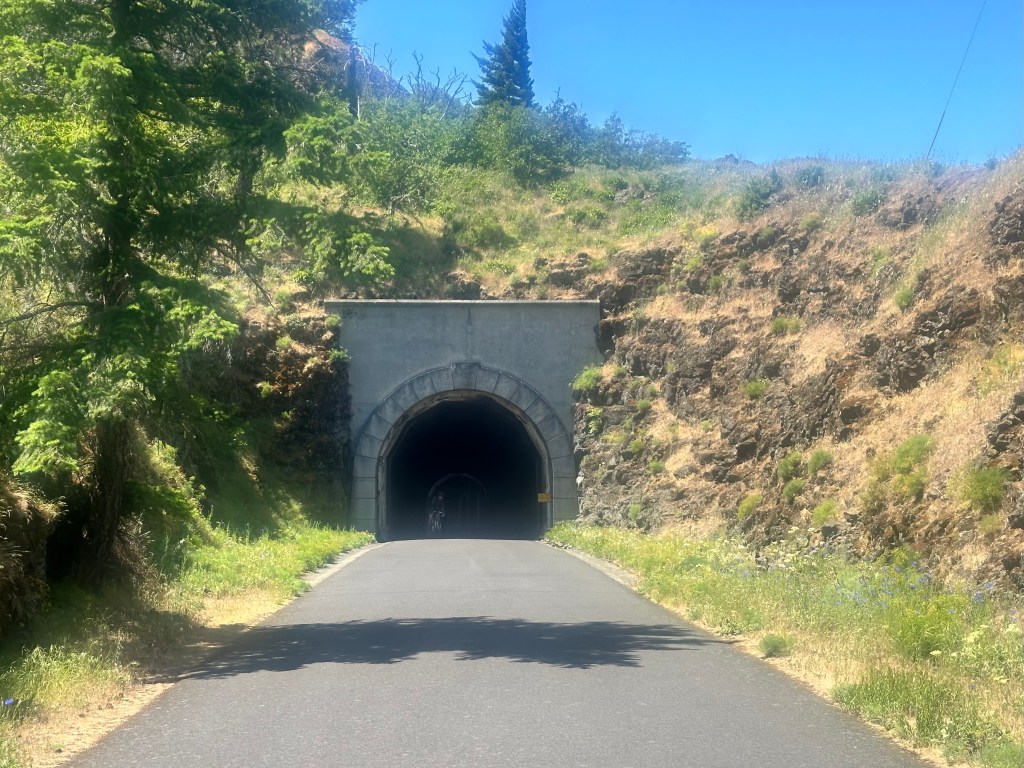
Each of these twists and turns represented switchbacks up or down, but they were always well graded and never too steep, one bend even went through a dramatic tunnel.
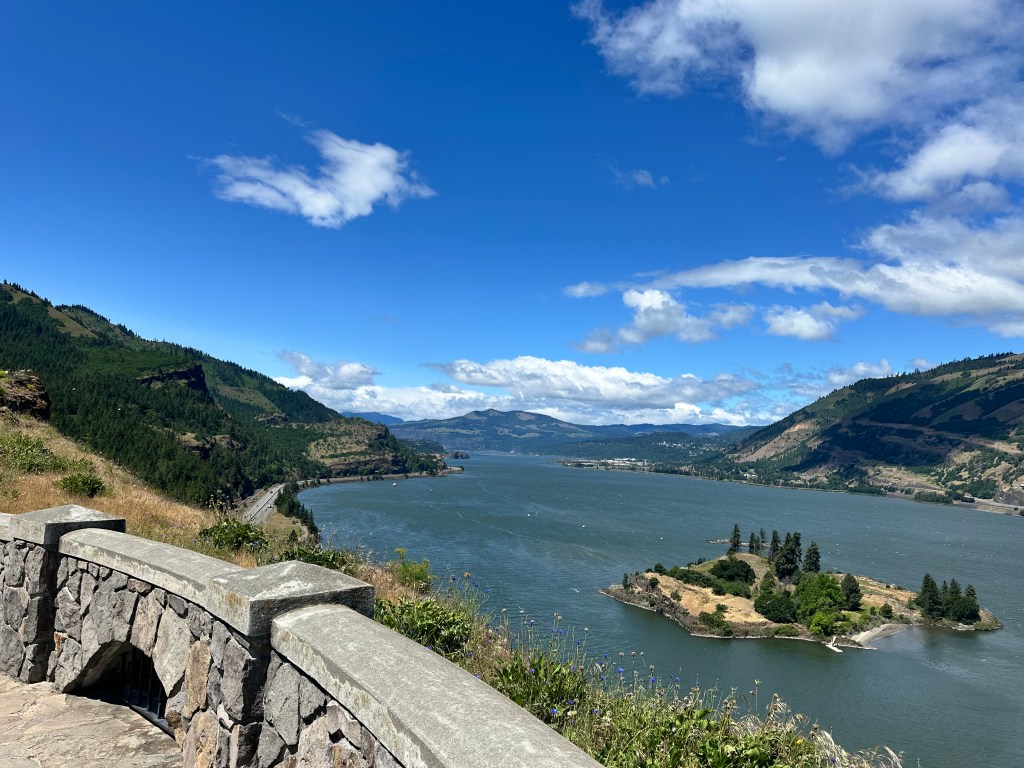
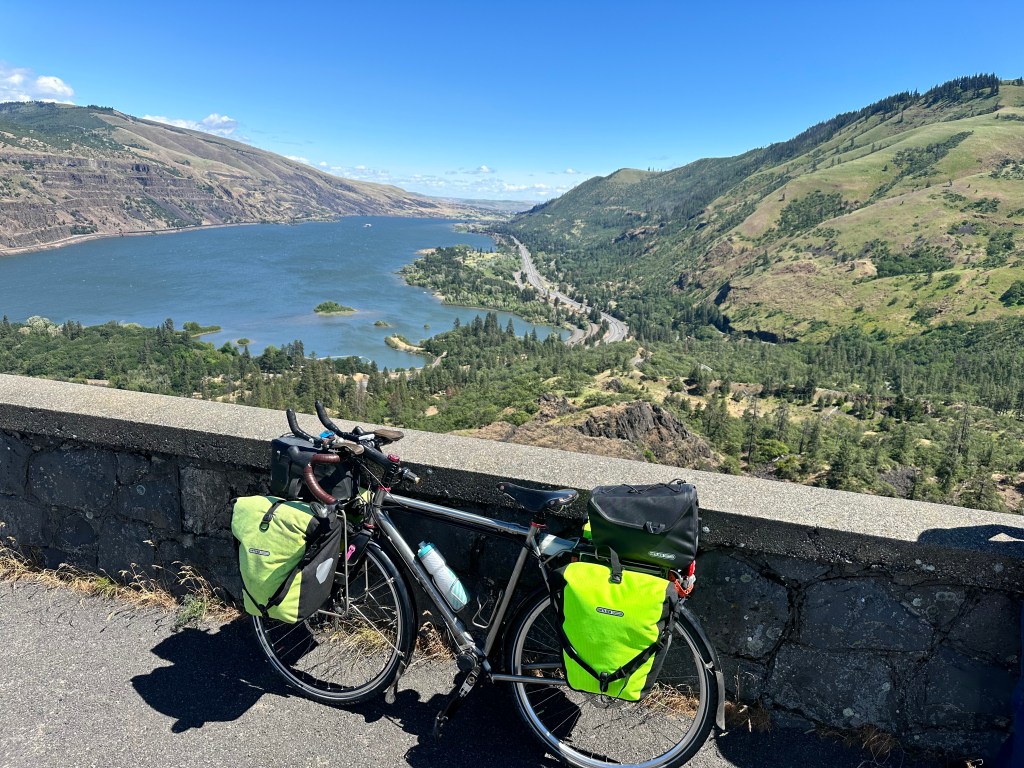
And of course, they led me to spectacular views.
Check out those twists and turns
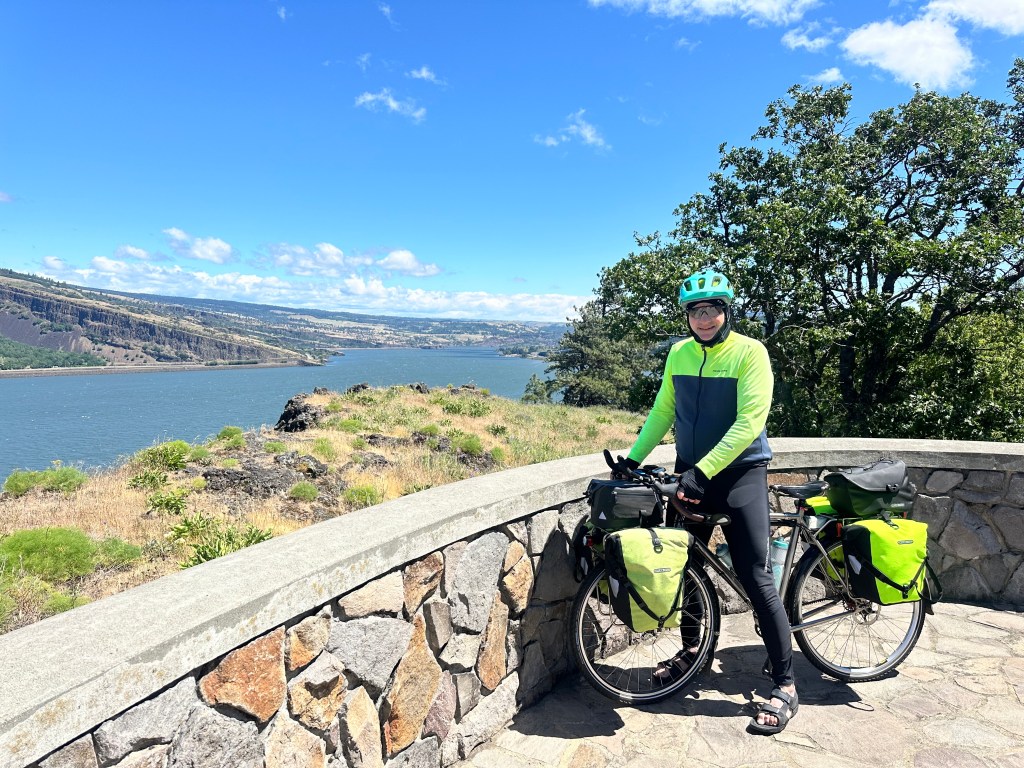
If you look closely at this last picture, you will see that one of my water bottles is missing. Sure enough, I accidentally knocked it over a 200 foot cliff. Reminiscent of that scene in Wild, where Cheryl Strayed/Reese Witherspoon hurls her too-small boots over a cliff in frustration (I stifled the primal scream).
It dawned on me that I was a litterbug. And here, in one of the greenest states in the nation. Looking up trivia about the movie, I found the producers were accused of littering also. Later, a hiker found those boots and they’re now enshrined in a bar in Seattle, autographed by Reese herself.
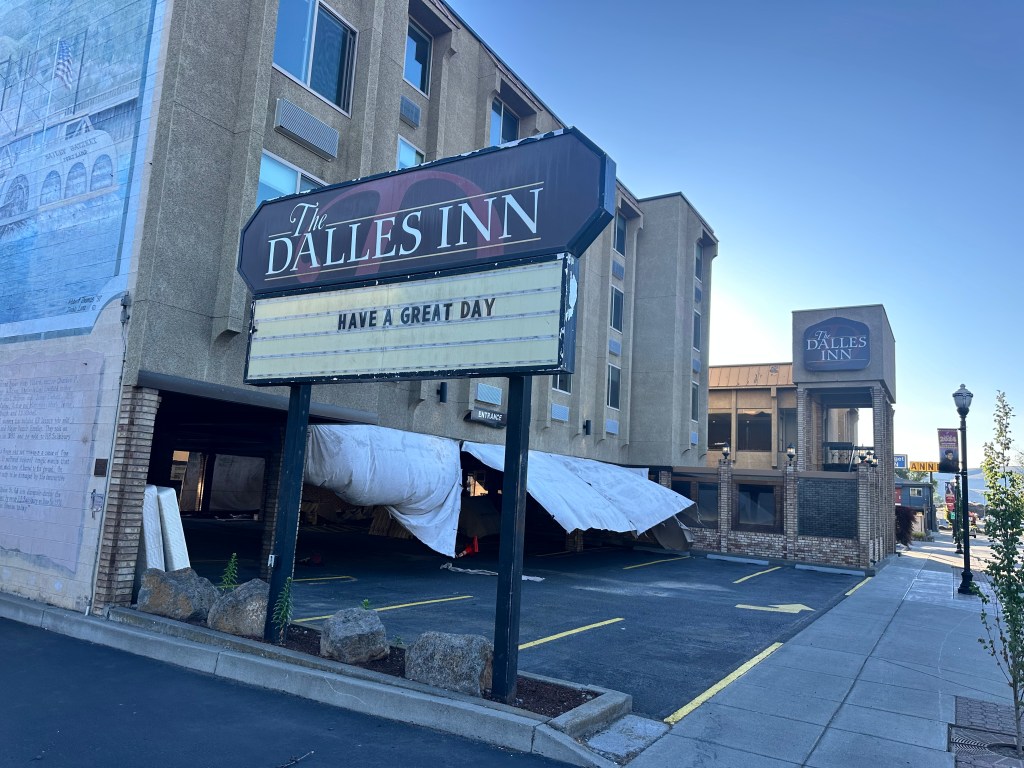
My trepidations about booking that fleabag hotel were not helped by my first view of it
My God, what have I done?
But that was just the backside, they were also undergoing renovations. The front side was better and the room was actually fine, and 1/4 the price of that Holiday Inn Express.
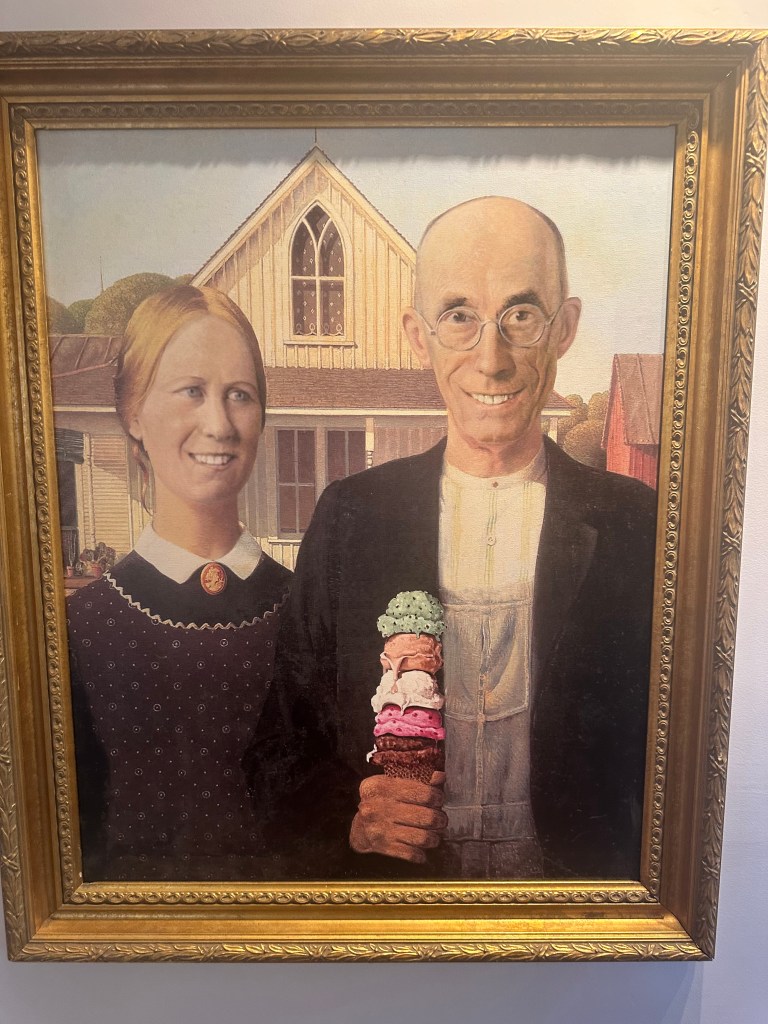
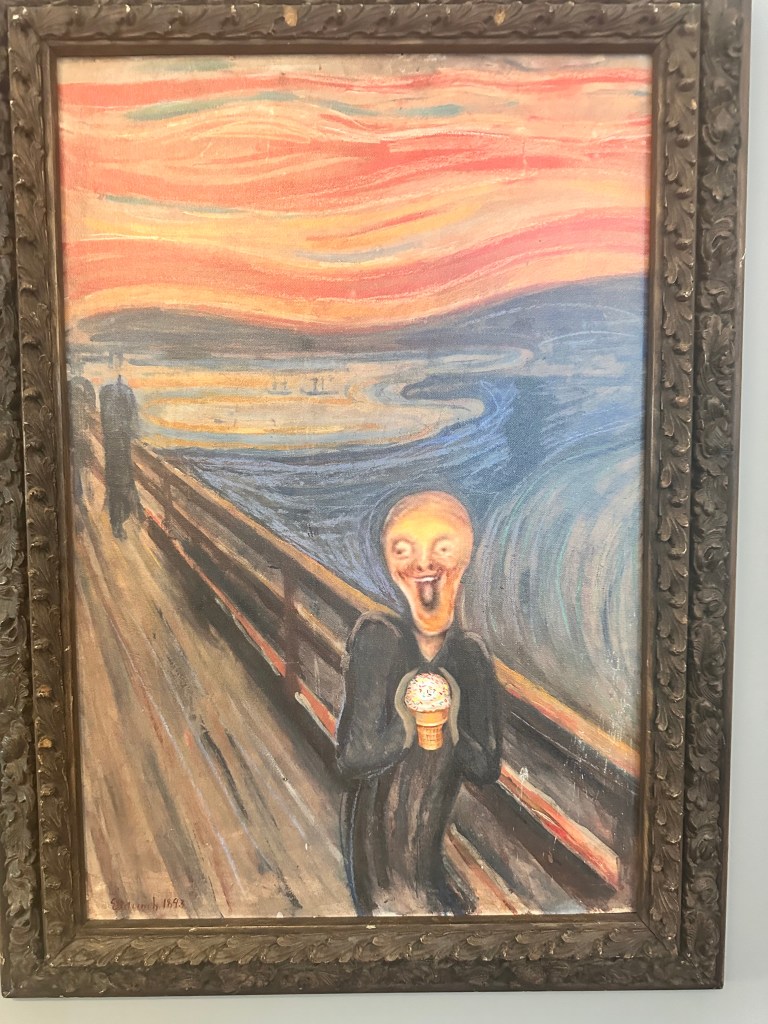
Patti Elliot, the Warmshowers host who offered me her home a few minutes after I’d booked that fleabag met me for dinner anyway, at a nice Indian restaurant, and we shared our biking and family experiences. We got homemade ice cream at Shannon’s, and smiled at the whimsical paintings on the wall.
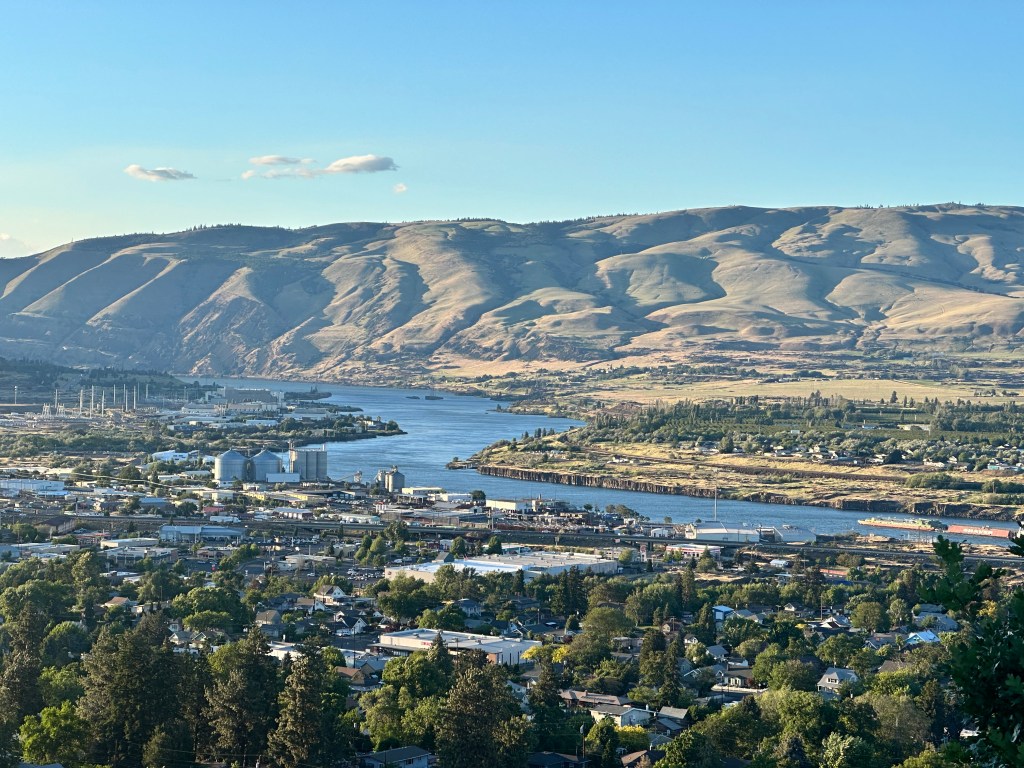
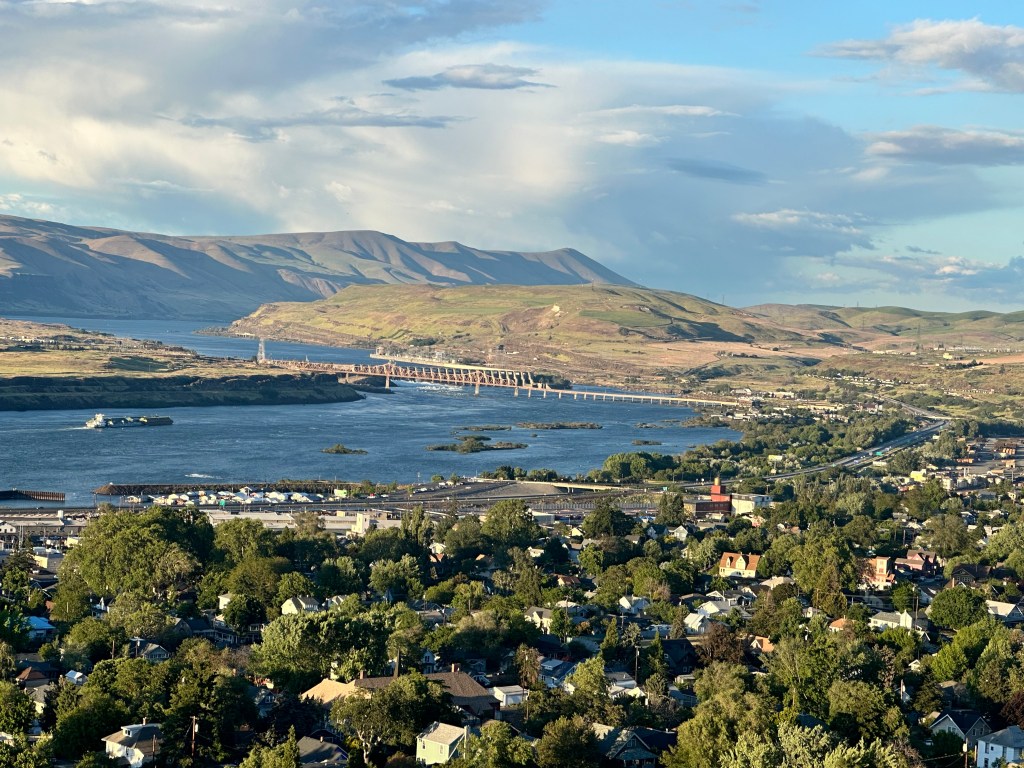
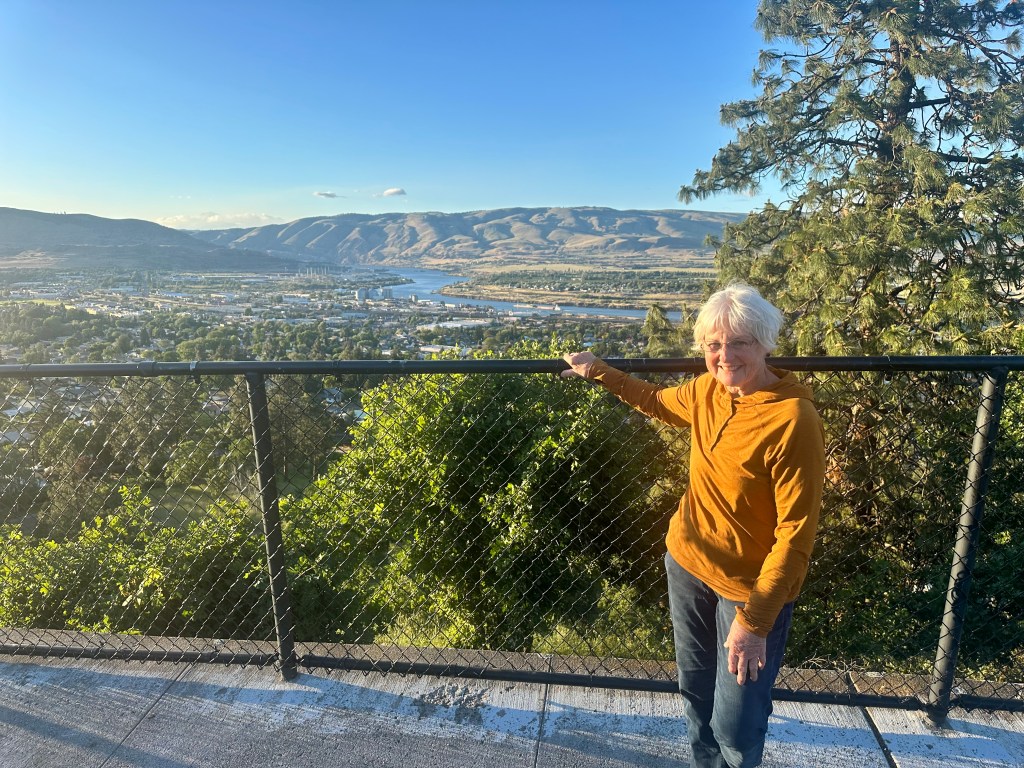
Patti capped off the evening by driving me up to a viewpoint above the city, for perspective of where the Columbia Gorge gives out into the Klickitat hills.
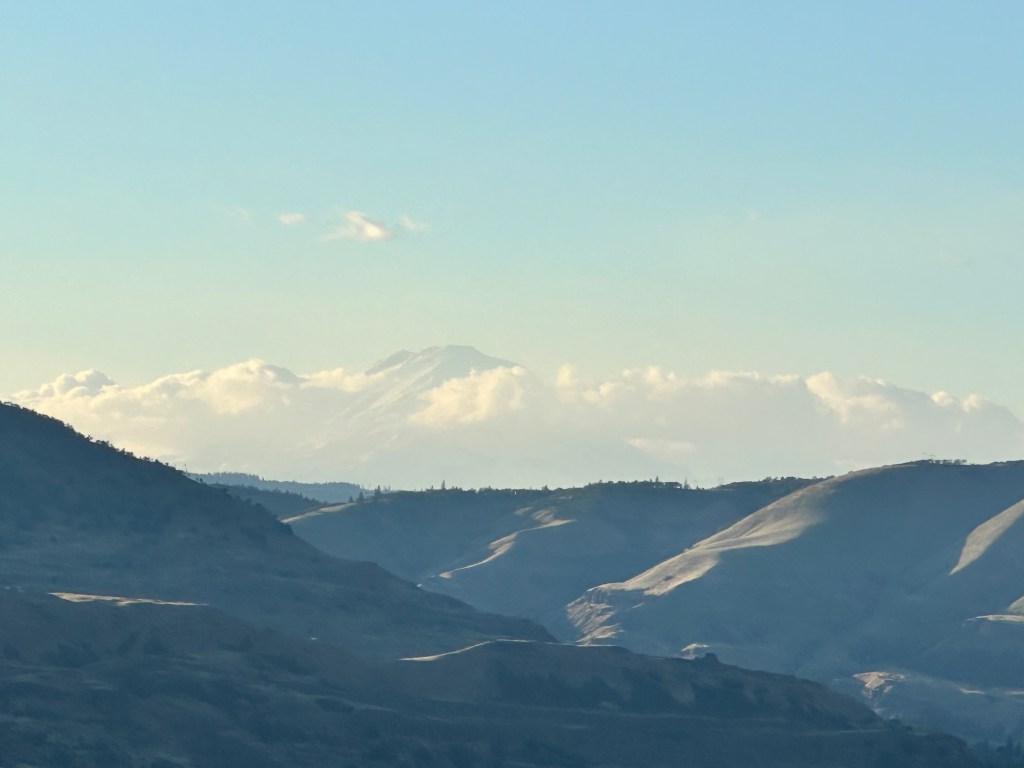
Many of those buildings on the waterfront are operated by Google The bridge I’ll be crossing tomorrow, back into Washington, and one of the Columbia River barges That’s Mount Adams, second highest of the Cascades, peeking through the clouds Patti, my delightful dinner companion
Followers of this blog will think I’m a broken record, talking incessantly of the kindness of strangers. Patti gave me lots of route advice, and warned me that the next stretch of this bike route was an “accommodations desert” with no Warmshowers hosts, motels, or even campgrounds for over 100 miles. Well, I’ve been pretty self-indulgent these last few days, still licking my wounds, reveling in the spectacular scenery, but only doing meager mileage. Now it’s time to step up. At least there should be a tailwind. Time to stop blogging and get to sleep.
Distance 29 miles, 751 total. Time 4 hours with stops. Elevation gain 1,672 feet
Cascade Locks to Hood River Oregon Saturday, May 18, 2024
You’d think after all my touring, I’d be an old pro at booking accommodations. Today’s experience showed how much I still have to learn.
Last night’s stay was in an unprepossessing place with reasonable rates. I was taken aback by the outside decor, they said they were undergoing renovations.
Ah yes, the toilet in the shower. Always a classy touch.
But you know what? It was fine. Comfortable, quiet, inexpensive, personable staff, no bedbugs.
I knew today’s destination, Hood River, was popular with tourists and that it was Saturday night. I sent requests to five Warmshowers hosts the day before, but none answered. Still going down to the low 40s at night, I’m still balking at camping. So I had to find a motel last minute, and was a victim of surge pricing. A nice Holiday Inn Express, but more than three times the cost of the night before.
My good friend and earlier host Annie Krumboltz always likes staying at Holiday Inn Express, and we joked about an old ad they ran claiming that staying there makes you smarter. I didn’t feel so smart this time. https://youtu.be/eHCTaUFXpP8?si=MKPLrz8GAwrjBBWj
Another smart move. Today’s ride was beautiful, but I only got this one picture, after two of that marginal motel room.
You can see that the interstate-adjacent bike path this time was well graded, not so abruptly hilly; I failed to capture the beautiful balustrades it had as it soared gracefully above the Columbia. You can kind of see ahead how the mountainous walls come very close to the river, forming a venturi, a natural carburetor that focuses the wind. In fact, just around the bend is Hood River, with a reputation for being the windiest place on earth. Fortunately for me, it was a tailwind.
There were a couple of blips. The bike path abruptly ended, and there was no choice but to ride on the interstate itself, which is allowed when there are no alternatives. It had a wide shoulder, protected by rumble strips, but still unnerving to have cars and trucks roar by so close.
The other blip was a sharp hill towards the beginning, with a 12% grade. I had to walk parts of it, but definitely found the dropper post made it easier to get back on the bike and continue when the grade lessened. A couple of lean cyclists were taking their racing bikes up and down this hill, I guess it’s comparable to one in the Tour de France, and they were training. Even they had to walk sometimes, and were impressed that in my lowest gear, I was going slower than their walking.
Jane, who had been there before with the family during my first failed attempt on Mt. Hood, told me the waterfront at Hood River was beautiful, full of windsurfers and kiteboarders plying the venturi winds. I figured it was worth 4 extra miles and another big hill to go see, but when I got there there was only one kiteboarder, too far away for a picture.
Determined not to be a victim of surge pricing again, I sent a last-minute Warmshowers request for tomorrow (generally frowned upon), and after not getting an answer in a couple of hours, went ahead and booked a fleabaggy room. Five minutes later, the host answered, saying I was welcome to stay there. D’oh!
Distance 24 miles, 722 total. Time 3 hours with stops. Elevation gain 1,779 feet