Boyz n the Hood

Timberline Lodge, Oregon. Sunday, May 12, 2024

It’s all very well to bask in this Coast to Hood thing, but the reality is I’m only halfway up the mountain. And as I’ve alluded to in the past, this mountain and I, we have a history.

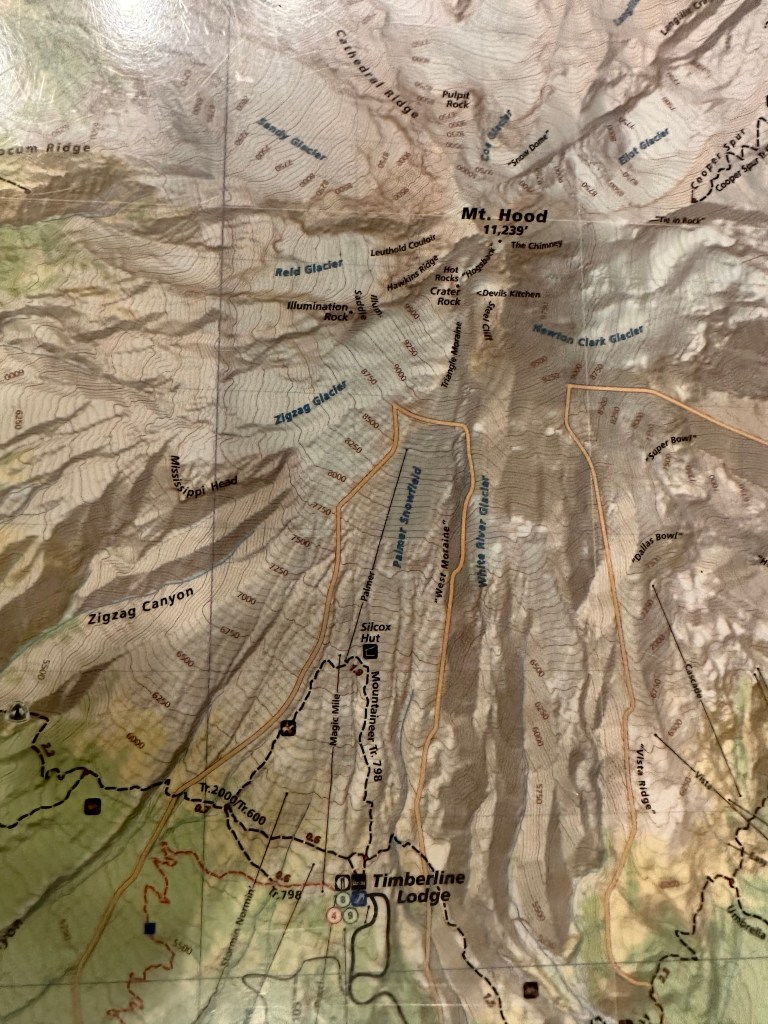
Today was Sunday, a day of rest, I took my time checking out of the Government Camp motel, chatted, web surfed, wished Jane a happy Mother’s Day, drove the 7 miles to Timberline Lodge, and waited around for early check-in to my room at 2 PM. Retrieved the big box from Jane, sorted out my gear, and didn’t really get going until four. In the lobby was a detailed contour map, you can zoom in if you like.
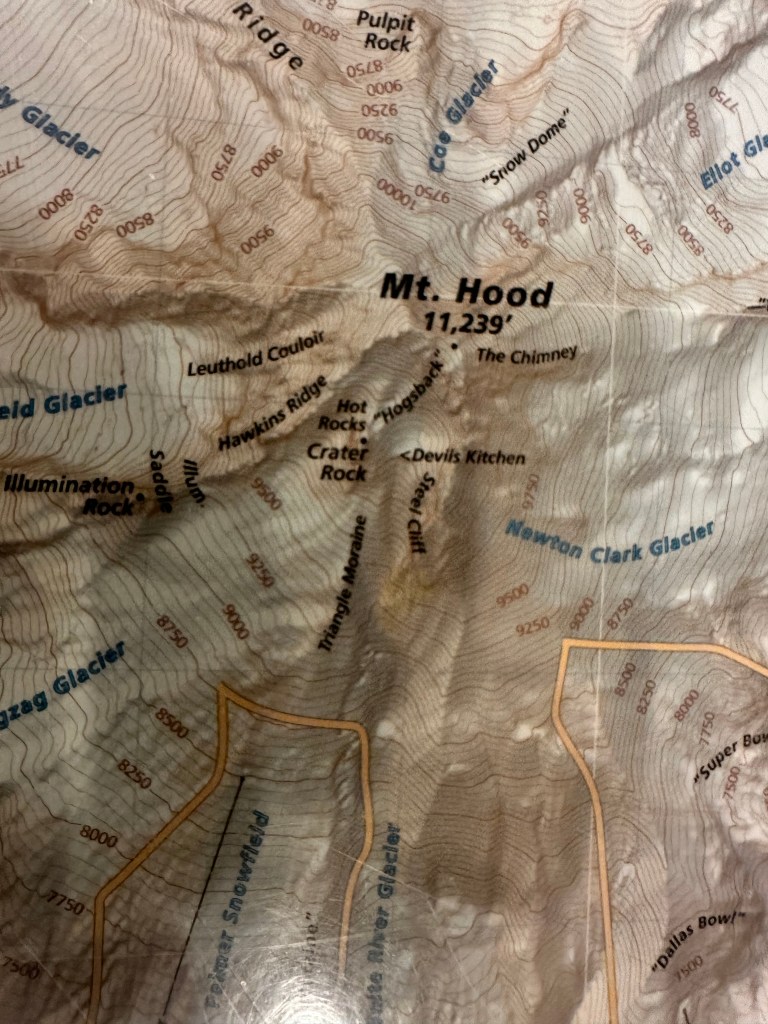
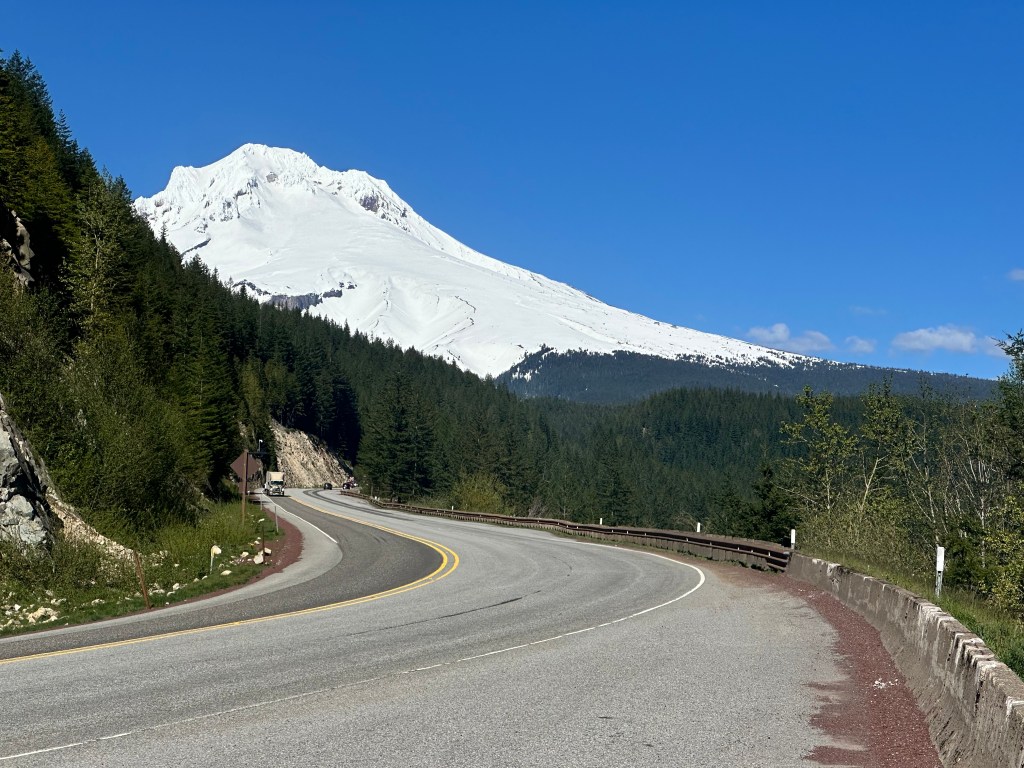
More vivid was the view from the parking lot, looking uphill the perspective is foreshortened, and doesn’t appear as steep as it actually is, but formidable enough.
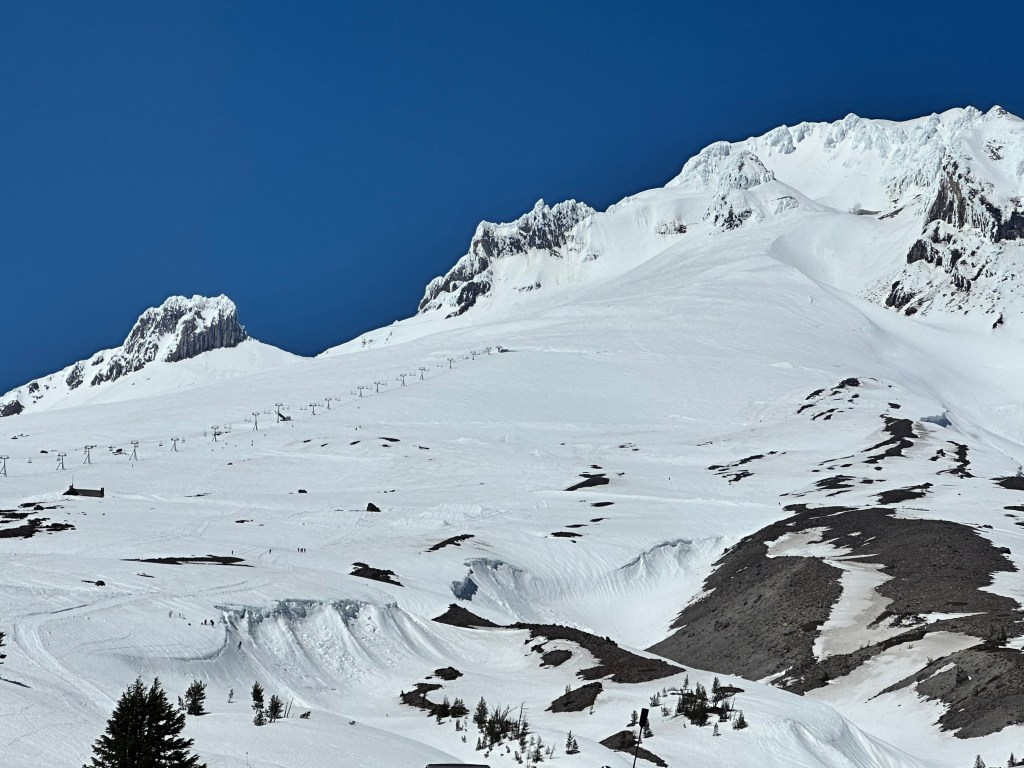
That’s the clean view, and here are my annotations:
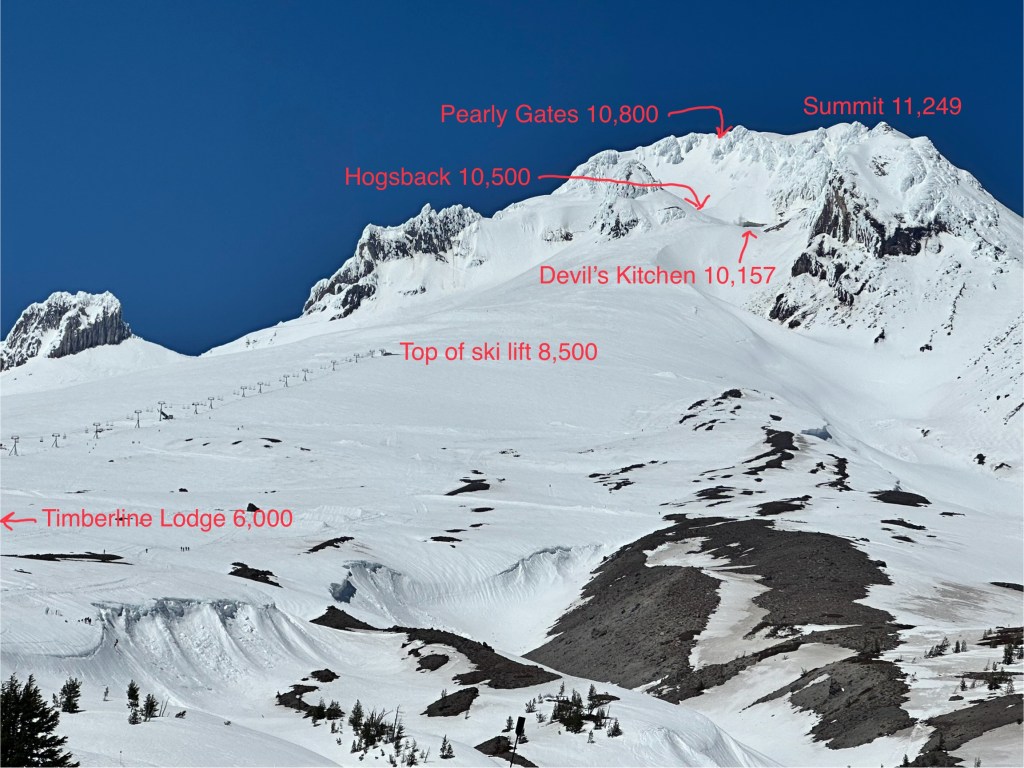
So we’re at 6,000 feet, with 5,249 left to go. To maximize chances of success, the guides insist on starting halfway up—at the top of the ski lift—and since they don’t run at night, that means taking a snowcat, a noisy, lumbering, carbon-spewing beast. Not too compatible with my whole sea-to-summit shtick. But we’ll get to that later.

Like on Rainier, they want you at the summit at 7:30 AM. Snowcats leave at 2 and 3 AM and when they drop you off, you rope up to your guide, with helmets, ice axes, and crampons, and start climbing.

I’ve done all this before, exactly 6 years ago, on May 14, 2018. I met my guide Brad, an affable, competent mountaineer, the day before for an ice climbing clinic. I appreciated the refresher although I just climbed Gannet Peak the year before. This May, like most Mays, I wasn’t in the best of shape, still carrying my winter weight, having been comparatively sedentary over the previous months. Brad remarked that my footwork could be better, and he was right, balance has never been my strong suit.

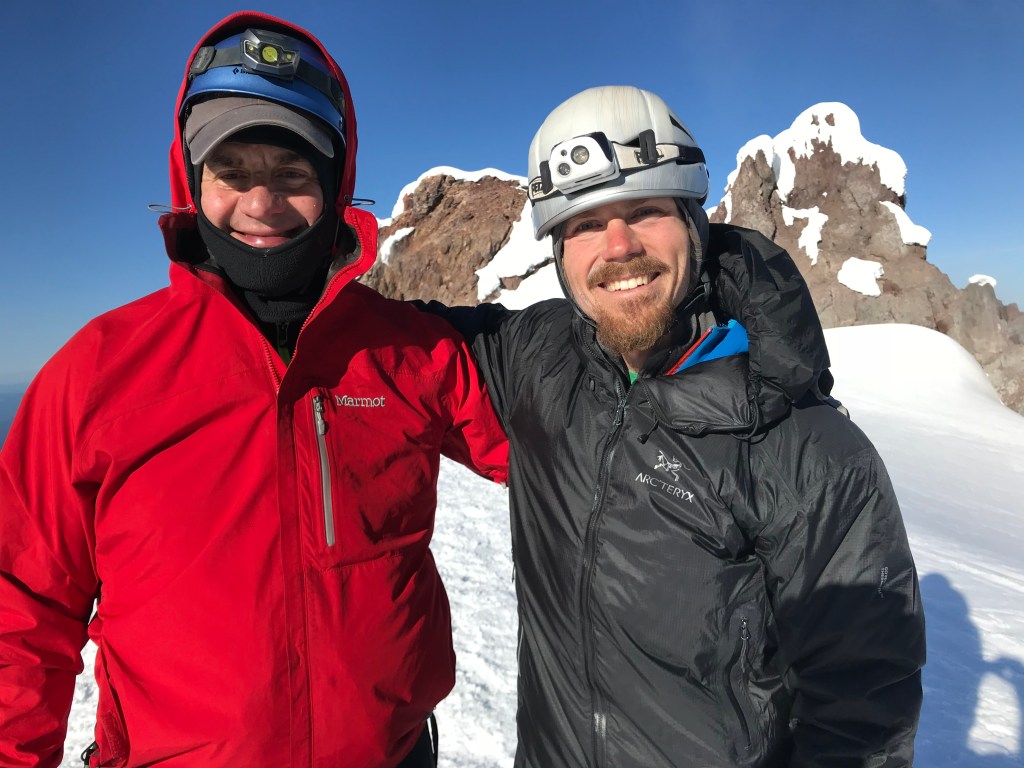
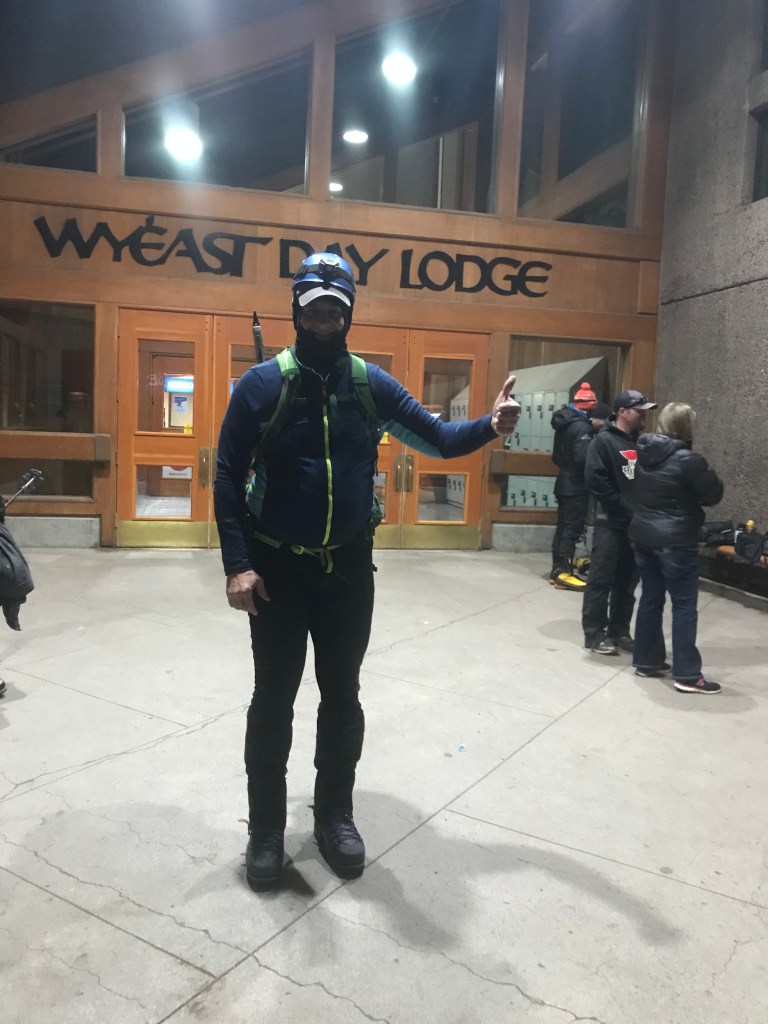
By the luck of the draw I got a 3 AM snowcat. Here I am looking hopeful at 2:45 in the ski lodge.
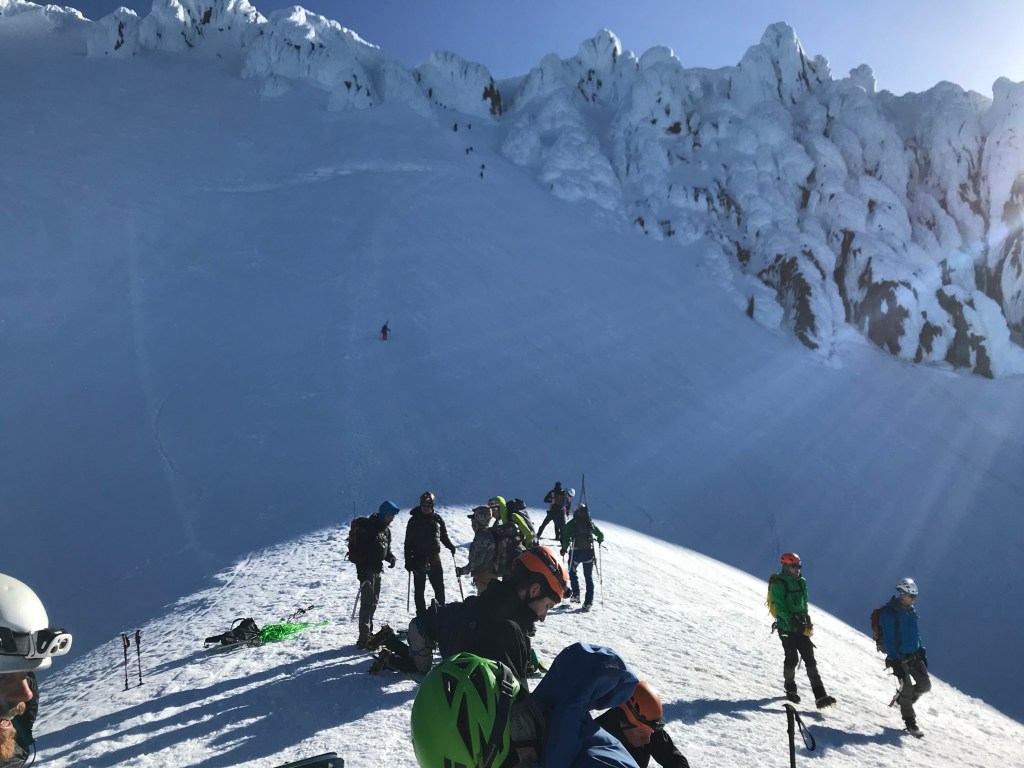
And here we are at the Hogsback, five hours later. A grinding uphill slog, uneventful but slow. We had just passed the Devil’s Kitchen, a sulfurous vent that reminded us Hood, like most of the Cascades, is a semi-dormant volcano. I felt tired but OK, but Brad recommended turning around. We only had 700 feet left to climb, but that included the treacherous Pearly Gates, a chute where most of the fatalities occur. You can see it at the top center, with climbers (mostly boyz, of course) strung along a rope.
They want you on the summit by 7:30, Brad said, because the risk of avalanches after that is higher. He didn’t insist we turn around, but he recommended it.

This is what BJ said at the Football Field, 19,500 feet, on Denali 20 years before. Then as now, we were just 700 feet from the summit. Then as now, we were slow, tired, but otherwise feeling fine. Then, I prevailed upon BJ to let us go on, and he reluctantly agreed. We made it without incident, but it wasn’t until we were halfway down, when the oxygen got back into my brain, that I realized the enormity of what I had done. I had gone against the guide’s recommendations. I had done the very thing I promised Jane I would not do. Done the very thing that led to most of those deaths depicted in Into Thin Air. I gotten away with it, but vowed never to do that again. Indeed, subsequently on Longs, Granite, and Gannet Peaks, I turned back, able to succeed later.

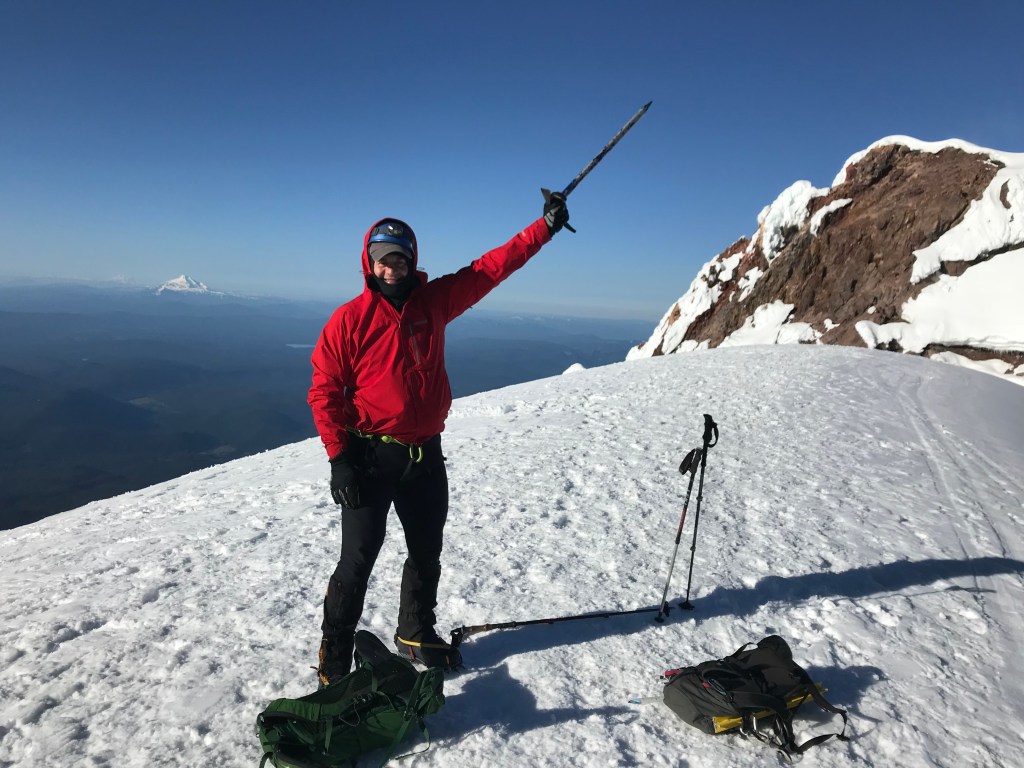
I raised my axe in “victory”, posed for a mug shot with Brad, and headed down.
I consoled myself that if I had gotten the earlier snowcat, I might’ve succeeded. Who knows? But this time I did snag a reservation on the 2 AM cat, and my guide is not one of the boyz, but Laura. I’m six years older, my balance still sucks, still overweight, but I’ve lost 20 pounds with my recent activities. And I’m still full of beans. We’ll see.

About the snowcat thing. I have gotten here a day early, so I can snowshoe up to the top of the ski lift, continuing the “old man with a walker” metaphor. The guides are right, if I had to do that the day of the climb, I almost certainly wouldn’t make it.

Today I took a dry run, climbed 330 feet in half an hour, about an eighth of the total. If I can maintain that pace, I should be able to get up in four hours, and down in three tomorrow. We’ll see.

I passed a group of guides as I started up the slope, one of them was a woman, could that be Laura? I think I heard them snickering at me and wondered why. Then I got a look at the selfie I had taken just before.
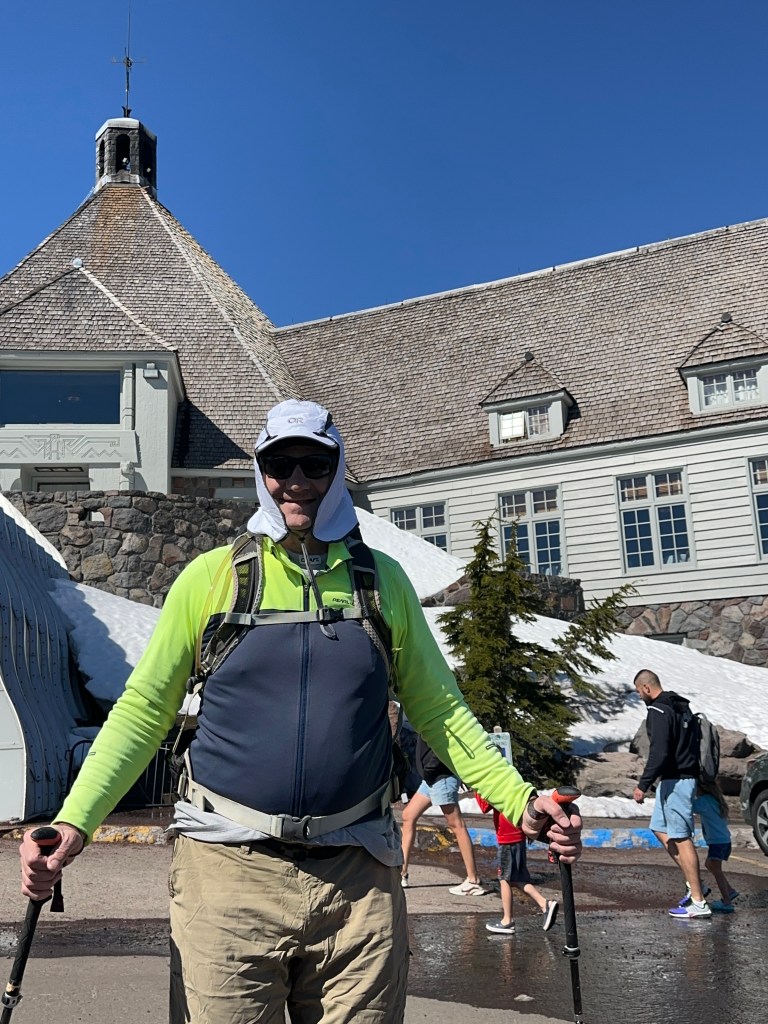
Yep, nobody can do dork like I can. Then I zoomed in on my face and thought OMG, I look like the Unabomber.


Snowshoed 2 miles, 641 total. Time 1 hour. Elevation gain 330 feet

©️ 2024 Scott Luria
Coast to Hood

Government Camp to Timberline Lodge, Oregon. Saturday, May 11, 2024

How had I not heard of this? A number of people I talked to on the way up said hey, you’re doing Hood to Coast backwards! Turns out it’s the largest relay race in the world, having been run annually since 1982. This movie looks like it might be worth paying the four bucks to rent. https://youtu.be/1m_1Vm666bc?si=WiBK9yXJNS7kPvL9

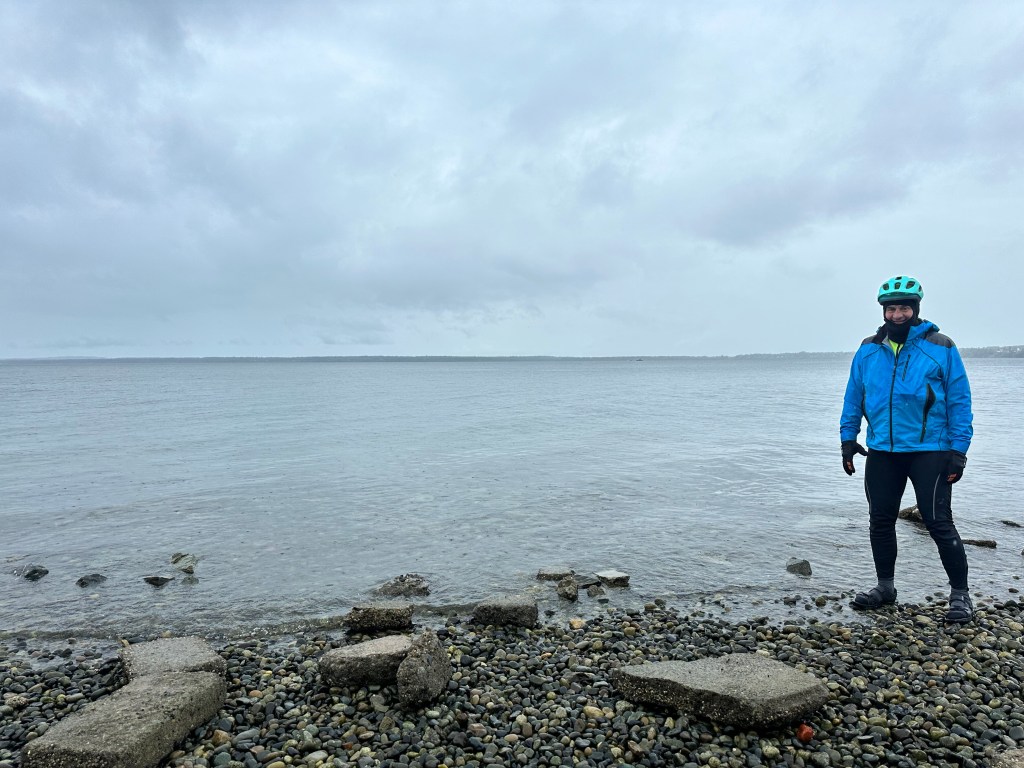
Yeah, I did it backwards. Started on the coast and ended at Timberline Lodge. Instead of 36 hours, it took me two weeks. Instead of Seaside, Oregon, I touched the ocean in Bellingham, Washington.

Reposting the “Ground Zero“ photo from Saturday, April 27

Instead of 200, it was 639 miles. Instead of a rolling party, it was just me. Oh yeah, and it was all uphill. 29,436 vertical feet to be exact, higher than Everest!

And if I’m lucky, I’ll finish on the summit, not just at Timberline Lodge. We’ll see.

Today sounded like I was slumming it, just 14 miles, on a bare bike. 7 miles up, 7 miles back down. But those 7 miles were crazy steep, rising 2000 feet. At points the grade exceeded 9%, and I had to walk. I sure hope I get stronger as this trip progresses.

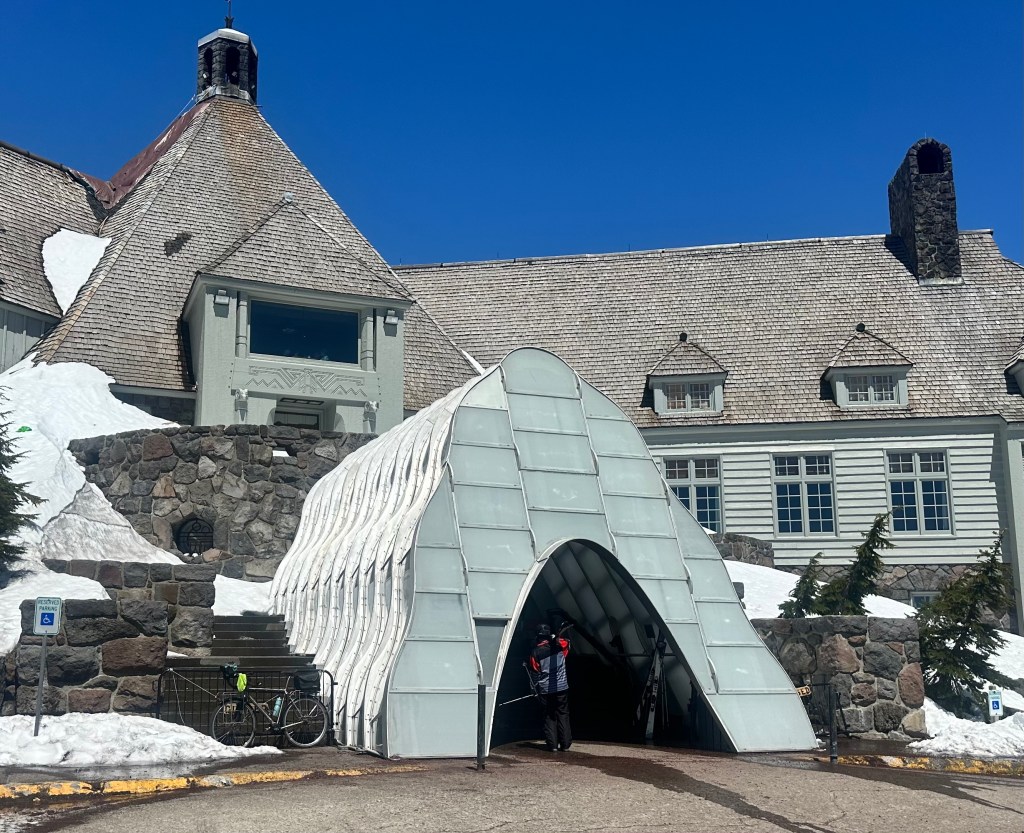
Here is the money shot, my bike by the entrance of the lodge, with its weird metal tunnel to cut through the snow drifts.

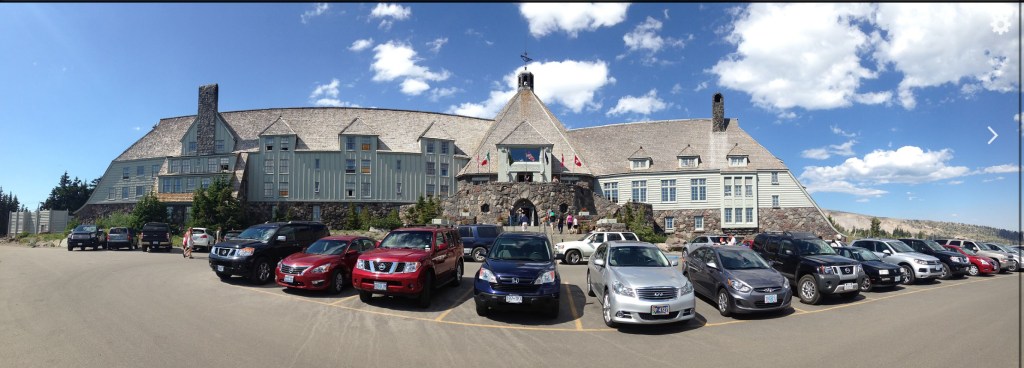
File photo of the lodge in summer

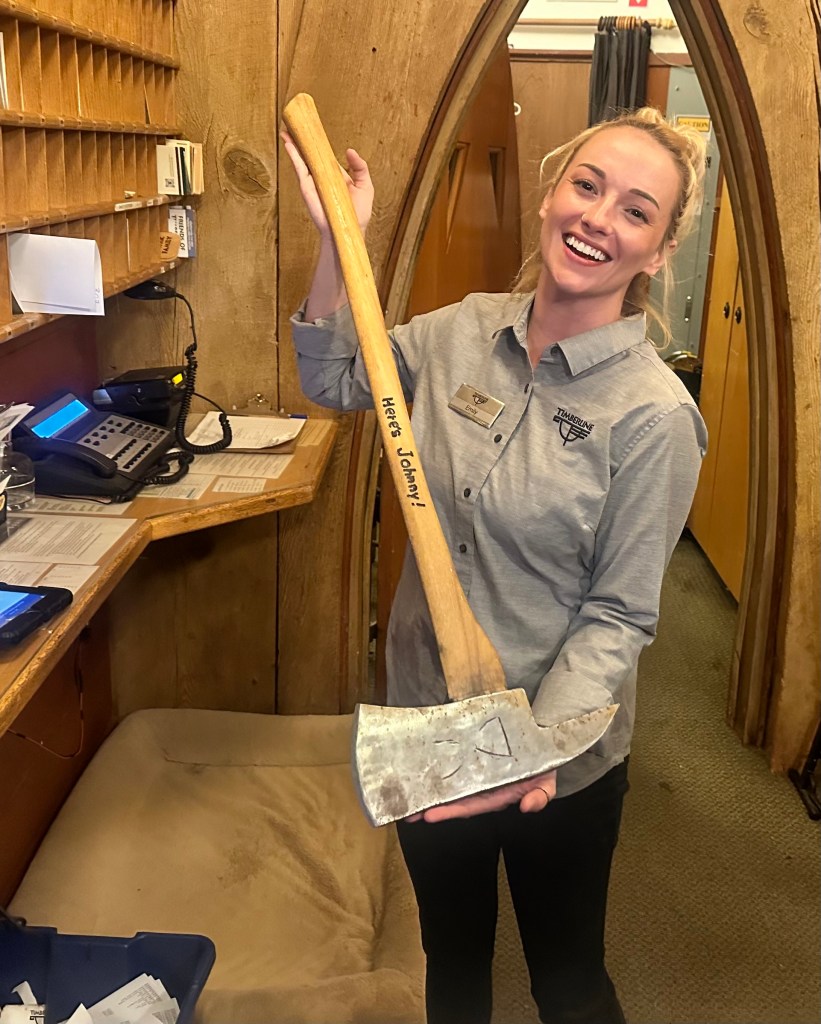
Timberline Lodge was the setting for the Overlook Hotel in Stanley Kubrick’s The Shining. Only the exterior shots were used; the inside, and the road leading up to it, were different. But the hotel is proud of its legacy, here’s the receptionist holding up the infamous “Here’s Johnny” axe.

Timberline Lodge is also the center of a ski resort that has the greatest vertical drop in the country, with slopes both above and below. There was a lot of skiing and snowboarding going on today, even with temperatures in the high 60s. It has a parking lot the size of Connecticut, which looked like a tailgating party; lots of shorts-and-sandals-clad hipsters hanging out in beach chairs, blaring music, and drinking beer. I wandered over to Timberline Mountain Guides, in hopes of meeting my assigned guide Laura, but she was not there that day. I will meet her on Tuesday.

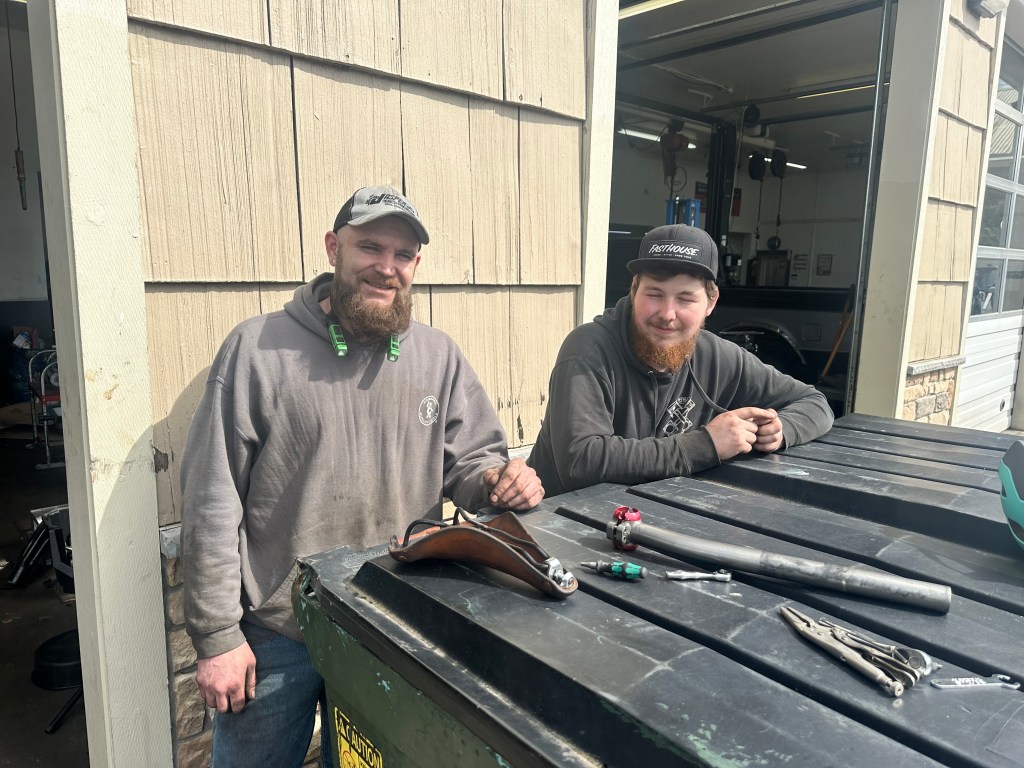
Two hours up, 15 minutes down. Plenty of extra time in the day, and I won’t be needing my bike again until Thursday. Time to address my seat problem definitively.

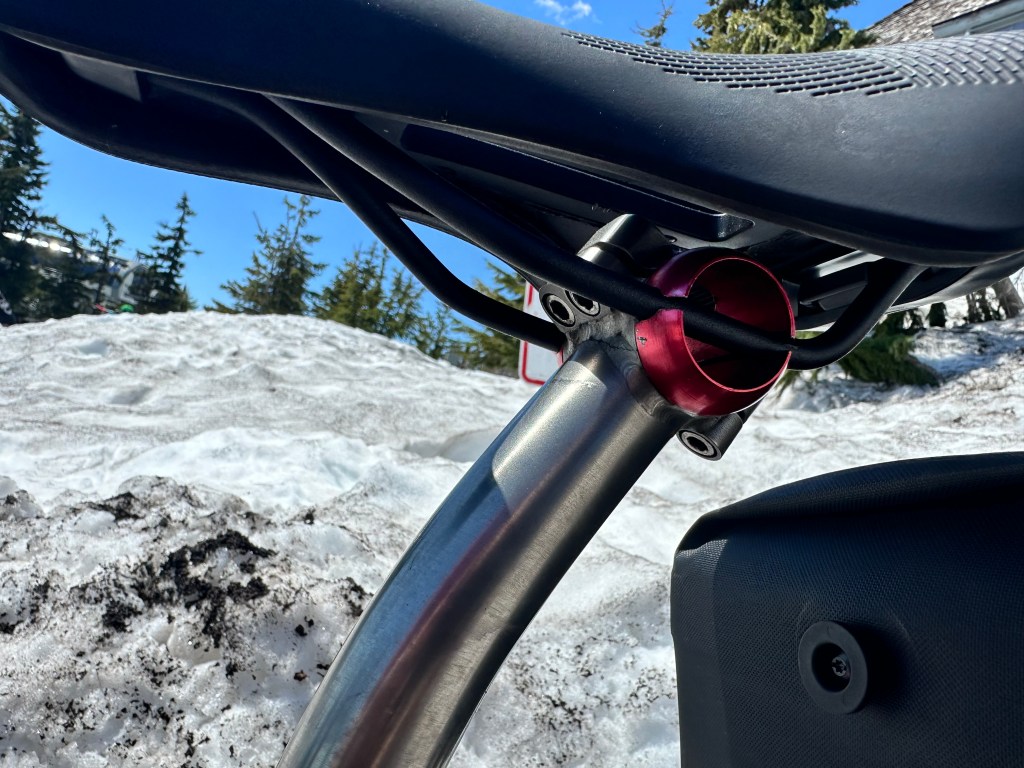
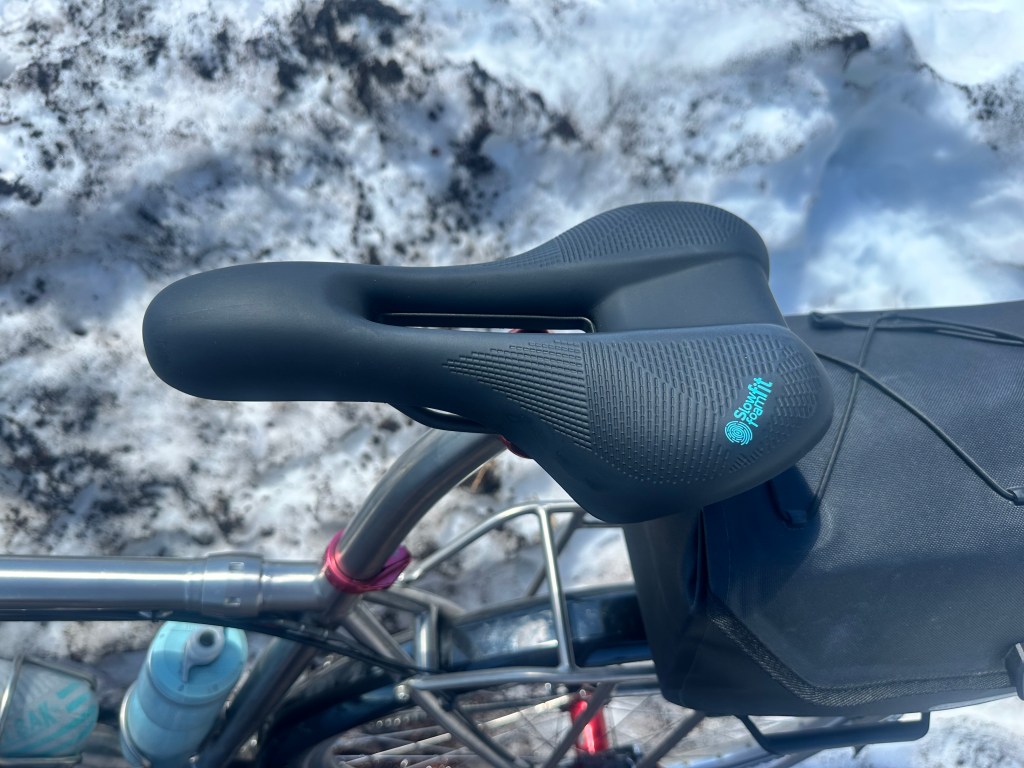
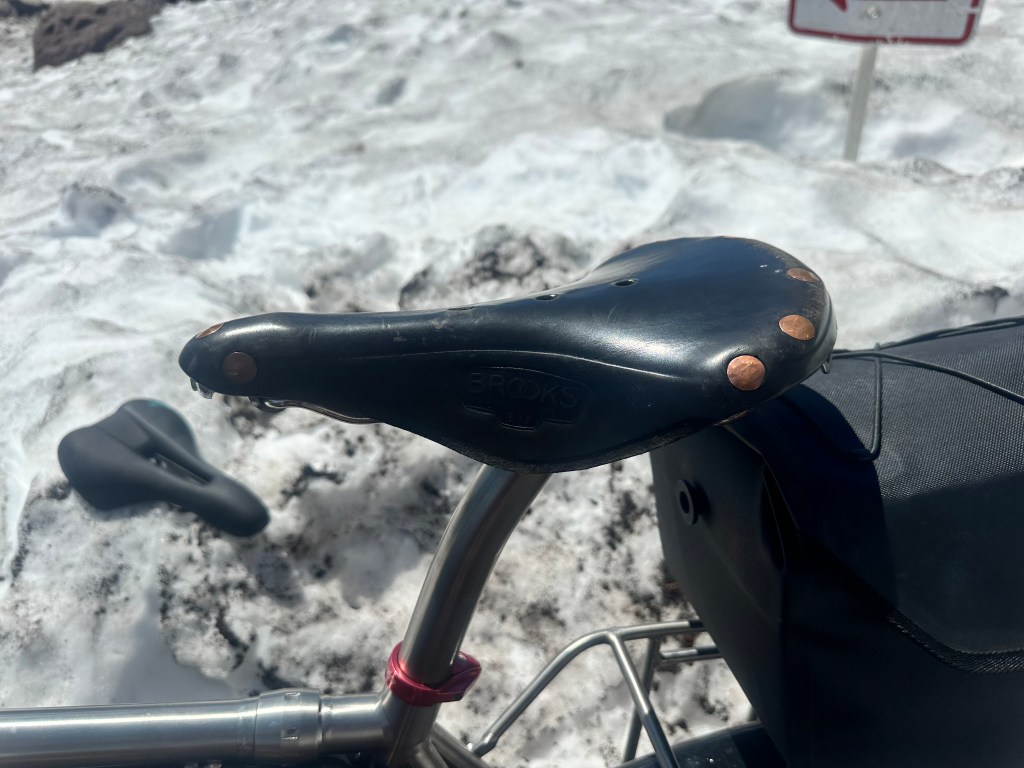
Jane had sent a big box to Timberline, with snowshoes, my mountaineering gear, and my other broken-in Brooks Saddle. Before I mounted it, I got some pictures of my temporary saddle, and the way it’s attached to the seat post.

The attachment looks elegant, but you can see how it pinches the saddle rails in only two spots, focusing a lot of stress there; I suspect this is why the rails broke on the prior seat.

The replacement seat itself looks comfy, heavily padded, with an anatomical cutout to accommodate your nether regions (as my dad used to call them).

But curiously, I prefer my rock-hard Brooks Saddle, just a single sheet of smoothly polished leather—agonizing for the first thousand miles as it breaks itself in to mold perfectly to those aforementioned regions—but then, heaven. Also, much less friction between shorts and saddle as you’re pedaling.

To each his own

Anyway, I’m concerned that mounting is going to break the rails of this seat too, so I should replace the seat post. The latest technology is something called a dropper post, where you can flick a lever to raise and lower the seat. Designed initially for competitive mountain bikers, who want to keep the center of gravity low on steep descents, it’s been embraced by the geriatric cycling crowd, who drop the seat when stopped. If you can put your feet flat on the ground it’s easier to start pedaling, then pop it back up to ideal height once you get going. Jane and I tried these when we rented electric mountain bikes in New Zealand, and were impressed.

I drove the bike down to George Wilson, owner of Mt Hood Bicycles, where I had stopped yesterday on the way up. He has ordered the dropper post for me, it should arrive early next week and he should have it installed by the time I come down from Hood on Wednesday. As I said, George is a fellow clinician, I was impressed by his meticulous shop. Look how neatly he has all of his tools mounted on that pegboard.

I feel better having my fancy bike in his shop anyway, rather than visible to all in the back of my car.

Tomorrow will be a low-key day, just driving up to spend the one night I do have at Timberline Lodge, and get ready for the big snowshoe on Monday. I’ll explain about that then.

Distance 14 miles, 639 total. Time 3 hours with stops. Elevation gain 2,000 feet

©️ 2024 Scott Luria
Old man with a walker

Sandy to Government Camp, Oregon Friday, May 10, 2024

I didn’t want to do it this way, but it turned out to be the right way.

The jumping-off point for most climbs of Mt Hood is Timberline Lodge, a beautiful rustic building halfway up the mountain. Built as part of the New Deal by the Works Progress Administration in 1937, it is the only accommodation at this location. Knowing this, I called in January to reserve three days there. I was told I could only have the first day, it was otherwise fully booked for a convention, but I should keep checking back. I did so, but those other two days never opened up.

Rats. That meant I would have to stay at the village of Government Camp, 2000 feet lower on the mountain, and get myself repeatedly back up the mountain. The day of the climb would be particularly problematic, we leave at 1:45 AM; there’s no shuttle, or Uber, or cab that could take me up at that hour. Even the guides are prohibited from doing so, because of liability concerns. I would have to rent a car.

Followers of this blog know how much of an anathema that is for me. I wanted to do this whole trip without using fossil fuel, going to almost comical lengths to avoid it. But I’ve had to knuckle under, most notably in that jet from Montreal to Vancouver. So I guess I’ve already besmirched myself.

Well it turned out to be a blessing in disguise. I discovered on my jaunt to Paradise a week ago that I am simply not (yet) strong enough to pedal my fully loaded bike above a grade of 5%. The track to Timberline Lodge is frequently steeper than that. I would have to do those parts without the extra weight, and figure out later how to get the bags up. After researching every other possible option, a rental car seemed the only way to go.

Things seemed to fall into place. The closest rental car is at Sandy, last night’s destination. I found a reasonable weeklong reservation for a Toyota RAV4, that could fit my bike easily. The motel said I could keep the car in their lot for the day. Stashing my bags inside, it was just a matter of an out-and-back to Government Camp with the stripped down bike.

Just a matter. It was only 30 miles each way, and I felt light and free for the first 20, but things got really steep in the end. I passed the last bike shop I would see in a while, and scored some extra chamois cream (you experienced bikers know exactly what I’m talking about; as for the others, look it up. Once you start using it, you’ll never go back.) Turned out the owner is a fellow clinician, a retired orthopedic physician’s assistant, and his shop reviews mentioned he’s a specialist in installing dropper posts. Far out. I could use one of those puppies, and made arrangements. More on that later.

All of this slowed me down, of course, and it was early evening as I ground up those last switchbacks. This gut-punch view of the mountain didn’t help, though anyone else would have thought it beautiful.

It was six before I limped in to my next motel at Government Camp, grabbed a chocolate milk and an apple, and went roaring back down to Sandy. You don’t even realize how steep the slope you climbed was until you zoom down it. The temperature had peaked at 87° on the way up, but I was chilled going down. Found out to my disgust there was actually a 530 foot hill to climb on the way back. Got back to the car at 8:30, barely beating the sunset, totally gassed. Snagged a dinner salad at Subway just before it closed. Found out unusual solar activity was making the aurora borealis visible this far south, but a big white mountain was blocking my northern view.

Not so for Jane, who sent this view from Hope’s apartment in Portland, Maine

Luckily, this next motel, another Best Western, is pretty nice. Collapsed into bed without blogging, that’s why this post is late.

This Aztec two-step feels, like I mentioned, like an old man with a walker, taking a tentative step, then bringing his baggage up behind him. Repeat performance tomorrow.

Distance 60 miles, 625 total. Time 10 hours with stops. Elevation gain 5,040 feet

©️ 2024 Scott Luria
A town called Boring

Portland to Sandy, Oregon. Thursday, May 9, 2024.

It’s always fun to find quirky place names. Truth or Consequences, New Mexico; Nameless, Tennessee; Old Dime Box, Texas—I have only read about those. At least these guys have embraced their name with a sense of humor.

My route today took me right through this town, named after William Harrison Boring, a union soldier and pioneer

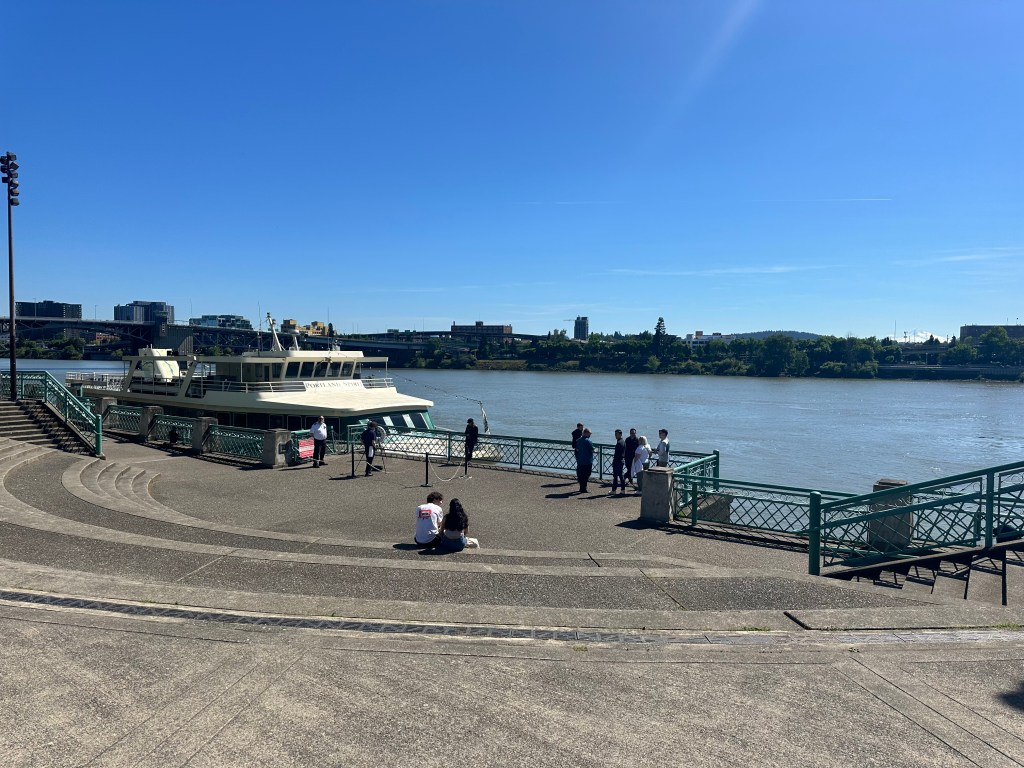
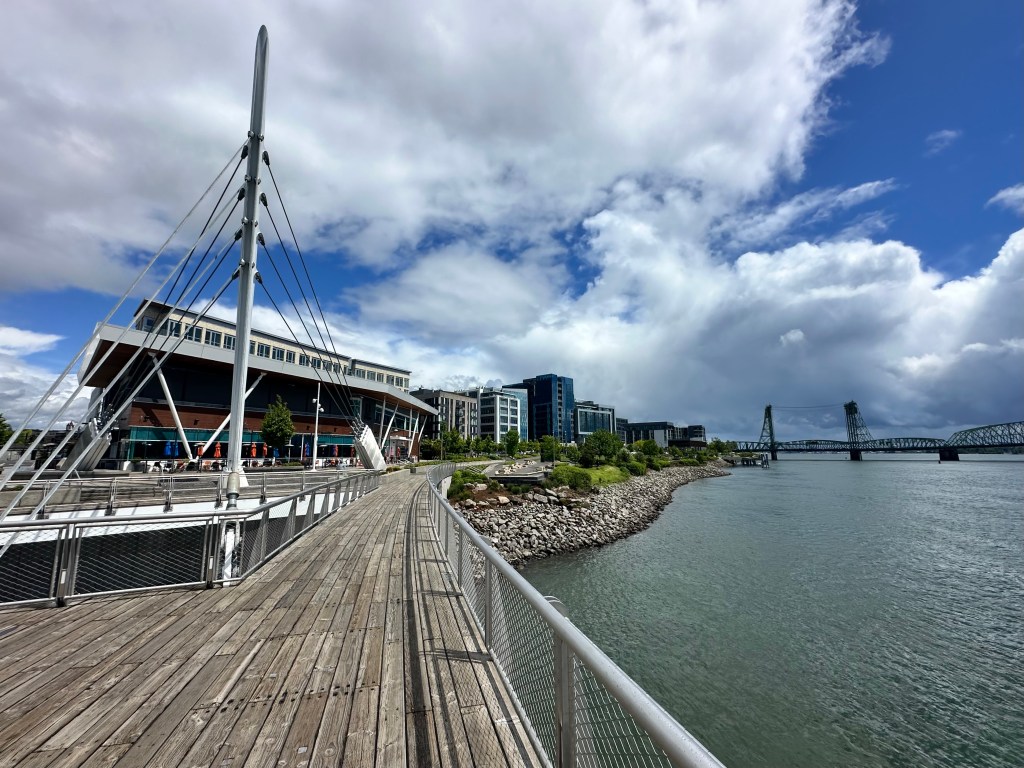
Otherwise, today was anything but. Reluctant to leave one of the coolest cities in the country, and one of the last cities I would see for a while, I savored the pretty Portland waterfront

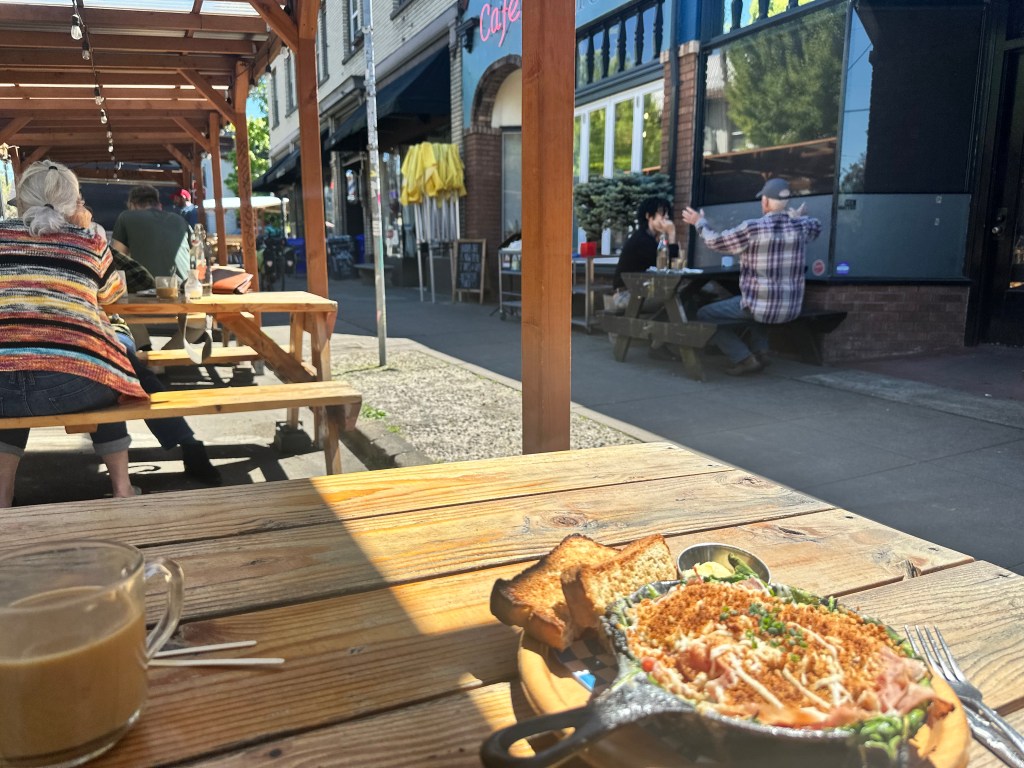
had a brunch of Lost Eggs at trendy Café Broder, as recommended by my daughter Hope,

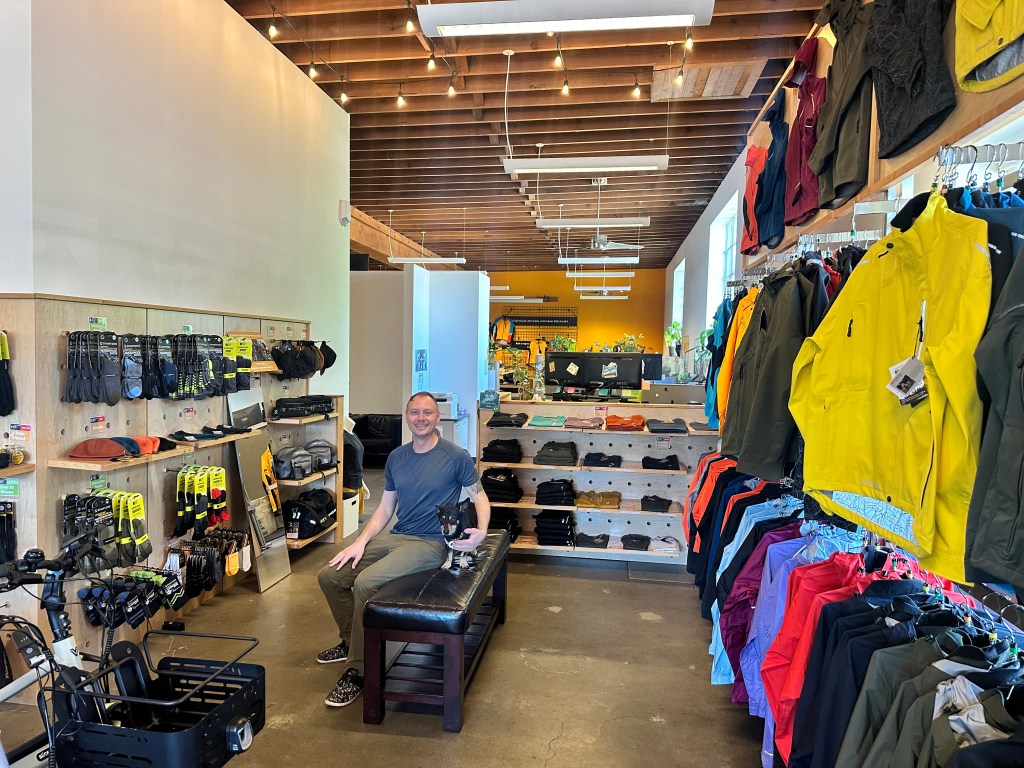
and succeeded in my pilgrimage to the second of two famous Portland bike gear manufacturers. I had to pass on Chris King Cycles yesterday, but Showers Pass makes, in my opinion, the best rain gear for cycling. https://showerspass.com I’ve been using their stuff for years, and it kept me from being miserable over those last rainy days on this trip. Evan showed me around their factory and flagship store, and let me trade in my waterproof gloves, five years old, for the latest model that was touch screen friendly.

Thanks, Evan!

I’ve been to Portland before with the family, and hit all the touristy spots, today I just exulted in the city that has the reputation of being the most bike friendly in the country. Sure, there are bike paths everywhere, and many accommodations that make bicycling more pleasant. But the feeling is deeper than that, and hard to articulate, or capture in photos—it’s a culture. You can’t find a street that doesn’t have something on it to promote cycling, and the proof is in the pudding, there are cyclists everywhere. You get a hint of what it must be like to bicycle in Amsterdam, or Copenhagen. The wave of the future, I hope.

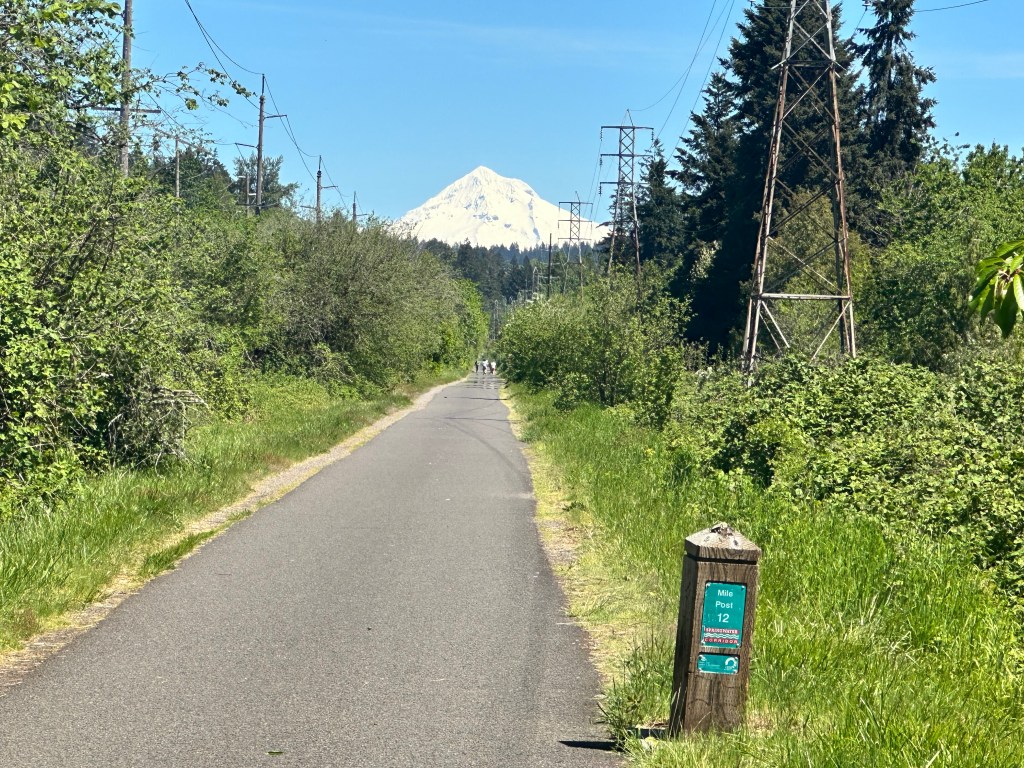
Portland is lovely, dark, and deep. But I have promises to keep, and highpoints to bag before I sleep. Except for the headwind, it was a blue bird day, which meant I couldn’t escape the image of Mt. Hood, looming ever larger over the otherwise dreamy Springwater Corridor bike path, trash-talking me, egging me on.

Are YOU talking to ME?

Hood is by far the easiest of the quintet of highpoints that require a guide—Denali, Rainier, Granite Peak, and Gannet Peak being the others, all of which I’ve done. It’s over 3000 feet lower than Rainier. It’s the only one that can be done as a day hike, and a patient of mine, two years older, has climbed it over 50 times. But it still looms large in my imagination, and my sense of dread. I have failed on it before, as I will elaborate in tomorrow’s post. It’s the only one I’m going to try to climb from sea to summit in a single trip, necessitating, as I’ll describe, a comical series of steps that reminds me of nothing so much as an old man using a walker. Stay tuned. As for today, I climbed the first 1,000 of its 11,249 feet. Miles to go before I sleep.

Distance 27 miles, 565 total. Time 7 hours with stops. Elevation gain 1,107 feet

©️ 2024 Scott Luria
If it had to happen…

Vancouver, Washington to Portland, Oregon. Wednesday, May 8, 2024

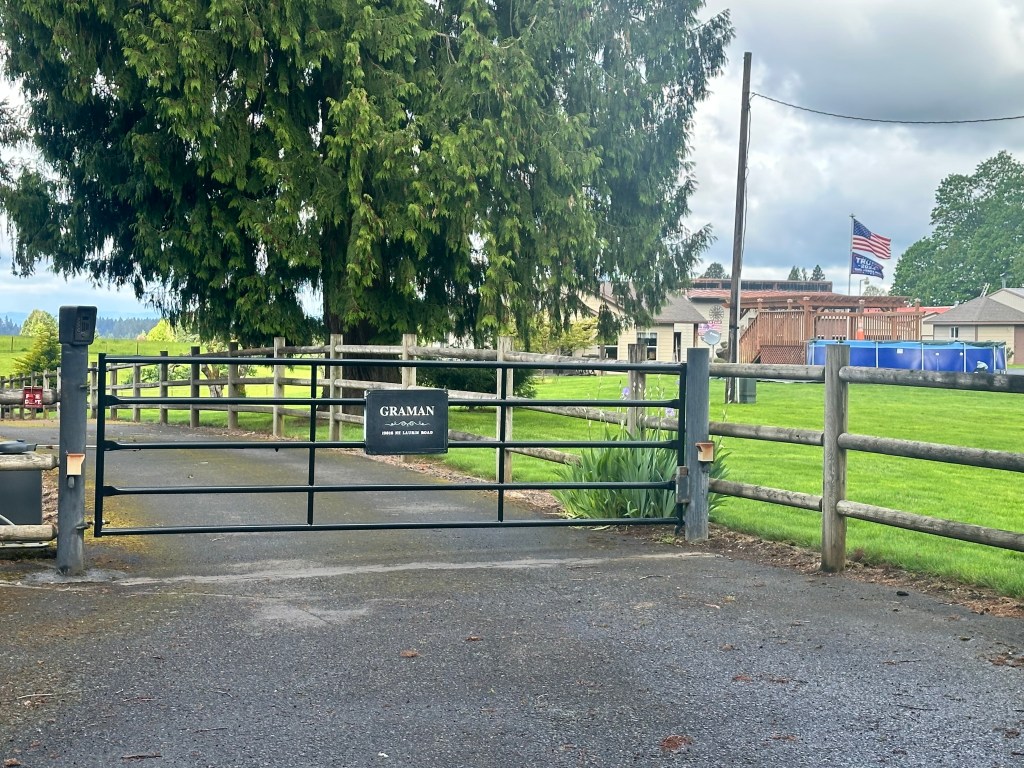
As predicted, it was all too easy to linger at the Graman’s, I didn’t get out till 11. Supposed to be an easy day today— just down the hill to the river, one more slightly scary crossing on marginal bridges, and then on to what is perhaps America’s most bike friendly city, Portland, Oregon. I had a hotel right on the Willamette river. Planned to make a pilgrimage to two famous bike gear manufacturers. The first is Chris King Cycles, whose precision hubs and headsets are so beautifully made, you look forward to maintaining them. Their classic rear hub in particular is a work of art—called the ring drive, it’s famous for the noise it makes when coasting, like a hive of angry bees. The bicycling equivalent of the Ferrari without a muffler.

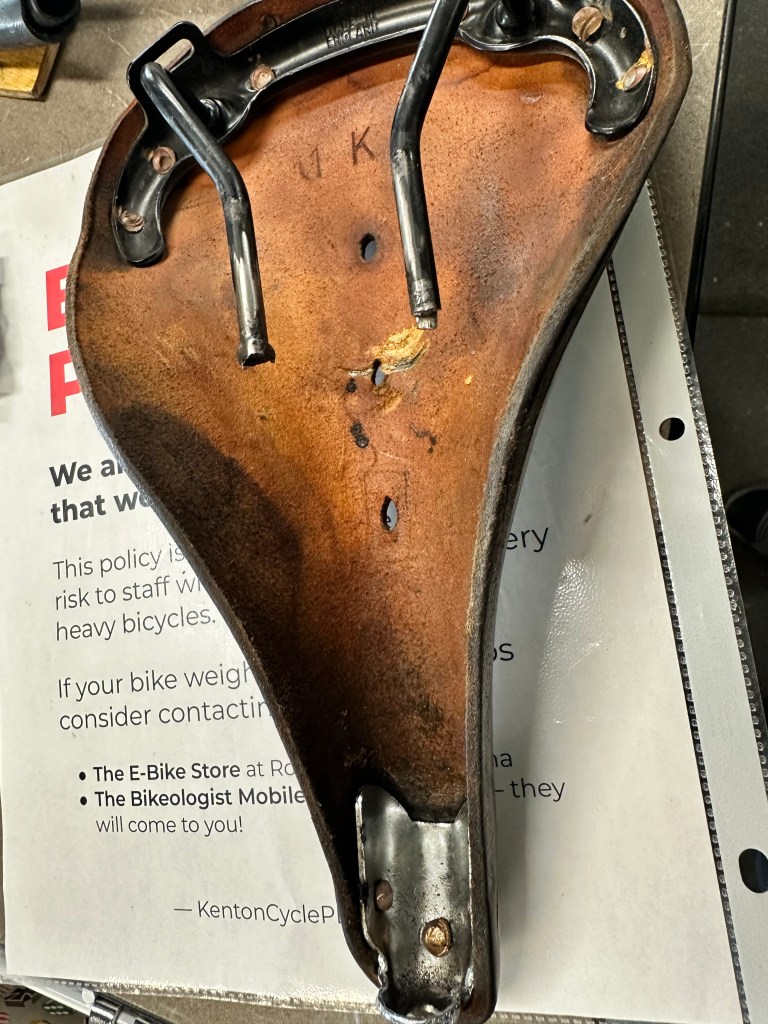
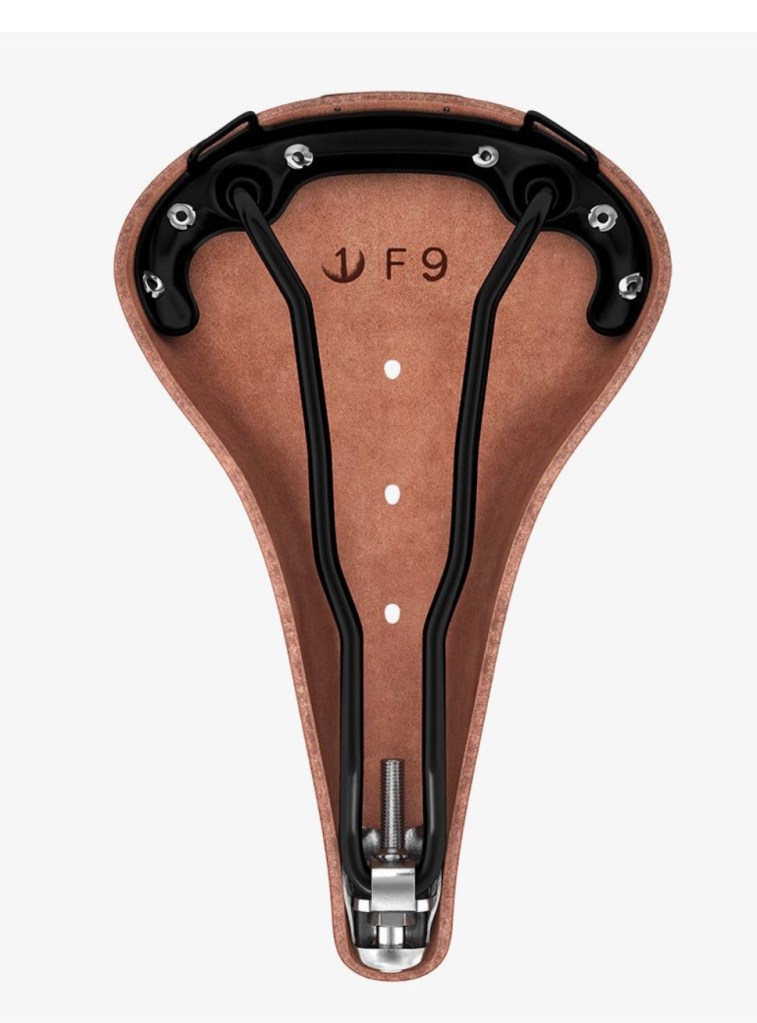
It was not to be. Just as I was crossing the river, I felt another sickening crunch between my legs, and this time the nose of my saddle was flopping around like a loose earlobe. Sure enough: both rails had fractured completely, and it was just the limp leather hanging. Here’s my seat, compared to a factory photo of what the underside is supposed to look like.

Almost totally unrideable, but it couldn’t have happened in a better place. Just 1.3 miles ahead was Kenton‘s bike repair shop, and there Rich proved himself to be another trail angel. He found me a serviceable replacement seat, and a box to mail my broken seat back.

Simon Firth of Firth and Wilson Transport Cycles in Philadelphia, is the North American service center for Brooks saddles. He has helped me many times in the past, and again was willing to do a warranty repair. The post office was just down the block from the repair shop, so after a couple of hours I was back on my way. Once again, my tour was saved by Trail Angels. I can hardly begrudge my original angels, Aaron and Blake in Eatonville. Their makeshift repair lasted a week and 290 miles, 12,000 vertical feet, and got me to Paradise and Portlandia.

Portlandia. The ultra-hip city gently mocked by the TV series of that name. I no longer had time to visit Chris King Cycles, a representative I had emailed said they were not open to the public anyway, and Rich at the Kenton repair shop said there was nothing to see from the outside. Instead, I just luxuriated in the nurturing web of the city’s bike trails and gorgeous riverfront promenade, where my hotel was. The receptionist recommended Luc Lac, a trendy Vietnamese restaurant. Saw very little of the homelessness I understand is endemic here. Sated, contented, saved from catastrophe, I felt blissed out.

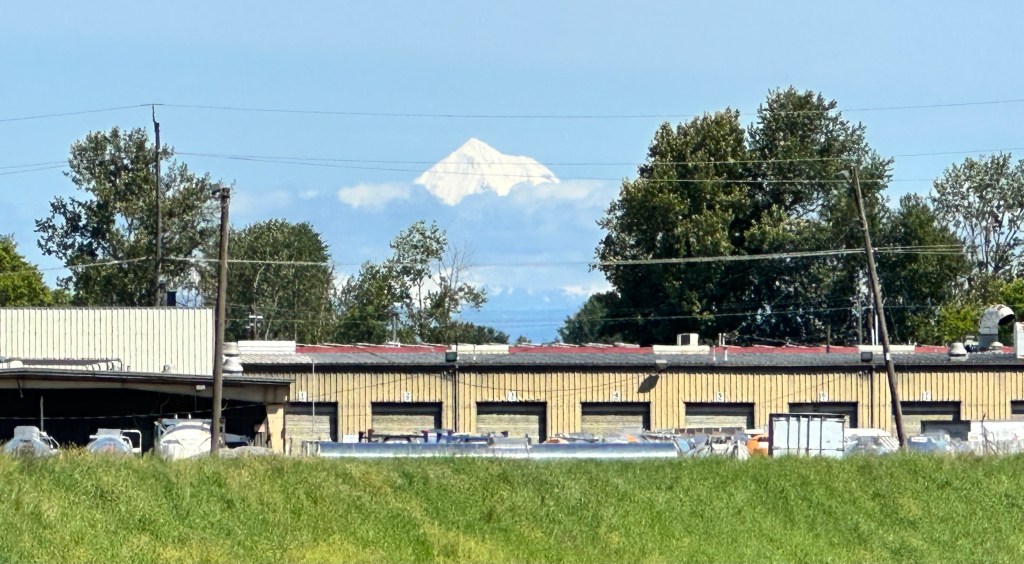
Only one little thing. Quite unexpectedly, as I threaded through the warehouses outside the city, I caught a glimpse of my next objective, Mount Hood, Oregon’s highpoint, rising 11,000 feet above us.


Beautiful, but yikes. This one I’ve got to climb, not just get to the parking lot. The next week will be dedicated to this.

Suddenly, I felt very old.

Distance 22 miles, 538 total. Time 5 hours with stops. Elevation gain 752 feet

©️ 2024 Scott Luria
Howard, Don, and J.R.

St Helens, Oregon to Vancouver, Washington. Monday – Tuesday, May 6–7, 2024

Wait, what? Vancouver? I’ve come over 500 miles and I’m still in Vancouver? Of course not. This is Vancouver, Washington.

Old George Vancouver sure got around. This bedroom community of Portland, the bigger city in British Columbia, and the huge island opposite were all named for the good captain. Though lesser known, the one here was founded first.

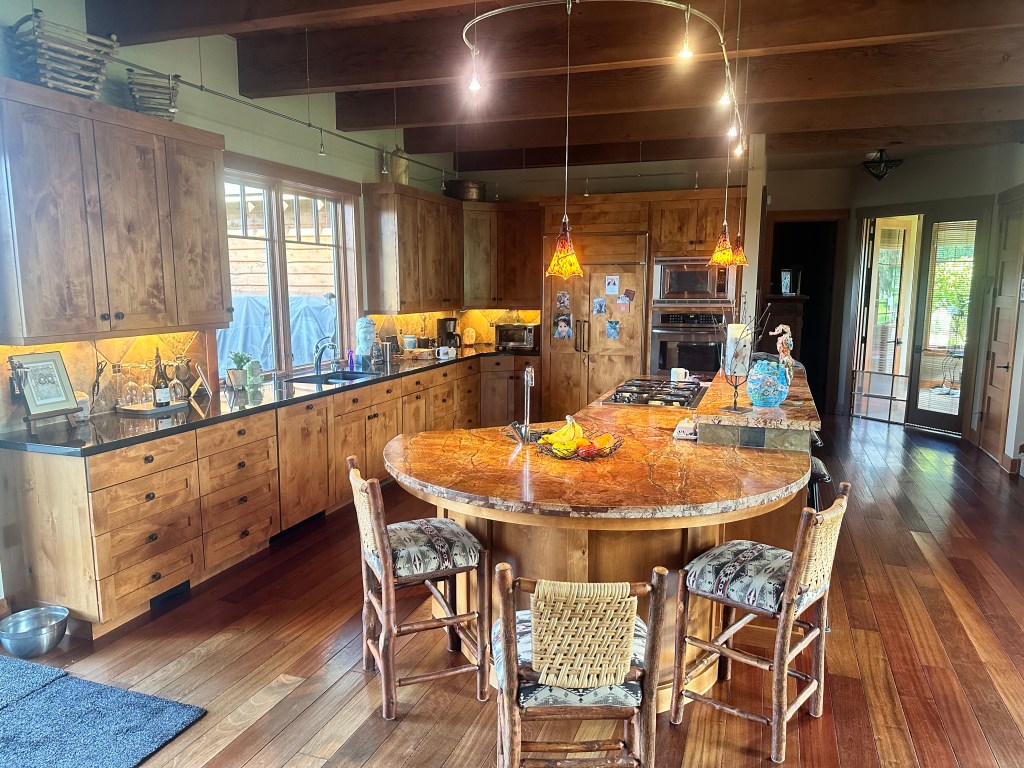
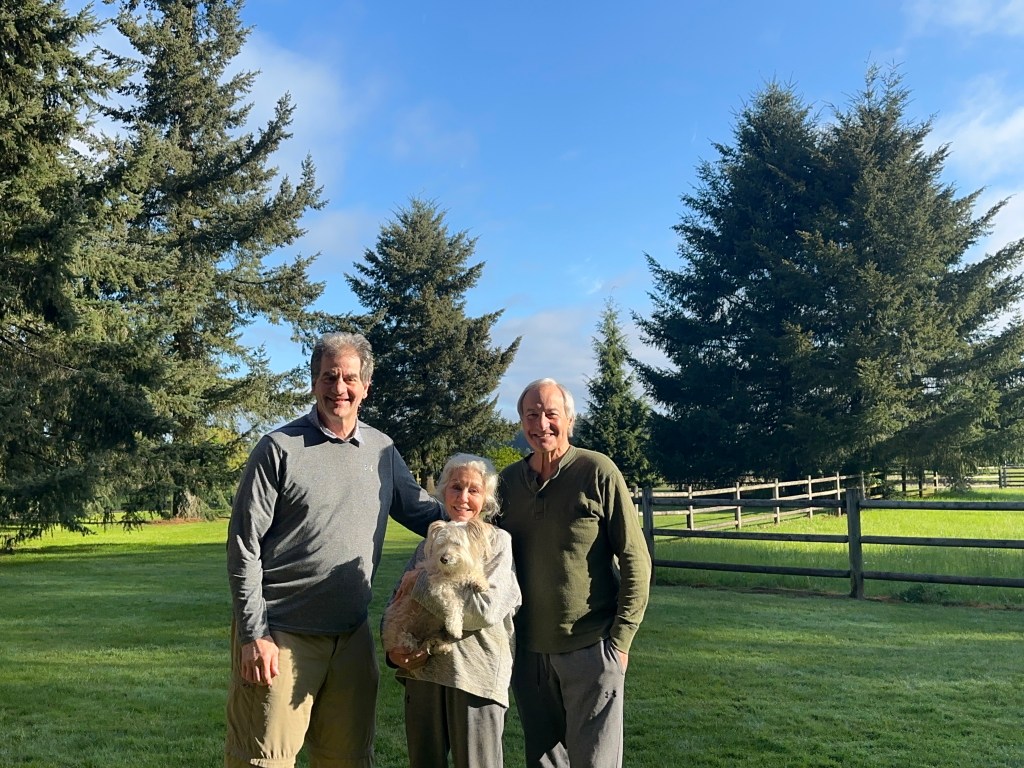
I was crossing back into Washington over the Columbia to visit an old friend, former colleague and mentor, Howard Graman and his wife Katherine. Howard and I worked together at the University of Vermont Medical Center, then called Given Health Care Center, from 1987 to 1996. Howard was our practice manager, and a real inspiration for me. He was a natural leader, smooth, firm, urbane, and sensitive to (and loved by) his patients. He pioneered a videotaping technique to teach interviewing skills to medical students and residents. Handsome with jet black hair, creative, and always impeccably dressed, he was a kinder version of Don Draper from the series Mad Men. He starred as Bernardo in our local repertory’s version of West Side Story. He was a real inspiration for me, and I loved working with him, but he was headed for bigger things. Recruited by the Cleveland Clinic to establish a primary care facility to complement and support their world-renowned referral center, he went on to be CEO of Cleveland Clinic’s Florida facility, the Carilion Clinic in Roanoke Virginia, and finally Peace Health in the Pacific Northwest, physician-led consortium of more than 600 doctors. His wife Katherine, a nurse and therapist, came to love horses and with each move acquired a larger herd. They settled finally in Vancouver in a lovely home that reminded me a bit of Southfork Ranch in Dallas, which they share with four horses, two donkeys, a parrot, a parakeet, and an adorable little dog named Cabot.

OK, perhaps I’m laying it on a little thick, but Howard and Katherine were like that, glamorous but always down-to-earth and approachable. They graciously hosted me for two nights, and what a respite from those grueling and soggy miles I’d been doing. Great wine, food, conversations and reminiscing, and a bed so luxurious I feared I would never want to leave. These pictures only begin to capture the beauty.

The Vancouver waterfront on the Columbia
The door opened silently as I approached
I slept like a rock
“J.R.” and Southfork
The CEO gets back to the basics of medical care
Me and my mentor
Me, Katherine, Howard, and Cabot

Uh-oh, I’d better get going. The last time I stayed in a place this posh, it was too hard to resume life on the road, I wound up going home.

 Distance 49 miles, 516 total. Time 7 hours with stops. Elevation gain 1489 feet

©️ 2024 Scott Luria
Sinko de Mayo

Toledo, Washington to Saint Helens, Oregon. Sunday, May 5, 2024

Or maybe I should title this post Stinko de Mayo. My clothes were all dry after hanging by the space heater overnight, and seemed remarkably odor-free. But then I was reminded of that Febreze commercial, where everybody but the reeker notices the reek.

But no, I’m calling it Sinko, because the rain never stopped, for a second straight day. I know, I know, I got the memo, the Pacific Northwest in the spring. Get over it. Easier said than done.

At least I was comforted by an old friend. The Adventure Cycling Association, the AAA of the bicycle crowd, had curated most of the route I followed today. I have described this organization, the former Bikecentennial, in my post of 5/2/21. What a joy to have your path chosen by people with local knowledge, rather than just by an algorithm.

In my further musings about the differences between our nation’s capital and Washington state, I focused on Columbia, DC stands for the District of Columbia. But no, there is plenty of Columbia in Washington state. As previously mentioned, the highest point on Mount Rainier is called Columbia Crest. And much of the southern border of the state is defined by the Columbia, one of our nation’s great rivers.

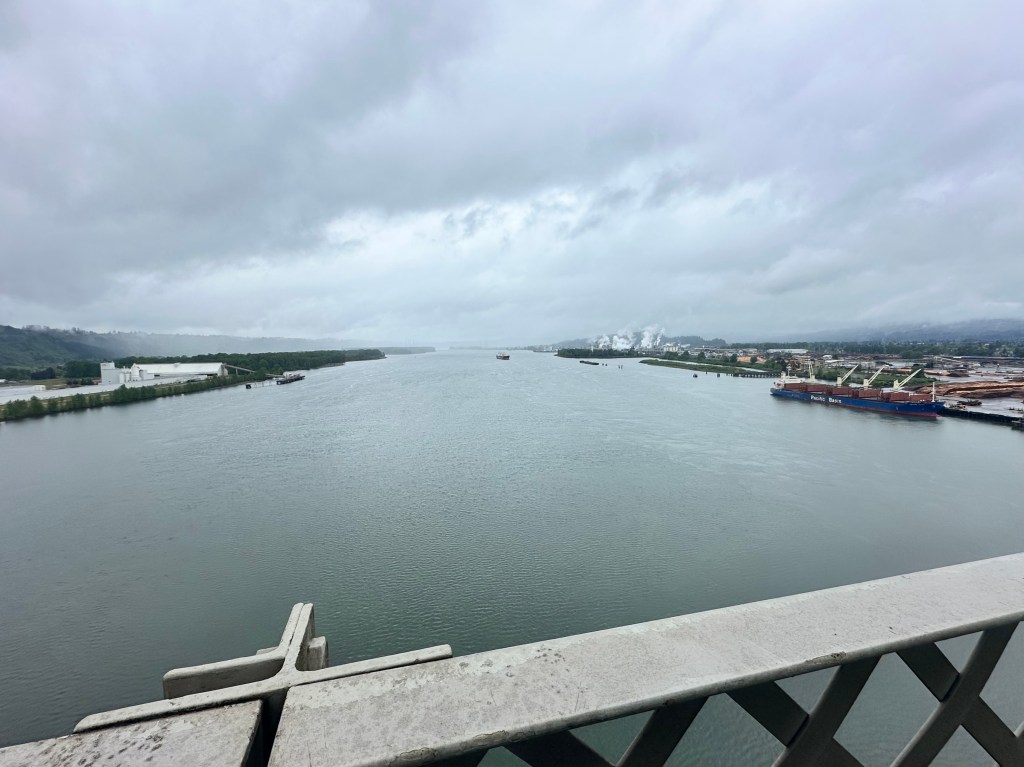
I’ve seen it only once before, when we crossed near Astoria on our West Coast bike ride in 1987, the bridge there was 4 1/2 miles long. The Lewis & Clark bridge at Longview was shorter, but just as high. There was only a narrow shoulder with no margin of error, with the cars and trucks whizzing by only inches away. I had to keep an iron grip on the handlebars, and didn’t dare stop for a picture until I got to the crest.

I didn’t know this: The Columbia has the greatest flow of any river entering the Pacific outside of Asia

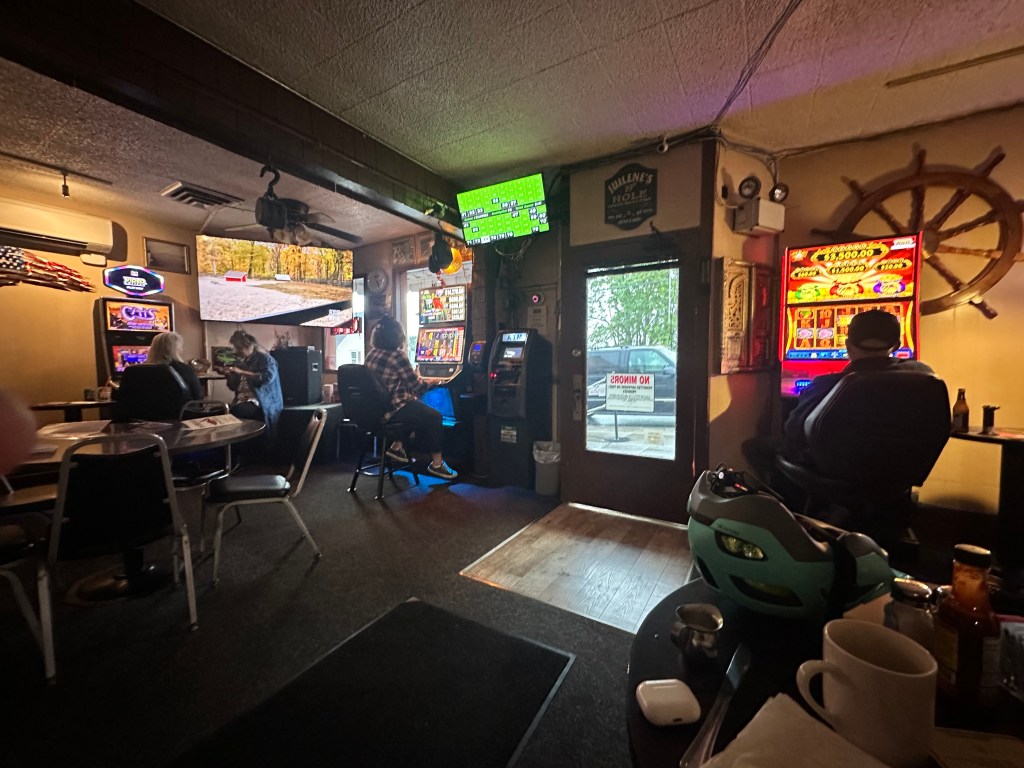
And then suddenly I was in Oregon, following the trail of Meriwether and William, I had earlier followed their route through North and South Dakota. I was hungry, there was only one dive in Rainier, didn’t look too prepossessing, but they had a crab salad to die for. It sheltered me and the bike through the heaviest downpour; the patrons inside were mostly focused on losing money at the multiple casino screens, but were bemused at the sight of this dripping wet stranger and his peculiar story.

They had trouble grasping what on earth I was doing, but they were kind and wished me well. Also kind was the motel clerk, Amber, who did my laundry for free since their guest machines were broken. I was grateful, did not want to show up at my friends’ house tomorrow in clothes that had been unwashed for three days.

Interesting parenthetical note: Cinco de Mayo is a much bigger deal in the US than in Mexico, where it is only a minor chapter in their vivid history.

 Distance 54 miles, 467 total. Time 8 hours with stops. Elevation gain 1452 feet

©️ 2024 Scott Luria
Nutty George

Eatonville to Toledo, Washington Saturday, May 4, 2024.

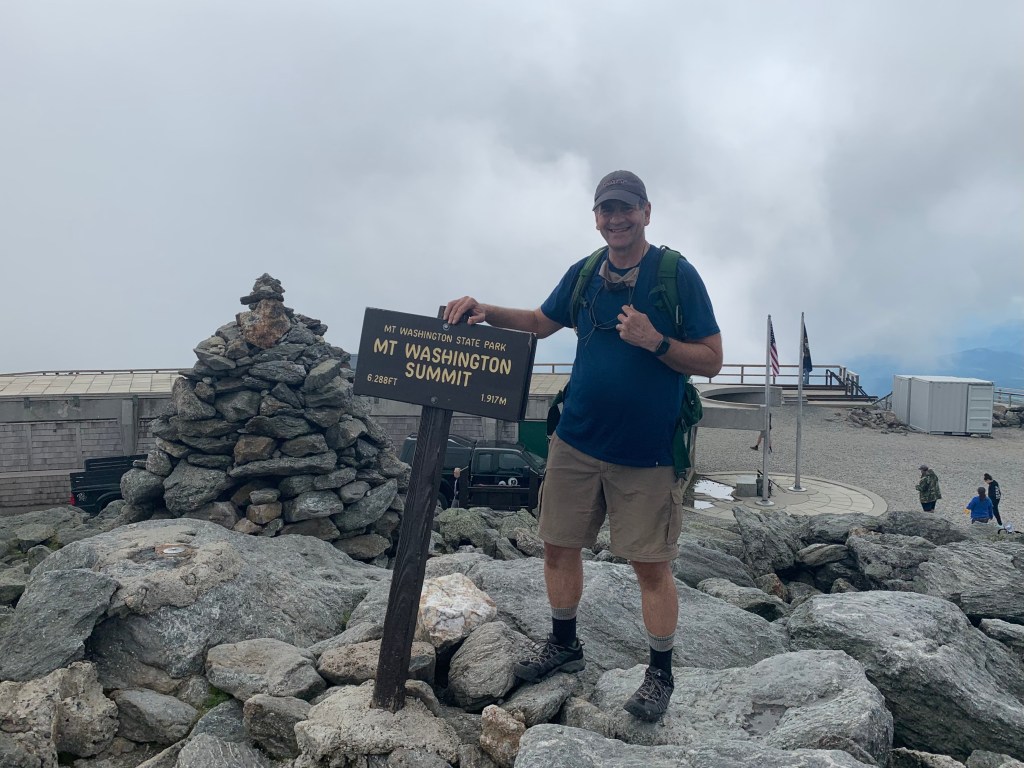
I was thinking more about mountains that were named for people that never saw them. George Washington never saw Mount Washington in New Hampshire, which was called Agiocochook by the native peoples. The very first entries in this blog where about the beginning of my journey to climb Washington from the ocean, I still need to go back and fill the rest of that story in, but here is the money shot.

August 1, 2020

Of course, Nutty George (that’s what my dad called him, after a Bob Newhart routine https://youtu.be/_Tk76aLOH0M?si=EVhdhZlhXB4sKuWy, see 1:50 and 4:27) never saw the state that was named for him either, it didn’t exist yet. Still, you can’t escape his profile, it’s on every state highway sign.

Seeing it so frequently struck a chord with me. Washington DC is my hometown, George Washington University was my medical school, and he was my first president. Most of the portraits of him make him look like my grandmother, but Lin-Manuel Miranda’s wildly popular musical Hamilton really brings him to life.

I listened to the whole soundtrack today, some sections were so poignant I almost choked up. I needed a distraction on this soggy day. The rain was back, the hills and headwinds unrelenting. My high-tech Gore-Tex gear eventually got soaked to the bone, although I was warm as long as I kept moving. The checkout clerk at the grocery store was very patient with me las I fished out my credit card without taking off my sodden gloves. My bare bones B&B had no laundry, so I draped my stinky clothes next to the space heater. Charming.

My destination was Toledo Washington. Not the beautiful city in Spain, nor the much maligned one in Ohio. It brought to mind one of the most memorable bits from Saturday Night Live. “We’re Mr. and Mrs. WHINE-er. We come from To-LEE-do, and we have diverticu-LIE-tis.”

Ohio was also evoked because of the date. The Kent State massacre was 54 years ago today, I also noted it in my blog of 5/4/21. So relevant now, with the recent campus unrest about Gaza. My hometown paper, the Washington Post, has an excellent long form article today, but restrictions keep me from posting the link here.

Instead, I’ll repost Neil Young’s thumping lyrics.

Tin soldiers and Nixon’s coming
We’re finally on our own
This summer I hear the drumming
Four dead in Ohio

 Distance 67 miles, 413 total. Time 10 hours with stops. Elevation gain 3108 feet

Paradise

Eatonville to Paradise and back. Thursday to Friday May 2-3, 2024.

Mount Rainier, it turns out, was named by Captain Vancouver, the first to explore Puget Sound, in honor of his friend Peter Rainier, a British rear admiral who fought against the Americans in the revolution. He never saw the mountain. Just like William McKinley never saw Mount McKinley, before the name was changed back to Denali. I don’t believe Sir George Everest ever saw Mount Everest either.

Fortunately the weather was good. Left my bags at the motel, got an early start, and with the help of 4 cups of coffee

I needed it
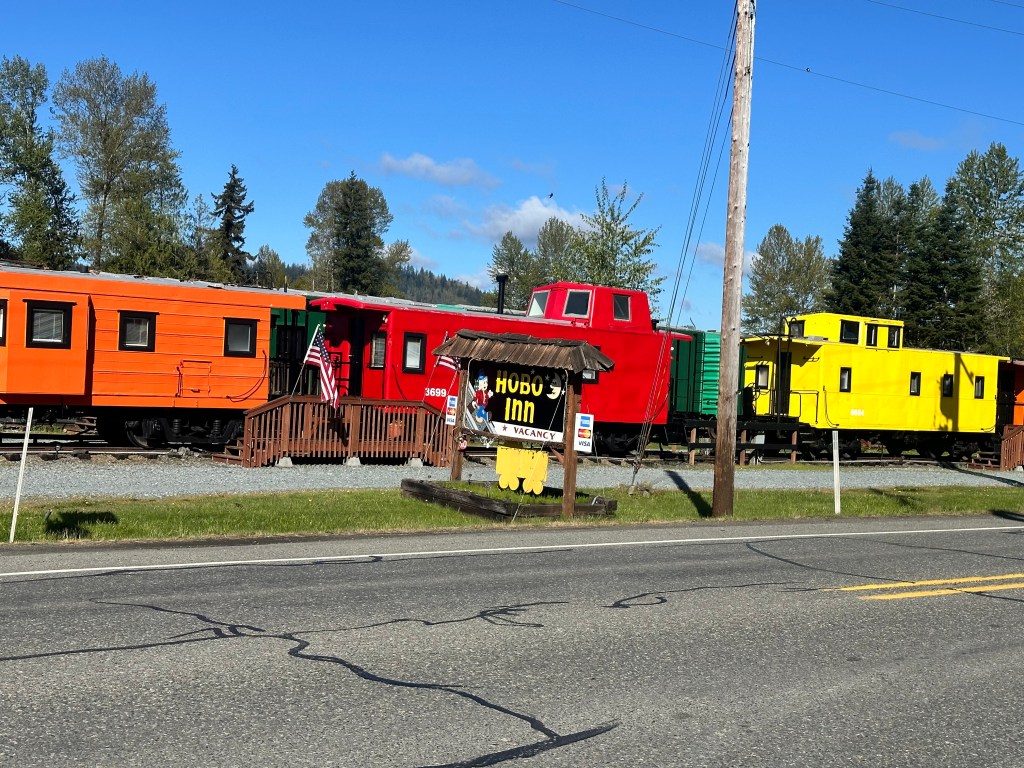
Wish I’d known about this place, wasn’t listed online. I always wanted to stay in a caboose.

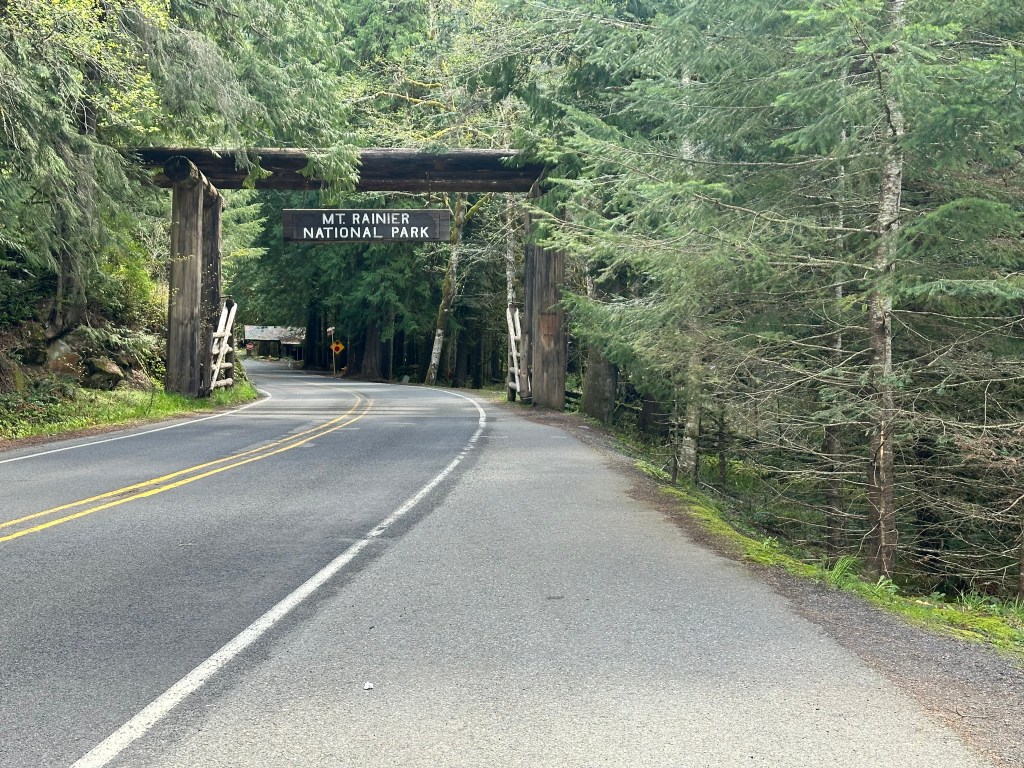
made it to the national park entrance by mid afternoon.

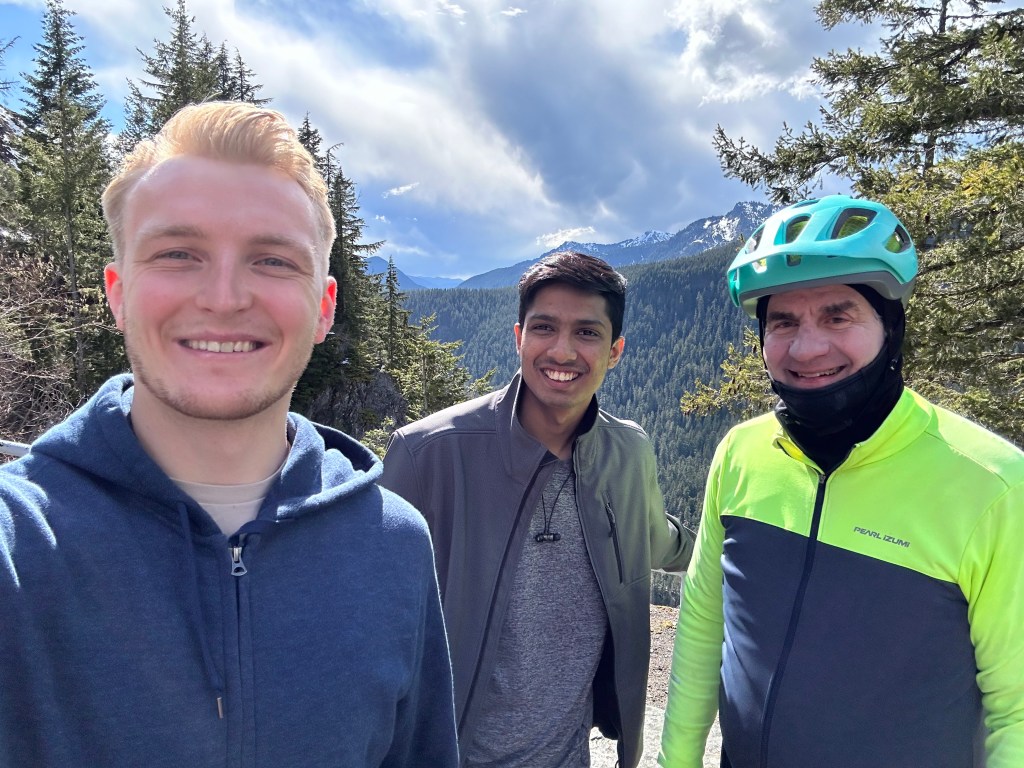
but the steep part of the climb was yet to come. 3000 feet in 11 miles, I had to stop frequently, at one scenic area I met Jacob and Zephaniah, classmates at Bible school, who gave me a blessing.

They had their own view of Paradise, but for me, the destination was embodied in three songs of that name. John Prine talked about a favorite haunt from his youth, until Mr. Peabody’s coal train hauled it away. https://youtu.be/DEy6EuZp9IY?si=qXJdN53o6ujz8wk4

My favorite Eagles song is this eco-parable about unchecked development, The Last Resort (you call someplace paradise, kiss it goodbye). https://youtu.be/4ETN21RZwwI?si=5C1-tdhRs-J643EL

Finally, The Boss himself wrote the most haunting version of Paradise. You had to listen carefully to realize it was about 9/11, a suicide bomber, and a Pentagon widow. https://youtu.be/rcWF7se6EfA?si=BgUds5oZm579t8sV

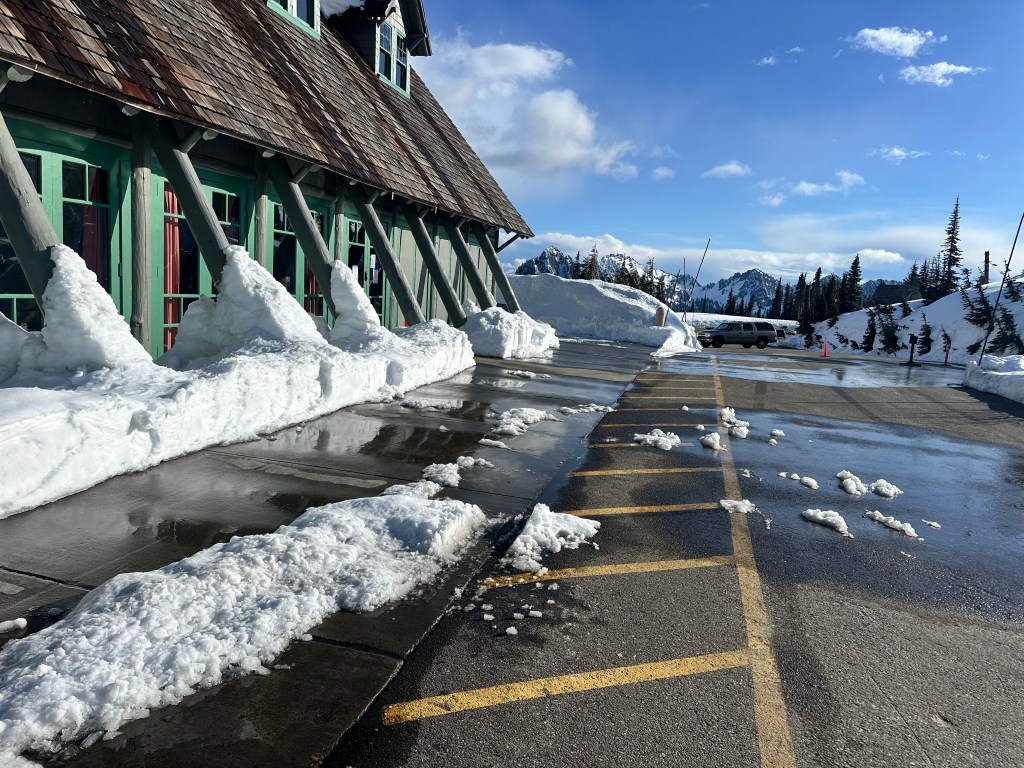
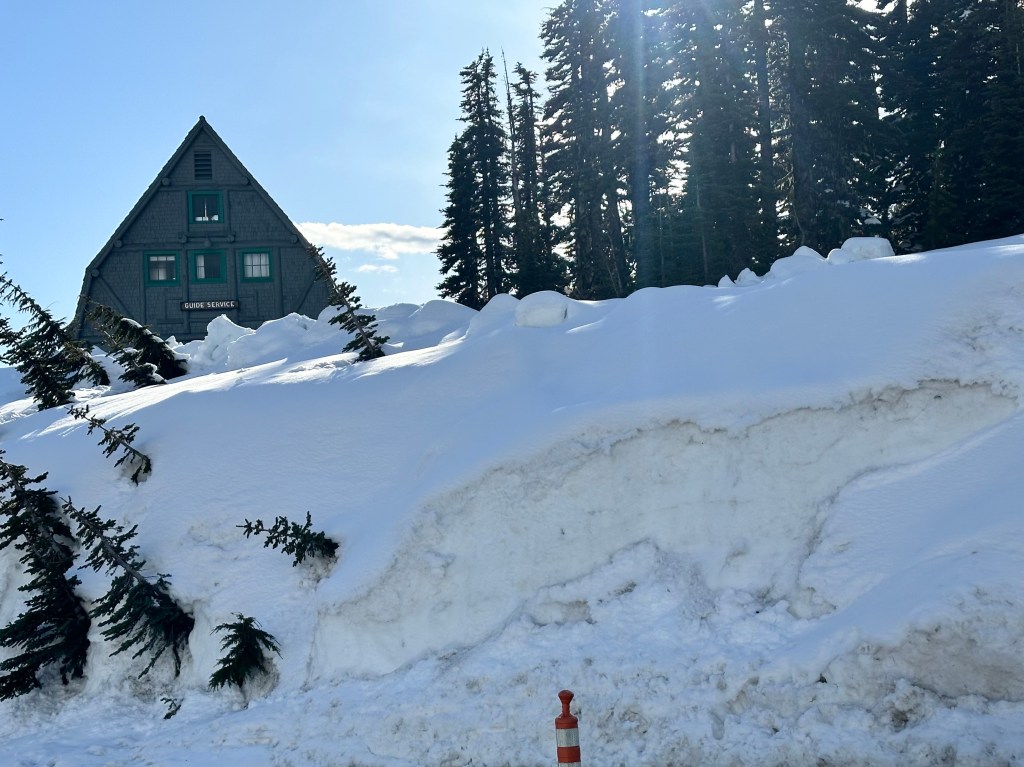
These songs sustained me as I ground up those last few miles, suddenly surprised to see I was surrounded by high snowbanks. It was 6PM when I reached Paradise, the snowiest place in the continental US, and there were still over 10 feet on the ground. It was hard to recognize the iconic Inn and guide service headquarters where I’d began my climb 30 years ago.

Flashback: it was August 1994, and I was stuck in a boring conference in Coeur d’Alene, Idaho. On a whim I called Rainier Mountaineering Inc. (RMI), the main guide service on the mountain, started by Jim Whittaker, the first American to climb Everest. Their trips were booked six months in advance. But they had a cancellation!

Ecstatic, I had Jane FedEx my stuff to Paradise, and drove the 350 miles there the next day. My first view of the mountain was so dramatic I almost drove the car off the road. It looked like the Emerald City.

RMI has the climb down to a science. The first day is an outdoor classroom, where you learn how to handle crampons, ice axe, and a rope. They drive you pretty hard that first day, and if you seem to be flagging, they warn you to drop out now, and get a partial refund. Once you start the climb, you’re liable for the full fee, even if they pull you.

I befriended two vivacious ER nurses, Renée and Linda. They would work double shifts and every few weeks have the money to take major expeditions like this. Linda confided to me that she had just found out she was pregnant; too late to cancel the climb, she was going to try anyway.

It’s almost like a cattle drive. 36 clients roped together in six groups of six, with a guide at the head of each. That second day is just a grind, 4500 feet up to Camp Muir, via a deep snowfield. The Camp is a bare bones cabin with bunk beds stacked four high. We were supposed to bring our own food, but on the short notice, all I had was peanut butter crackers. No matter, everyone else had packed too much, and were happy to let me eat their leftovers. Otherwise, they’d have to pack them back down. It occurred to me that you could mooch your way up any big mountain, and have people be grateful to you.

Bedtime was 6 PM, but nobody slept very well. They wake you up at midnight, get all your equipment sorted out, rope you up in those groups of six, and you’re off with your headlamps. Every thousand feet of vertical climb, they stop you by a group of tents, stuffed with sleeping bags. There the guides cull the stragglers in the herd. They say “you, you, you, you’re out.” You have to wait in the tents, warmed by the sleeping bags, until a total of six have been pulled, spread over the various stopping places. When six are out a guide can be peeled off to take them back down. Linda tried her best, but got yanked at the second stopping place.

The rest of us crossed the glaciers in the dark, then clambered up the stony Disappointment Cleaver, it was quite a sight to see all the crampons kicking up sparks on the rocks. The Cleaver got its name because it didn’t take you all the way to the top, it ended with 1500 more feet to go. The sun rose as the guides continued to push us, we had to be on the summit by 7:30. The snow gets too soft later in the day, and avalanches and rock slides are common.

Mount Rainier is a volcano, and sure enough there is a small summit crater. It turns out the true highpoint, Columbia Crest, is on the far side, about a 20 minute walk. It’s not part of the regular itinerary. I was told I had to convince five other people to come with me, to justify peeling off a guide to take us. After some cajoling, I got Renée and four others to come along. Everybody else, cold, exhausted and anxious to go down, gave us the stink eye.

It had been almost 90° that previous morning at Paradise, but Rainier often develops a cloud cap, a yarmulke of sorts, with nasty weather underneath. It was 20°, complete whiteout, and blowing on top. Nevertheless, the six of us were delighted to cross the crater and celebrate at the highpoint marker. (The few pictures I have of the climb are buried in our files, I’ll try to scan them in later.)

Going down was a plodding, painful affair, and we were reminded why we had to get started so early. One glacier we had to cross was called the Bowling Alley, and sure enough every minute to so a rock would come bouncing down. It was almost like waiting at a crosswalk for traffic, still roped together we would dash across between boulders. The guides admonished us not to look triumphant when we joined up with the stragglers heading down. We got back to Paradise, then as now, around 6PM. Long day.

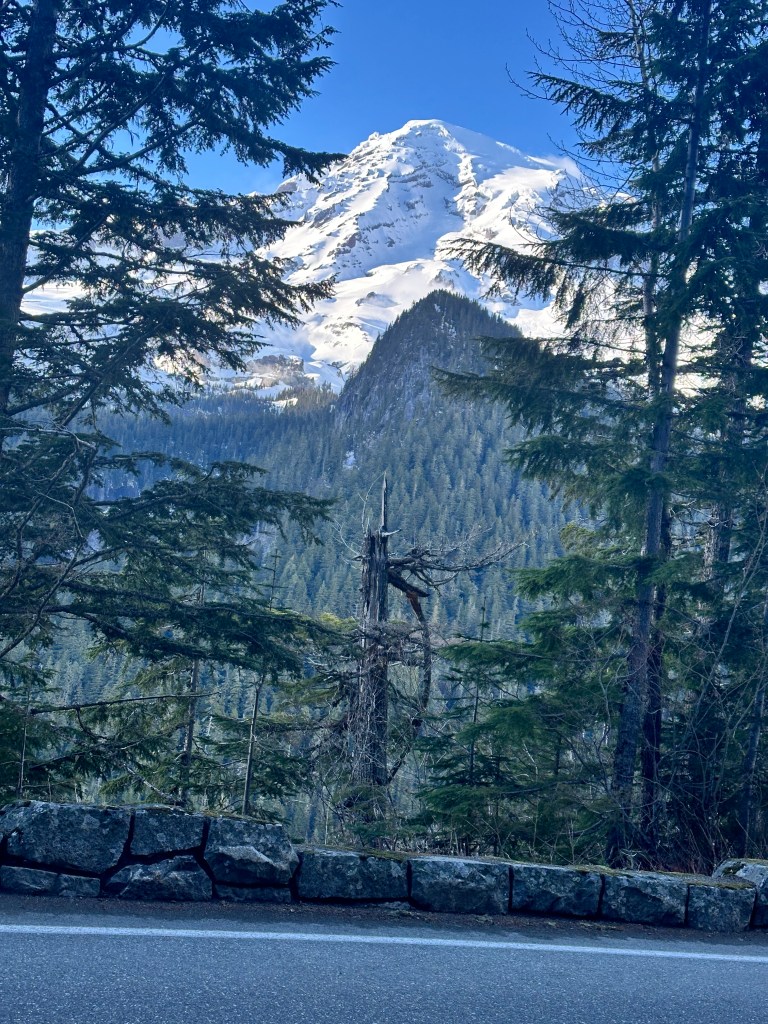
Here I was, 30 years later, reminiscing about all this, but soaked in sweat and getting chilled. Really chilled heading back down at 35 miles an hour, but whooping for joy. Every bend of the road seemed to have a drop-dead view of the mountain.

The Big Rock Candy Mountain

The pictures, foreshortened this close up, don’t really do it justice. With the possible exception of the Grand Teton, I think it’s the most beautiful mountain in the lower 48. And I climbed it. I climbed all of it. As goofy as my two-stage process sounds, I was delighted beyond words.

Rather than go back 45 miles to my motel, I stayed at the National Park Lodge near the entrance, even though it meant paying for two rooms that night. People at the lodge had seen me on the road, were congratulating me and I wanted to chat, but the dining room was about to close. When I got to my room at 9 PM, sweaty, stinky, and ready for a shower, I discovered the room hadn’t been made up. I didn’t care. Housekeeping had left for the day.

The next day was an easy ride back to my original motel. But maybe I should’ve pushed on. Rain is predicted for the next three days.

At the time, Rainier was my 22nd highpoint. I’m still at 37 total, but now I can say I’ve climbed 20 of them from sea level. Cool. Turned that pin gold.

Distance 88 miles, 346 total. Time 14 hours with stops. Elevation gain 6000 feet

©️ 2024 Scott Luria

I am not throwing away my shot

Sumner to Eatonville, Washington. Wednesday, May 1, 2024.

Not to put too fine a point on it, but there are three levels of weird here.

First of all, highpointing is peculiar, there’s no getting around it. You can see wanting to get to the big mountains, but come on—Florida? Delaware? That funny one in Connecticut where the top isn’t even a mountain, but just where the state line crosses the slope of a higher mountain? What’s up with that?

But OK, let’s say you can see that highpointing is a thing. After all, they have a club, a magazine, an annual convention where a bunch of mountain nerds get together and pat each other on the back. Almost 400 people have done all 50. But I’m not content to stop there. I have to insist that they all be climbed from sea level, entirely under one’s own power. Nobody’s done that. Nobody’s even thought of that. Who cares?

And to that I am adding a third level of weird. I’ve climbed most of the hard ones, but always from a trailhead, a parking lot, not from the sea. I’ll post this map again, only the ones with gold pins have been climbed from sea level.

You need to zoom in to see the pins

Since retirement, I’ve been working to turn all the pins to gold. I reclimbed all the ones in the northeast, and did the ones in the Midwest for the first time that way. Actually, I climbed South Dakota and Nebraska anew. Now I’m on the final leg of this journey, starting in the northwest, aiming to finish all the ones I haven’t done and to claim that I have climbed those hard ones from sea level. Being an old man, I can’t climb them again. That ship has sailed. But if I bike now to those prior parking lots, wouldn’t that count? Sea to summit in two stages, after the fact? Huh? Wouldn’t it?

Casting weirdness aside, that’s what I’m trying to do. And the first one is Rainier. The Paradise Inn, where I began my climb in 1994, is at 5400 feet, and only 115 miles from Annie‘s house in Seattle. I had allowed myself four days, seemingly plenty of time. But poor sleep, distractions, and delayed starts have put me behind schedule. I’m two days in, but I’ve only done about 70 of those miles, with most of the climb still ahead of me. There is only one more day of good weather. After that, they’re talking about inches of rain and I don’t want to be on a high mountain road in that.

Today’s ride was typical. Most of it was flat or on good bike trails, but there was one stretch of gravel so bad I had to backtrack and plan out a bypass on busy roads with no shoulders and lots of semi trucks. One of them almost ran me off the road. I was so sleep deprived I felt like I was running on fumes. That last 6% grade hill into Eatonville was only half a mile, but I had to stop three times.

Once there, spotted in automotive garage that didn’t look too busy, and thought oh good, I can get my seat checked out. Right as I was starting in Vancouver, I heard an alarming snap in my saddle as I sat on it, but a cursory inspection didn’t show anything wrong. It was raining, the seat was covered, but it seemed OK, as it did on further inspections. Still, I noted a disconcerting thunk from time to time as I pedaled. I have the parts and tools I need for a repair, but I also need some heavy tools that only a garage would have. Here was my chance. I’m always sheepish, bugging garage mechanics, but Blake was pleasant and seemed happy to help. For the first time, I took my seat completely off and was horrified: one of the main rails that support the seat had fractured completely.

On top of everything else, this felt like a devastating blow. This has happened once or twice before, perhaps a design flaw in the other otherwise perfect Brooks Saddle, perhaps because I’m overweight, but in those cases I sent it back to the North American service Center, and they repaired it, charging me only postage. Still, it took about two weeks. I felt like the whole trip was over.

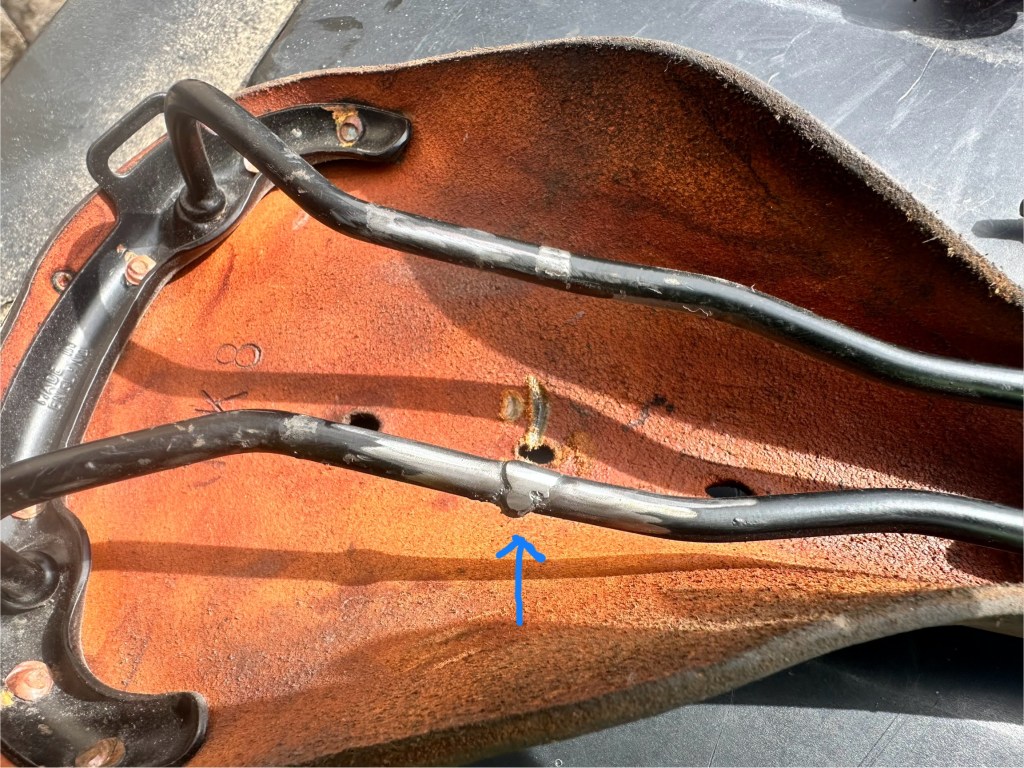
But Blake was nonplussed. He said oh, I think we have somebody here who can weld it for you. And sure enough, Aaron did just that.

The blue arrow marks Aaron’s weld

He apologized, said he couldn’t weld it all around for fear of damaging the leather, but it looked pretty solid to me. Blake leant me the tools I needed to complete the repair. I was so grateful I was almost in tears, and gave them a huge tip. A perfect example of a couple of trail angels.

Aaron and Blake

Time will tell. I’ve asked Jane to send me another saddle off another bike from home, but that will take more than a week (a pretty big ask, today is her 68th birthday). I’ll just have to hope for the best. The repair burned up another couple of hours, so I decided just to stay in Eatonville.

Why not just buy another saddle? Because once you’ve broken in a Brooks Saddle (they’ve been made in England since 1868), nothing else will do. It takes about 1000 painful miles to break it in, but once you do, pure heaven. I’m totally spoiled. But I suppose I could get another one if I have to.

So here I am, with 44 miles and 6000 feet of climbing to do an a single day. Almost 90 miles round-trip. I’ve got this motel room for two days, so I will keep all my heavy bags here, turning my 115 pound rig into 35 pounds. I’m getting to bed early, have decided to break my xanthine abstinence and use performing enhancing substances (caffeine). I’ve got this one chance.

Hey yo, I’m just like my country
I’m old, scrappy and hungry
And I’m not throwing away my shot

Distance 35 miles, 248’ total. Time 7 hours with stops. Elevation gain 1332 feet

©️ 2024 Scott Luria